Turn a Cup of Water into a Math Story
This poster can begin with a familiar question: why are some containers labeled in liters while others use milliliters? Use cups, bottles, measuring jugs, and water drops as the main illustrations. A title such as The Math Inside a Cup of Water makes the topic friendly and easy to understand.
The Key Lesson: Liters and Milliliters
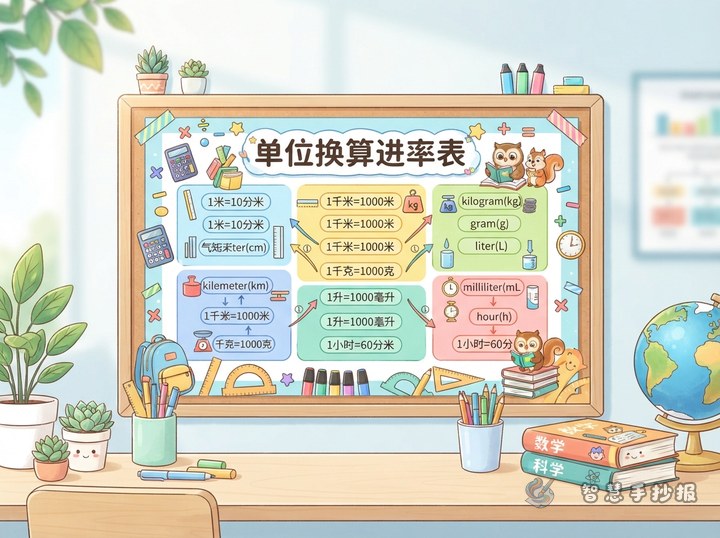
Draw a large measuring jug in the center and write the most important relationship beside it: 1 liter equals 1,000 milliliters. To change liters into milliliters, multiply by 1,000. To change milliliters into liters, divide by 1,000.
- 2 liters equals 2,000 milliliters.
- 500 milliliters equals 0.5 liter.
- 250 milliliters equals 0.25 liter.
- 1,500 milliliters equals 1.5 liters.
Place the word liter beside a large jug and milliliter beside a small cup. Arrows can show how the number changes when the unit changes. Three or four examples are enough to keep the poster clear.
A Capacity Observation Station
Create a section where readers compare familiar containers. For example, 500 milliliters can also be written as 0.5 liter, and two 500-milliliter bottles together contain 1,000 milliliters, or 1 liter. Add a question such as: if 500 milliliters are poured from a 2-liter jug, how much remains? The answer is 1,500 milliliters.
Water bottles, cups, sports bottles, and simple scale marks make useful decorations. Treat the numbers as examples for practice instead of assigning exact capacities to real products.
Add a Small Try-It-Yourself Corner
Leave room for three practice questions: How many liters are 3,000 milliliters? How many milliliters are 1.2 liters? If one cup holds 250 milliliters, how much water is in four cups? Hide the answers in drop-shaped boxes, clouds, or folded-paper designs so the activity feels playful.
A Clear and Cheerful Page Layout
Try a central-measuring-jug layout. Put the title at the top, the large jug or water drop in the middle, the conversion rule on the left, daily examples on the right, and practice questions along the bottom. Blue and turquoise can suggest water, while yellow or orange adds warmth. Use dark colors for numbers and unit symbols so they remain easy to read. Sketch the sections first, then add text, borders, and small bubbles.
After arranging the text and sections, you can continue designing the page in the 智慧手抄报 WeChat mini program, making it easier to turn the capacity lesson into a neat handwritten math poster.