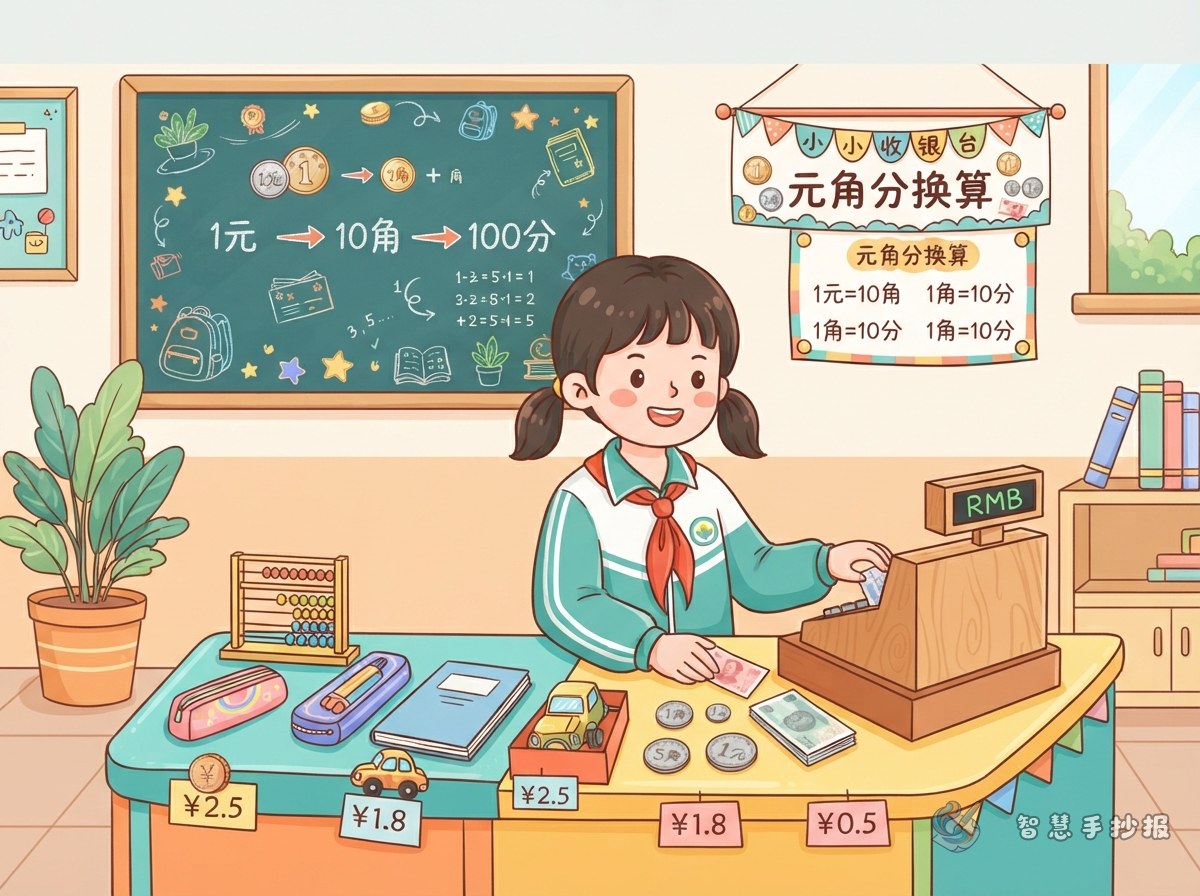
Start with a Scene: Open a Paper Supermarket
Yuan, jiao, and fen are not only textbook math. They appear when you buy stationery, pay for breakfast, take a bus, or save pocket money. For the poster, choose a life scene such as “Little Cashier” or “Flea Market Shopping Day.” A clear scene helps readers understand that this poster is about Chinese money units.
Possible titles include “Today I Am the Cashier,” “Yuan, Jiao, Fen, I Can Convert,” or “The Math on a Price Tag.” Add a subtitle: From fen to jiao, from jiao to yuan, every ten makes one.
The Conversion Rules Are the Math Foundation
Three rules to write clearly
- 1 yuan = 10 jiao
- 1 jiao = 10 fen
- 1 yuan = 100 fen
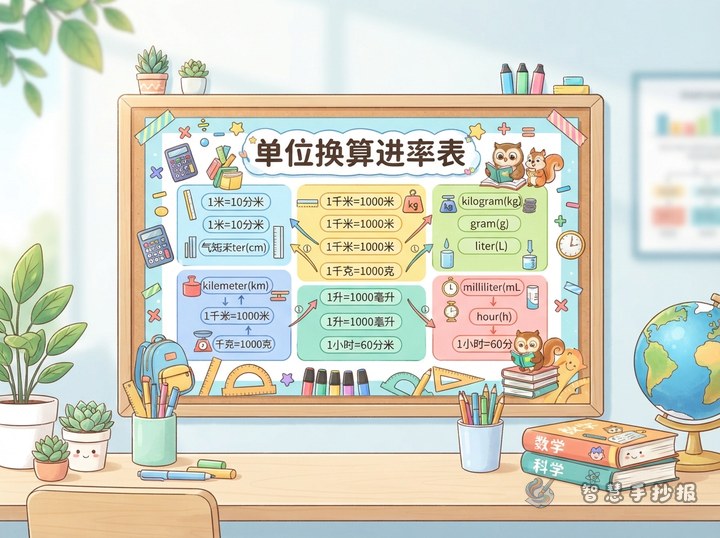
Draw these rules as a staircase. Put fen at the bottom, jiao in the middle, and yuan at the top. Write “divide by 10” beside each upward step and “multiply by 10” beside each downward step. This makes the poster easy to read and easy to remember.
How to read and write prices
A price like “3.50 yuan” reads as three yuan and five jiao, or 3 yuan 5 jiao. Make a small “price tag lesson” on the poster: the number before the decimal point is yuan, the first digit after it is jiao, and the second digit is fen. Circle yuan, jiao, and fen in different colors so readers can see the units clearly.
Add Shopping Problems: Total, Compare, and Change
Do not just copy the rules. Add a few everyday math questions. You can adapt these examples:
- A pencil costs 8 jiao and an eraser costs 5 jiao. How much do they cost together?
- A notebook costs 3 yuan 5 jiao and a ruler costs 1 yuan 2 jiao. Which is more expensive, and by how much?
- You pay 10 yuan for a notebook that costs 6 yuan 8 jiao. How much change should you get?
- How many 1-jiao coins make 1 yuan? How many 5-jiao coins make 1 yuan?
Design a “Change Notebook” section. On the left, write the money paid. On the right, write the money spent. Put a minus sign in the middle, and write the change at the end. Leave one or two answers blank so classmates can solve them while reading.
Layout Ideas: Shelf, Price Tags, and Wallet
Divide the paper into top, middle, and bottom areas. Put the title and conversion rules at the top. In the middle, draw a shelf or a stationery counter with a price tag on each item. At the bottom, write shopping calculations and a change notebook. You can also use a wallet, coins, and notes as border decorations, but leave enough space for writing.
- Title area: Write “Little Cashier” or “Yuan, Jiao, Fen Conversion” in large letters.
- Price tag area: Draw a pencil, eraser, ruler, and notebook with prices beside them.
- Calculation area: Include two or three shopping problems using yuan, jiao, and fen.
- Rule area: Use colorful arrows to show the direction from yuan to jiao to fen.
Final Checks Before You Color
Check that the units are correct: do not mix up yuan, jiao, and fen; do not forget the decimal point in prices; and keep the conversion direction consistent. If you write “8 jiao + 5 jiao = 13 jiao,” change it to “1 yuan 3 jiao” to match everyday speech. In a corner, add a summary: The secret of yuan, jiao, and fen is that every ten makes one.
To make the layout neat, divide the paper lightly with a pencil first, then trace the lines with colored pens. If you need more templates, sections, and text ideas, open the Smart Handwritten Newspaper mini program in WeChat and continue with a math measurement and life application theme.