Choose a clear story for the poster
This poster can focus on the question: how do the words and patterns on ancient coins help us understand money? Instead of listing too many dynasties, introduce coins through four ideas: shape, writing, details, and daily use. This shows that coins were not only used for buying things, but also carried clues about culture and commercial life.
A suitable title is “The Historical Clues on a Square-Hole Coin”, with the subtitle “Read commercial civilization through coin inscriptions.” You can begin with the question, “Why can such a small coin show us how people lived in the past?”
Four sections that explain a coin
Shape and practical use
Introduce the familiar round coin with a square hole. Explain that the hole made it possible to string coins together and carry them easily. A simple sentence is enough: “Round coins with square holes were widely used because they were easy to connect and carry.”
What the inscription tells us
Use familiar examples such as Kaiyuan Tongbao or Kangxi Tongbao. Explain that coin inscriptions could help people identify a coin’s name, period, or ruler. Draw only a few large, clear characters and make the words “Tongbao” stand out.
Small details worth observing
Add questions about the edge, the central hole, and the marks left by casting. For example: “Why does the coin have a hole? Are the characters evenly placed? How might coins from different periods change in size or color?” These questions make the poster more interactive.
Coins and commercial life
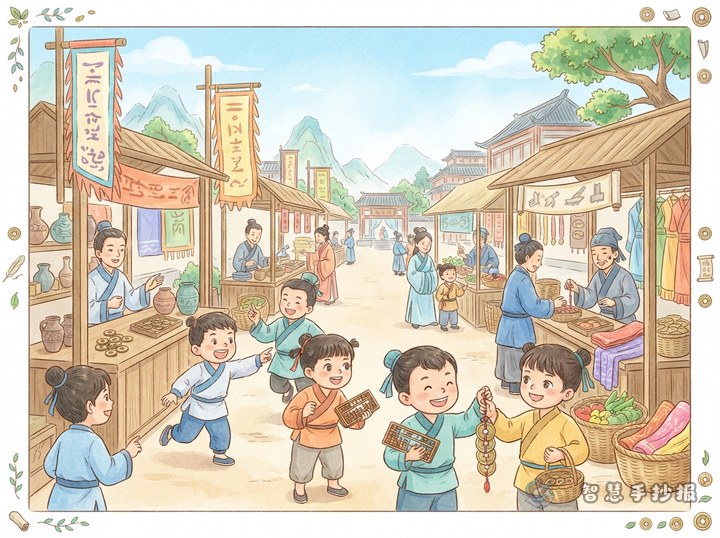
Draw a small scene of people buying rice or cloth in an old shop. Add the explanation: “A recognizable and convenient currency helped people from different places trade more easily and made market activities more orderly.” This section connects the coin to commercial civilization.
Turn the layout into an enlarged coin
Try a central-coin layout. Draw one large square-hole coin in the middle, then place four note boxes around it: “Shape,” “Writing,” “Details,” and “Use.” Connect each box to the matching part of the coin with arrows. Put the title above and a short observation summary below. The result will look like a historical exploration chart.
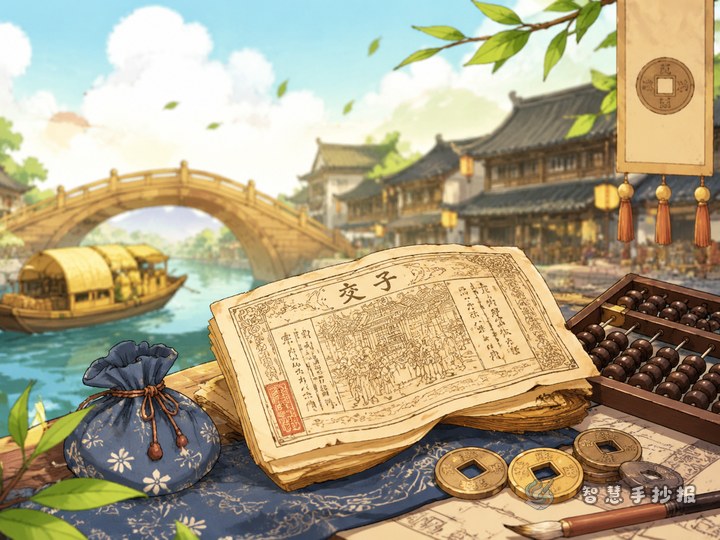
Use warm ochre, cinnabar red, dark green, and brown for an old-fashioned but bright mood. Small drawings of coin strings, wooden boxes, shop counters, and abacuses can decorate the border. Leave enough empty space so the decorations do not cover the writing. Place the trading scene at the bottom or along one side to create visual depth.
Simple tips for writing and drawing
- Keep each section to two or three sentences and highlight key words with color.
- Write the coin characters carefully and do not invent characters when you are unsure.
- Use small labels such as “inscription,” “square hole,” “edge,” and “trade” to guide readers.
- Add a “What I noticed” box for a personal observation about the coin’s shape or writing.
Before coloring, check that the title is easy to see and that each section is clearly separated. Then unify the outlines and colors. If you want help arranging the page, you can use the historical theme layouts in the Zhihui Handwritten Newspaper WeChat mini program and adjust the text and decorations to suit your own idea.