Begin with a Ruler and a Balance
This poster can focus on how ancient measurement supported fair trade. When people bought cloth, grain, or salt, they needed a ruler for length, a measuring vessel for capacity, and a balance for weight. These tools were more than objects: they gave both sides of a trade a shared standard.
Use the title “The Business Wisdom of a Ruler, a Measure, and a Balance”, with the subtitle “How Common Standards Supported Ancient Commerce.” Keep the introduction short and explain that money made exchange easier, while measurement helped people judge the quantity of goods.
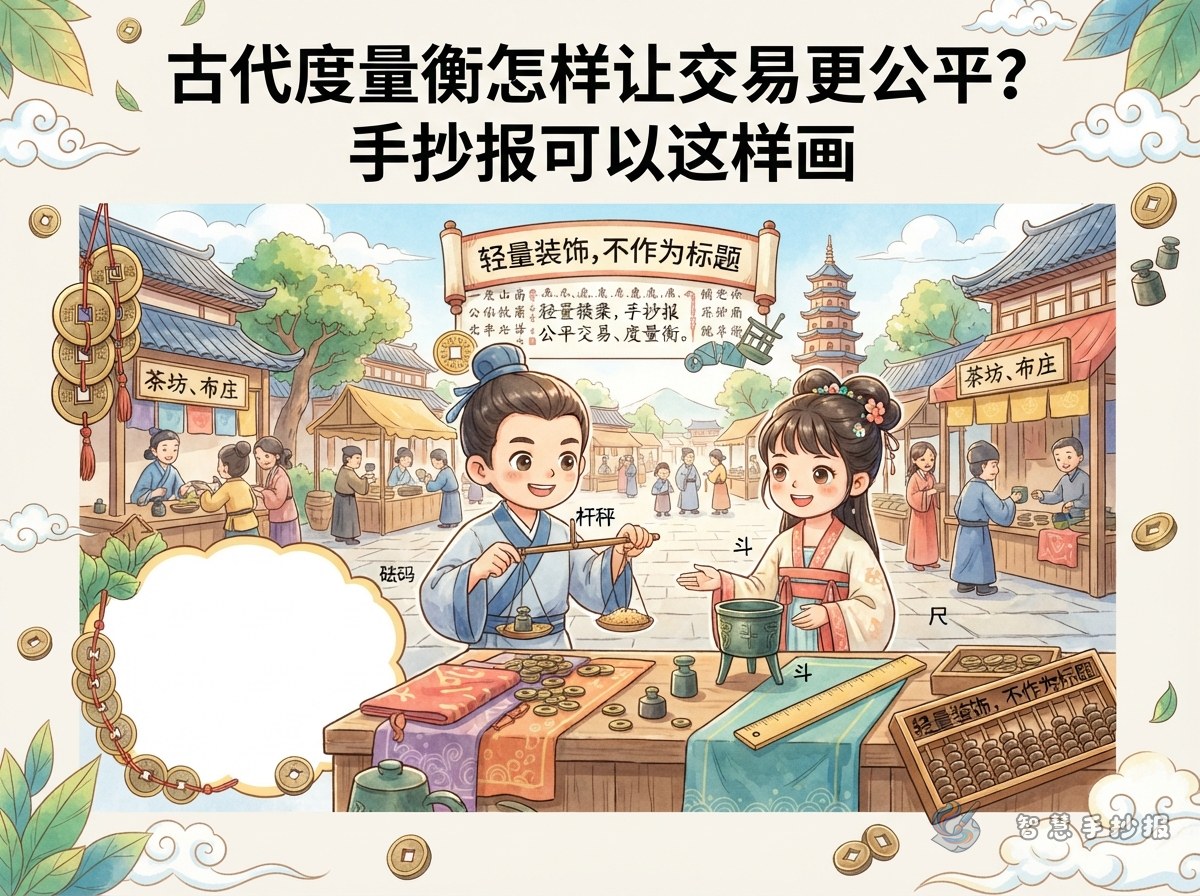
Make Three Measuring Tools the Main Characters
- Ruler: Show how cloth and wood could be measured by length.
- Measuring vessel: Use it to represent grain and other goods sold by volume.
- Balance: Draw a balance, pans, and weights to show how goods were weighed.
- Coins: Add a few round coins with square holes as supporting elements, without turning the poster into a history of coins.
Place a short caption beside each drawing: “A ruler makes length comparable,” “A measure clarifies volume,” and “A balance gives weight a basis.” The combination of pictures and captions is easy for children to understand.
Connect the Ideas with One Market Story
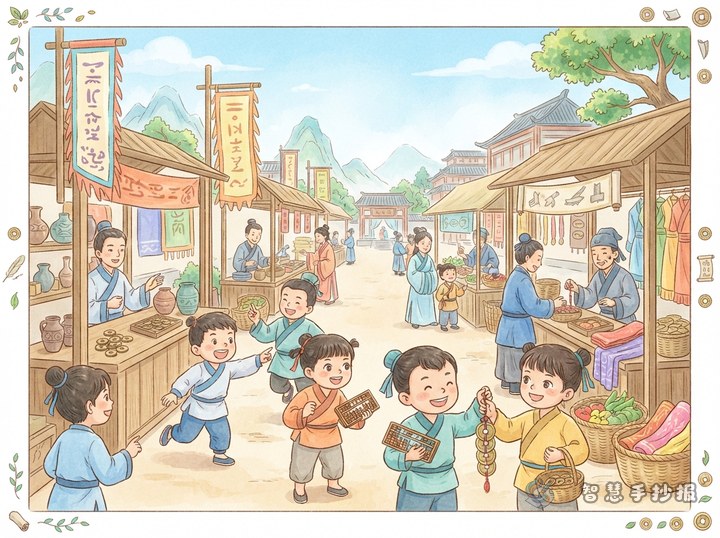
Add a “Buying Cloth in Ancient Times” section. The seller measures the cloth with a ruler, the buyer checks the weight of another product with a balance, and coins complete the exchange. Without shared rulers, measures, and weights, the same piece of cloth might produce different results and lead to arguments. This story shows that commerce needs not only goods and markets, but also rules that people accept together.
A Knowledge Card to Copy
Ancient measurement systems were tools and standards for length, volume, and weight. Shared methods reduced mistakes, helped people record quantities, and supported trade between different regions. They show the ancient respect for order, trust, and fairness.
Design the Page as an Ancient Trade Route
Try a horizontal layout. Put the title and a wooden ruler in the upper left, the ruler, measuring vessel, and balance in three central sections, and a merchant with a small stall on the right. At the bottom, connect four steps with arrows: “Measure the goods,” “Confirm the quantity,” “Use money,” and “Complete the trade.” Simple decorations such as rope knots, grain stalks, and wooden boxes can create an ancient market feeling.
Use brick red, ink black, warm white, and muted green. Keep important words dark and leave space between sections. Drawings should explain the text instead of covering it. After sketching, you can use the Wisdom Handwritten Newspaper WeChat mini program to adjust the layout, title style, and colors.
Three Final Checks
- Make sure the main idea stays focused on measurement and fair trade.
- Give every illustration a matching caption so the words and pictures explain each other.
- End by highlighting trust, fairness, rules, and cooperation in commercial civilization.