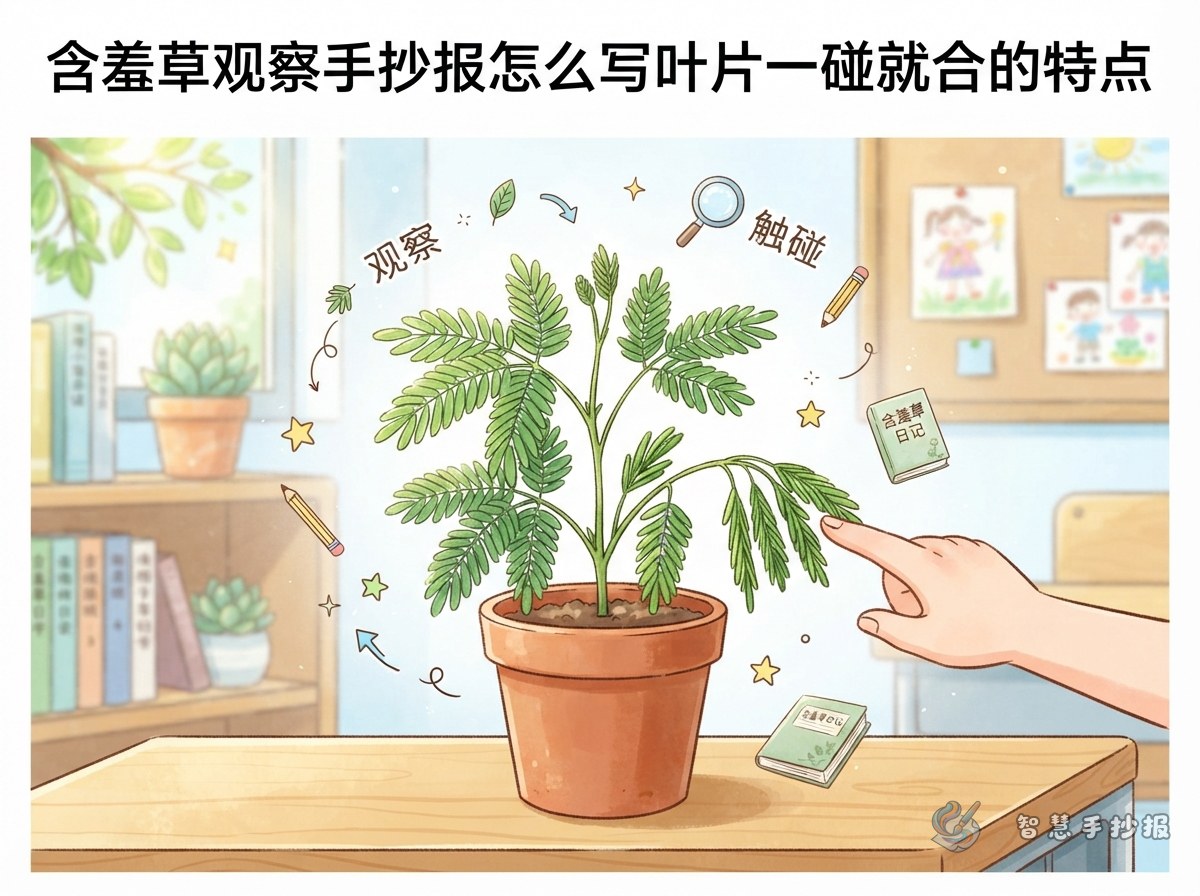
Make “The Plant That Moves” the Main Idea
The most interesting thing about a mimosa is that its leaves close when touched. Instead of writing only that it is “shy,” use the process of touch, closing, and reopening as the main line of the newspaper. This turns the page into a small observation record.
Choose a specific title, such as “The Shy Leaf,” “The Secret of Closing Leaves,” or “My Mimosa Observation.” Draw a few open and closed leaves beside the title to make it more inviting than plain large words.
Five Observation Boxes to Include
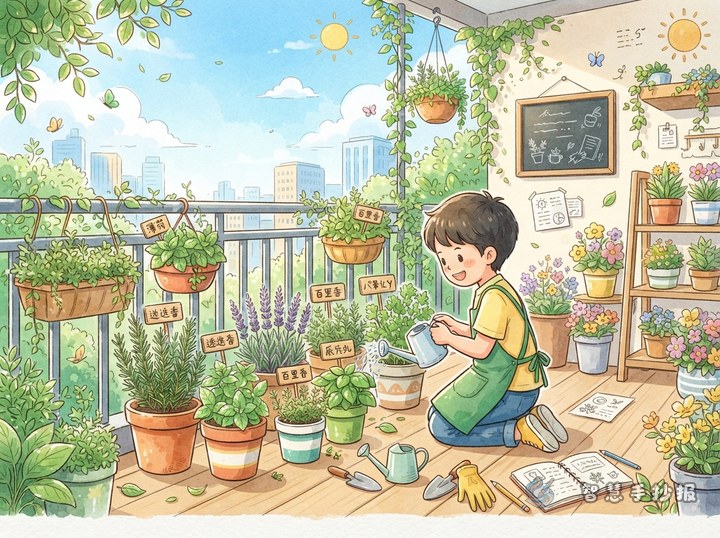
- The plant: note whether it is in a pot or in water, and record its position and light.
- Leaf shape: describe it with short phrases such as “like a small feather” or “four leaflets in a group.”
- Touch response: record how long the leaflets take to close after a gentle touch with a finger or pencil.
- Recovery time: check every few minutes and write down roughly when the leaves open again.
- My findings: add one or two real feelings, such as “when I touched it too hard, it took longer to open.”
You do not need to squeeze all five boxes into one row. Make “touch response” the large central box and arrange the others around it.
Layout: Use an Open-and-Closed Leaf Comparison
A mimosa page works well with a left-and-right comparison. Draw an open-leaf mimosa on the left and the same plant with closed leaves on the right. Connect them with an arrow and write “gentle touch” beside it. Even with few words, readers can understand the theme at a glance.
Use light green, grass green, and pale yellow as the main colors, with a little pale pink or light blue as accents. Borders can be vines, small dots, or leaf outlines, but do not make them too dense or the text will be hard to read.
Placement Tips
- Leave a title area at the top, about two or three lines high.
- Put the open-and-closed comparison picture in the middle, taking about one third of the page.
- Write observation records at the lower left and facts or thoughts at the lower right.
- Decorate the corners with small leaves, water drops, or a sun.
Short Sentences and Facts You Can Copy
- A mimosa leaf is made of many small leaflets, and the leaflets close in pairs after being touched.
- Closing is a response to a stimulus, and the leaves slowly open again after a rest.
- Observe gently and do not squeeze the leaves over and over.
- A “moving plant” does not walk around; its leaf position changes.
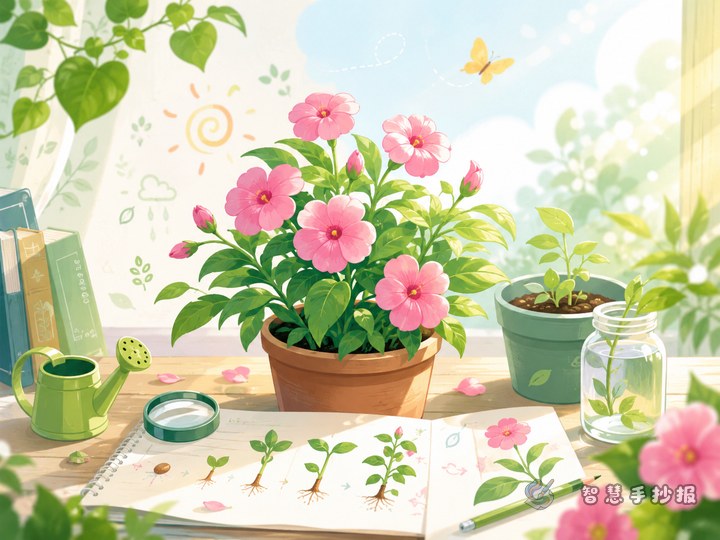
If you want to add an observation diary, use “Day 1,” “Day 3,” and “Day 5” as headings. Write only one or two sentences each time and add a small sketch.
Finishing Touches
Draw the pencil layout first, write the text next, and add color last. This keeps the words from being covered. Use lines or light background boxes to separate text-heavy sections, and write headings in large or outlined letters. When you are done, look at the page from a distance. If the theme is clear at first glance, the layout has worked.
If you want to save time on layout, open the “智慧手抄报” WeChat mini program, choose a plant observation theme, and use a layout as a reference before adding your own observation notes.