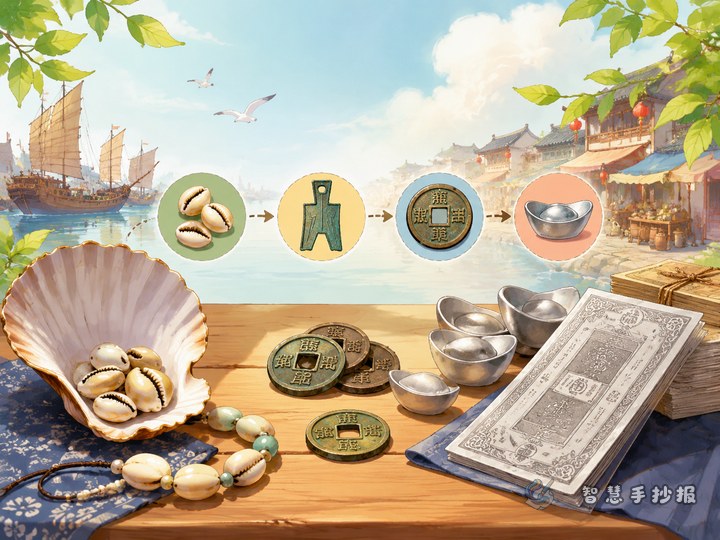
Begin with a Coin That Tells a Story
This poster can start with a simple question: why were words cast on ancient Chinese coins? Coin inscriptions could identify the currency and connect it with a particular period or monetary system. By examining inscriptions, shapes, and decorative details, students can link calligraphy and design with everyday trade.
Build Three Close-Looking Sections
Read the Inscription
Choose a few recognizable examples, such as Ban Liang, Wu Zhu, and Kaiyuan Tongbao. Explain that the characters on a coin are called its inscription. Enlarge the characters so readers can compare their appearance without filling the poster with long timelines or difficult terms.
Study the Shape
Round coins with square holes could be threaded onto cords for carrying and counting. Draw one enlarged coin and use short labels to identify the rim, central hole, and inscription. This gives the poster a clear visual focus.
Connect Money with Trade
Coins provided a shared way to price goods and complete exchanges. In a market, coins could be counted individually or grouped on cords. This section should show how money supported daily buying and selling instead of treating coins only as museum objects.
Short Text Ready for the Poster
- Main line:One small coin can reveal writing, rules, and market life.
- Fact:Tongbao became a familiar term in the names of many later Chinese coins.
- Observation:The order of the characters may need guide lines so readers know where to begin.
- Thinking point:A shared form of money made it easier to compare prices and exchange goods.
Shape the Page Around a Square-Hole Coin
Use a focal layout with one large coin in the center. Place the title near its outer edge, an inscription guide on the left, a market scene on the right, and a coin-reading challenge along the bottom. A palette of aged copper green, black, and a small amount of seal red will suit the topic while keeping the background light.
Simple cord knots, abacus beads, seal outlines, or small coin patterns can form the border. Keep drawings to about one third of the page and place each diagram beside its explanation so the reading path remains clear.
Check Facts Before Adding the Final Color
- Select two or three coin names and confirm the characters and their basic meanings.
- Sketch the title, main coin, information blocks, and activity area in pencil.
- Add a muted copper tone without covering the inscription with heavy weathering.
- Check spelling, historical order, and reading direction with a parent or teacher.
To refine the column sizes, title position, and colors, students can continue the project in the Smart Handwritten Poster WeChat Mini Program and then add their own coin observations for a personal finish.