Why This Painting Works Well on a Handmade Poster
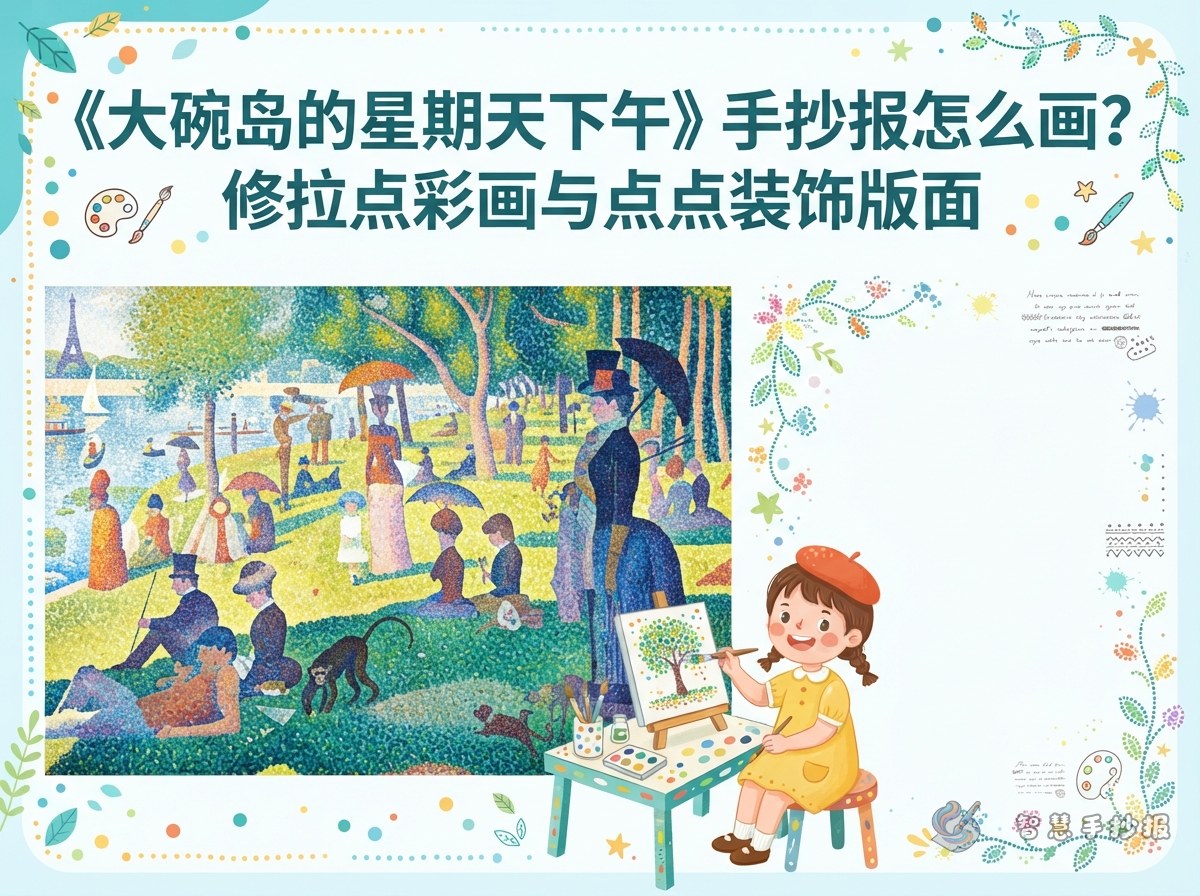
'A Sunday Afternoon on the Island of La Grande Jatte' by the French painter Georges Seurat shows people resting, strolling and fishing by the river at the weekend. The whole picture is built from thousands of tiny coloured dots, so it looks calm from far away and turns into separate points of colour up close. That makes it a perfect subject for a poster: there is a story to tell and a ready-made decoration style to copy.
Artist Facts You Can Copy Into a Box
A short profile
- Name: Georges Seurat
- Country and period: France, nineteenth century
- Technique: pointillism, also linked to neo-impressionism
- Well-known works: 'A Sunday Afternoon on the Island of La Grande Jatte', 'Bathers at Asnières'
Five or six lines are enough. The aim is simply to let readers know that this artist painted with dots instead of brushstrokes.
Small details hidden in the scene
- A lady sitting on the grass with an umbrella
- A person walking a small monkey
- Figures fishing by the water
- A little girl running on the grass
- Sailboats in the distance
These details can become a 'spot the detail' box: ask classmates to find three interesting things in the picture and write down which one they like best.
Three Ways to Use Dots as Decoration
Idea one: a dotted border
Place coloured dots along the outer edge of the page, shifting from dark to light shades. The border adds texture without taking space away from the text.
Idea two: dot-filled title letters
Draw the title in outline letters first, then fill each letter with small dots in two or three similar colours. From a distance it reads as a solid block of colour; up close the dots are visible.
Idea three: dotted illustrations
Sketch the outlines of grass, water and sky, then fill them with dots using cotton swabs or round-tip markers. Do not cover every inch, leave some white space so the picture can breathe.
A Simple Four-Block Layout
- Block one: the title area, with a main heading and a short subtitle such as 'Step into Seurat's world of dots'.
- Block two: the artist profile, with a small drawing of a palette or a simple portrait.
- Block three: an introduction to the painting plus the spot-the-detail box.
- Block four: an empty 'my dot experiment' area where the child can add their own dots.
Let the title area take about one fifth of the page and split the rest into three or four vertical columns. Use wider columns for text and a narrow one for a dotted decorative strip; the page will look livelier than an even grid.
Order of Work and Colour Choices
- Draw the border and column lines lightly in pencil so they can be adjusted later.
- Write the title and the text first, leaving enough space between lines.
- Sketch the main illustration outlines, such as grass, water and simple figure shapes.
- Fill in the colour with dots, starting with large areas and finishing with small ones.
- Add the dotted border and small decorations, then check for any empty patches.
Colour suggestions: grass green, yellow-green, lake blue, warm orange and ochre. Keep the overall tone bright and warm, and let the dots sit slightly unevenly, as Seurat's own dots do.
If you would rather skip the pencil planning, open the 'Smart Handwriting Newspaper' mini program on WeChat, choose an art-themed template, and replace the sample text with your own writing. Print it out, add your dots, and you will have a finished famous-painting poster in no time.