Why an Opera Map Beats a Long List
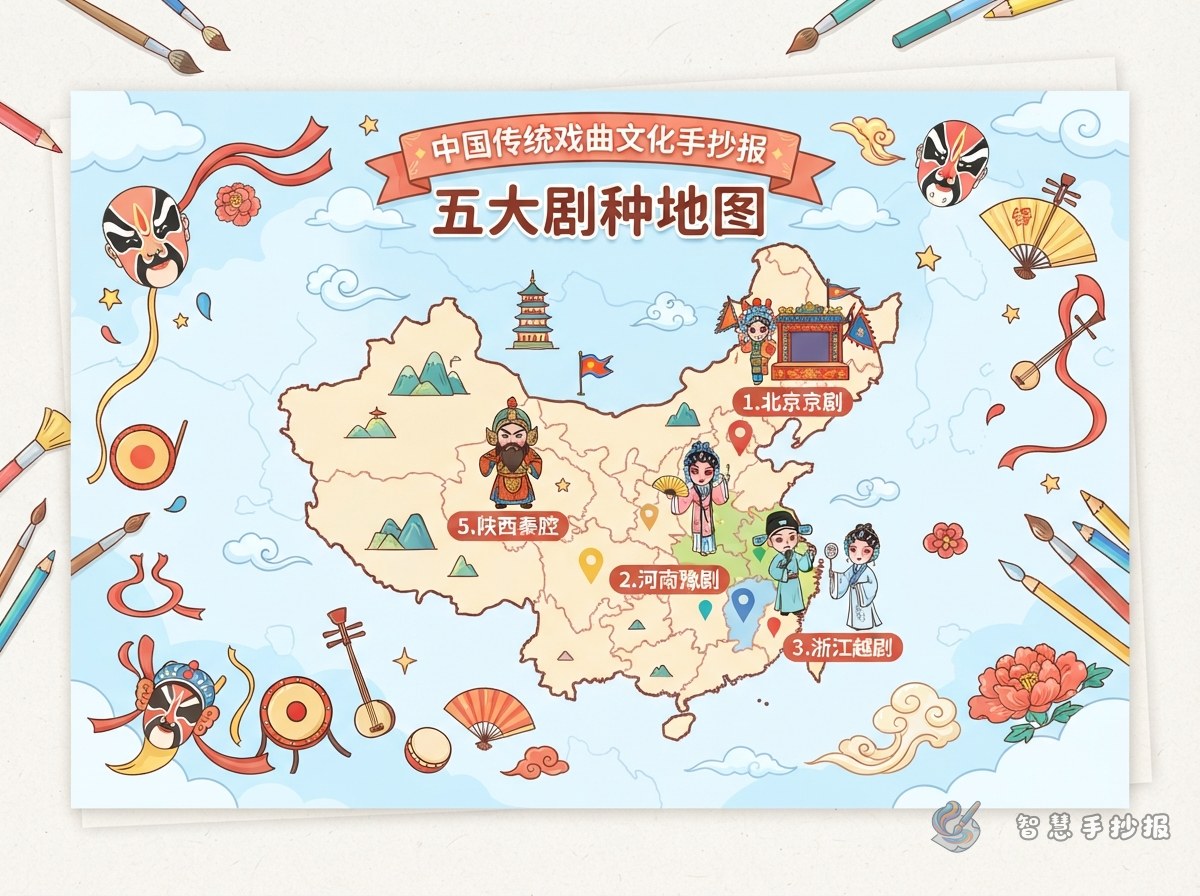
China has a large number of traditional opera genres. If you copy them one after another, the page turns into a dry list that nobody remembers. A stronger approach is to choose one main visual: draw a simplified outline of the country in the centre of the page and place genre names near the regions they come from, then arrange your text columns around it. The moment someone opens the page, the theme of an 'opera map' comes across clearly.
Planning the Space: One Big Map, Three Small Columns
Divide the page roughly like this, with the map in the middle and columns around the edges:
- Title area: main title, subtitle, class and name, taking about a fifth of the top.
- Main visual: the opera map with marked regions.
- Column one: short profiles of the five major genres, three or four lines each.
- Column two: one-line notes on three or four local operas.
- Column three: a small 'did you know' box or a note about the opera you most want to see.
Separate the columns with cloud patterns, flowing sleeves or thin lines, and leave some blank space so the page stays light.
Facts You Can Fit into One Line Each
These points give you a writing frame for the genre profiles. Rewrite them in your own words and keep them short:
- Peking opera: performed nationwide, built around singing, speaking, acting and acrobatics, with painted masks and the jinghu fiddle as its hallmarks.
- Yue opera: from the Zhejiang area, with soft melodic singing, elegant costumes and many romantic stories.
- Huangmei opera: from Anhui, lively and easy to follow, with everyday life stories such as 'Marriage of the Fairy Princess'.
- Pingju: popular in the north, using language close to ordinary speech and telling stories about common people.
- Yu opera: the representative genre of Henan, with bold, powerful singing and well-known pieces such as 'Mulan'.
Adding Local Operas for Extra Colour
Five genres can leave the map looking empty, so add a few distinctive local operas with just one sentence each:
- Kunqu: refined lyrics and graceful movement, often described as the ancestor of many opera forms.
- Sichuan opera: famous for face-changing and chorus support, with quick changes on stage.
- Qinqiang: an old genre from Shaanxi with a loud, forceful voice full of energy.
- Cantonese opera: sung in Cantonese and popular in Guangdong, Guangxi, Hong Kong and Macau, with splendid costumes.
Decorating Without Cluttering
Red, gold and ink black suit an opera theme, with a little pale blue or moonlight white to let the page breathe. Border motifs can include stage eaves, flowing sleeves, folding fans, mask outlines, gongs and cloud patterns. Keep decorations in the corners so they never cover your writing. Use one colour for the map outline and the same dark tone for column frames. The title should be clearly larger than everything else.
Before and After Copying: A Quick Check
- Draw faint pencil lines first so every line of text has a similar length and the characters stay even.
- Use a smaller size for words on the map and connect them with short lines rather than full sentences.
- Check the spelling of every genre name and make sure each one sits near the right province.
- Finish with your name and class, erase the pencil marks, and look for any area that is too crowded or too empty.
If you want a tidier finish, open the WeChat mini program '智慧手抄报', choose an opera-themed layout and place your finished text and map elements into it instead of redrawing the draft again and again.