Choose a clear focus before you start drawing
This topic should not be treated as only a bridge picture. A good handwritten newspaper should show that it is about bridge engineering and basic structure knowledge. A practical title could be “Getting to Know Cable-Stayed Bridges” or “Why Is a Cable-Stayed Bridge So Stable?”
If space is limited, build the whole page around one main question: How do the tower and cables help support the bridge deck? This keeps the poster focused and easy to read.
Best content sections for a cable-stayed bridge poster
Quick definition
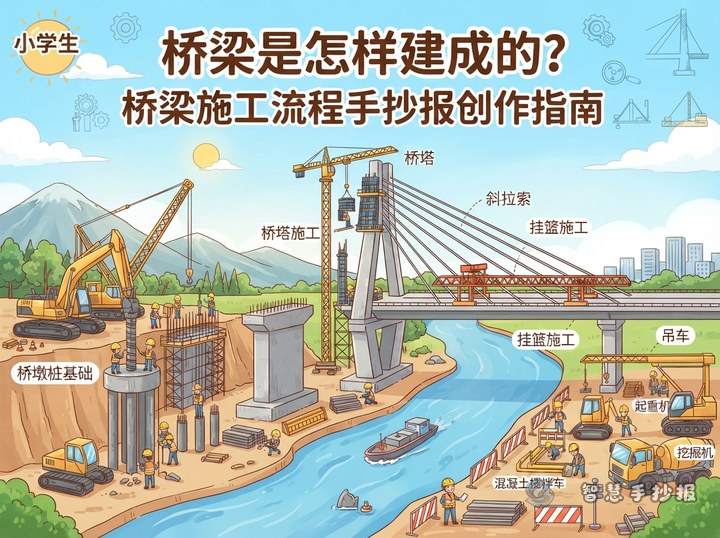
A cable-stayed bridge is a bridge in which towers, cables, and the deck work together to carry weight. The cables help transfer the load from the deck to the tower and then down to the ground.
Main parts
- Tower: the tall vertical support of the bridge.
- Deck: the part people and cars travel on.
- Cables: the slanting lines that connect the tower and deck.
- Foundation: the hidden support below that carries the weight into the earth.
How it works
Students can explain it simply: when cars move onto the bridge, their weight presses on the deck, the cables help pull and share that weight, the tower carries it downward, and the foundation keeps the whole bridge steady.
Why it matters in daily life
- It helps people cross rivers, bays, and wide roads.
- It shortens travel time and improves transport.
- It is often both useful and beautiful in a city landscape.
Short writing materials that make the page fuller
Instead of writing only one definition, students can add short lines like these:
- A cable-stayed bridge combines science with architectural beauty.
- The cables are not just decorative; they are important load-bearing parts.
- Bridge engineers must think about safety, weight, wind, and span length.
- Bridges connect places that were once separated.
A small “What I Notice” section also works well. For example: “I noticed that many cable-stayed bridges have tall towers and neat slanting cables that spread out like an open fan.” This makes the project sound more natural and student-friendly.
Layout idea: let the cables become the design feature
This topic looks best in a centered layout or a wide horizontal layout.
- Draw one tall tower first as the main visual point.
- Add slanting cables spreading to both sides.
- Place short text sections in the open spaces beside the cables.
- Use the bottom part of the page for a conclusion or observation note.
If drawing feels difficult, keep the bridge simple. Straight lines, a tall rectangle for the tower, and evenly spaced cables are enough to show the idea clearly.
Color choices and decorations
Engineering topics usually look better with clean colors than with too many decorations. Good options include:
- Blue: for sky, water, and a modern feel.
- Gray: for steel and structure.
- Orange or yellow: for titles and key labels.
You can add small gears, rulers, wave lines, clouds, or bridge silhouettes. Avoid filling every corner, because the bridge lines themselves already create a strong visual effect.
A ready-to-use section plan
- What Is a Cable-Stayed Bridge?
- The Secret of Towers, Cables, and Decks
- Why Can It Hold So Much Weight?
- How Bridges Help Daily Life
- My Simple Bridge Sketch
If you already have your topic and want help finishing the layout faster, you can continue creating in the Zhihui Shouchao Bao WeChat mini program.