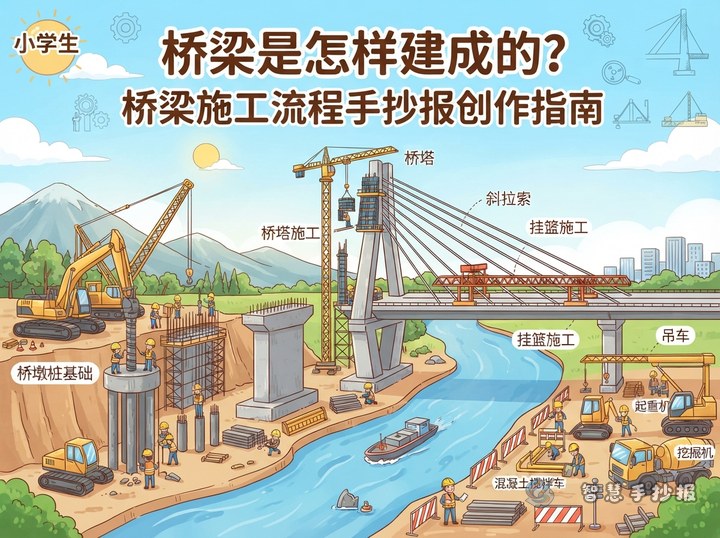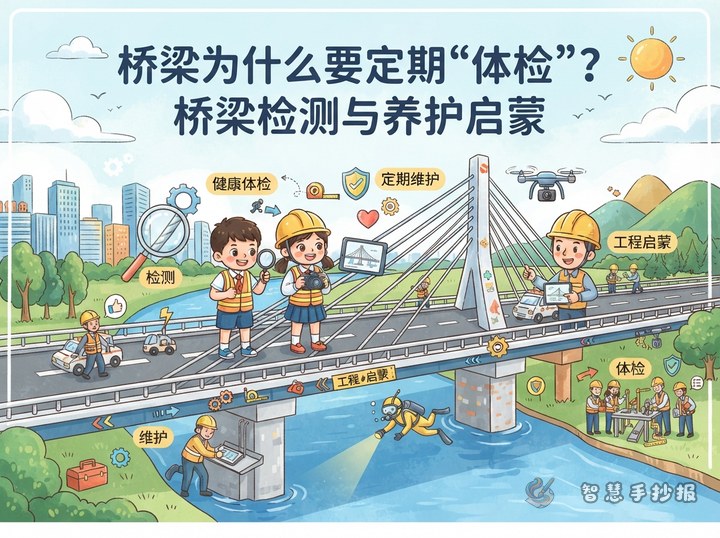
Compare three bridge types on one page
This topic works best when the handwritten newspaper compares beam bridges, arch bridges, and suspension bridges instead of introducing only one kind. A comparison makes the differences easy to see and fits an engineering basics theme very well. A title such as “Bridge Family Challenge” or “Three Common Bridge Structures” can work nicely.
You may begin with a short introduction: Bridges help people cross obstacles such as rivers, valleys, and roads. Different places and different distances need different bridge structures. Beam bridges, arch bridges, and suspension bridges all serve transportation, but they do it in different ways.
Key points to write about each bridge
Beam bridge: a straight deck held up from below
A beam bridge usually looks straight and simple. The deck is supported by piers or abutments underneath. It is often used for short or medium spans and is common in roads, overpasses, and small river crossings.
- Key words: straight, support, pier, practical
- Simple sentence: A beam bridge is like a long board held up safely.
- Drawing idea: piers supporting a flat bridge deck
Arch bridge: a curved shape that spreads force
An arch bridge is easy to recognize because of its curved arch below the deck. The arch helps move pressure outward to the sides. Many classic bridges and scenic park bridges use this form because it is both strong and beautiful.
- Key words: arch, force, elegant, stable
- Simple sentence: An arch bridge uses its curved shape to carry weight.
- Drawing idea: a half-circle arch under the bridge
Suspension bridge: a deck hanging from cables
A suspension bridge has tall towers, main cables, and many smaller hangers. The deck is suspended from the cable system. This type is good for very long spans, such as wide rivers or sea channels.
- Key words: tower, cable, hanger, long span
- Simple sentence: A suspension bridge hangs its deck from strong cables.
- Drawing idea: two towers with curved main cables
Four sections are enough for a clear poster
To keep the page neat, students can use four main sections:
- Bridge Basics: what bridges do and why they matter.
- Type Comparison: shape, structure, and where each bridge is used.
- Bridges Around Me: examples from daily life, such as footbridges or park bridges.
- What I Learned: a short reflection in a child’s own words.
If there is extra space, add a small vocabulary corner with words like deck, pier, tower, arch, and cable.
Short writing materials for children
- Bridges connect places and make travel easier.
- Beam bridges are straight and supported from below.
- Arch bridges use a curved shape to carry weight.
- Suspension bridges use towers and cables to hold the deck.
- Different bridge types show the wisdom of engineering.
A closing thought can be: I learned that bridges are not all the same. Different structures fit different places and needs.
Layout ideas for an engineering-style handwritten newspaper
A good layout is a big title in the center, comparison sections on both sides, and a short conclusion at the bottom. Blue, gray, and green can create a clean engineering look. Decorations can be simple: wave lines for water, arches for structure, and straight lines for cables.
Keep the title bold and the body text short. Small labeled sketches can make the page more interesting without making it crowded.
A simple ending that feels complete
You can end with a short summary: After learning about beam bridges, arch bridges, and suspension bridges, I understand that different structures solve different problems. Bridge design combines science, architecture, and everyday life. If you want to keep improving your layout and sections, you can continue creating in the Zhihui Shouchaobao WeChat mini program.