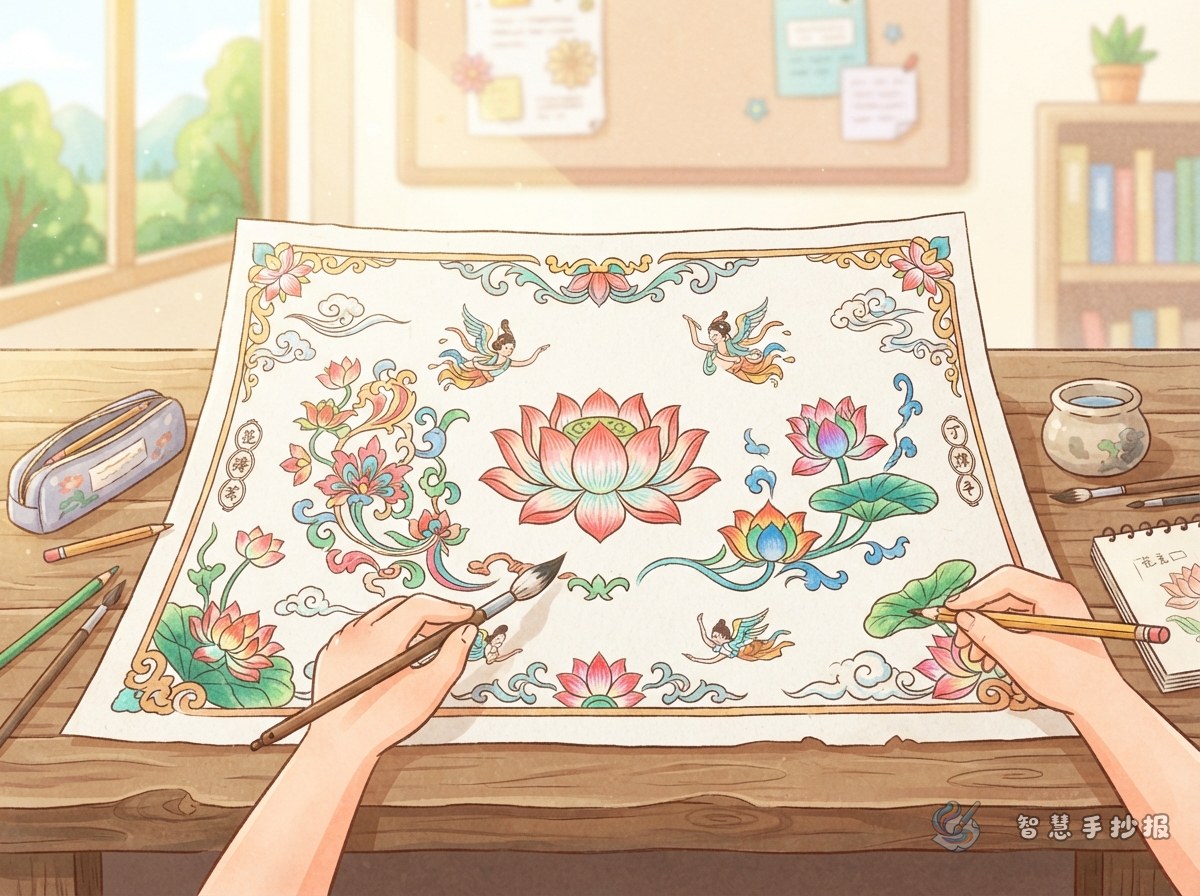
Begin with a “Mural Pattern Observer” Theme
This handwritten newspaper does not need to list many grotto names. Instead, build it around one question: how did ancient artists use lotus patterns to decorate grotto spaces? Draw a simplified lotus in the center and place three keywords beside it: “shape,” “meaning,” and “decorative use.” This gives the page a clear path for observation.
The title can be “Lotus Patterns in Grotto Murals”, with the subtitle “Discovering the Beauty of Traditional Art Through One Flower.” It clearly presents the Chinese grotto mural art theme while giving younger students an easy way to express ideas through pictures and short sentences.
Arrange the Page Like an Opening Lotus
Try a radial layout with the main lotus in the center. Place “What I Know About Grotto Murals” in the upper left, “Features of Lotus Patterns” in the upper right, “A Simple Drawing Guide” in the lower left, and “My Art Discovery” in the lower right. Connect the sections with small lotus petals, dots, and curved lines so the page feels complete rather than scattered.
- Main colors: Choose reddish brown, ochre yellow, and blue green for a calm, traditional mural feeling.
- White space: Do not fill every text box with color. Leaving a light background makes the page easier to read.
- Border: Repeat lotus petals or curling plant lines, but keep them simple so they do not compete with the title.
What Can Be Written on the Page?
A Short Art Introduction
Grotto murals are paintings created by ancient craftspeople on the walls and ceilings of cave temples. Flowers, figures, animals, and geometric patterns were often used as decoration. Lotus shapes have flowing lines and clear layers of petals, so they can appear alone or form a repeated border.
A Set of Pattern-Observation Words
Useful short sentences include: “The petals open from the center outward,” “The balanced shape makes the design steady,” “Repeated forms work well as a border,” and “The muted colors create an antique feeling.” Short phrases are better suited to a handwritten newspaper than long reference passages, and they help readers understand how the pattern is designed.
One Personal Discovery
For example: “I discovered that flowers in traditional murals do more than show nature. Through repetition, symmetry, and combination, they also make the grotto space feel orderly.” Adding a personal thought gives the page a more engaging and individual finish.
Draw a Simple Lotus Pattern in Three Steps
- Draw a center line, then sketch the middle petal to decide the lotus size and direction.
- Add shorter side petals on both sides. Aim for general balance rather than perfect symmetry.
- Use curves, dots, or small leaves to connect the petals into a border, then add two or three colors lightly.
If the page feels too full, let half a lotus enter from the edge of the paper. To create depth, use a large lotus near the title and repeat smaller lotuses around the section boxes.
Check These Four Details Before Finishing
- Does the title clearly connect the page with grotto murals and lotus patterns?
- Are the explanations short, with clear sections?
- Do the decorative patterns share a similar direction and size?
- Are there only three or four main colors, with the key points easy to notice?
After preparing the text and rough sketch, you can continue in the 智慧手抄报 WeChat mini program to organize the layout and adjust the colors before completing the page in your own drawing style.