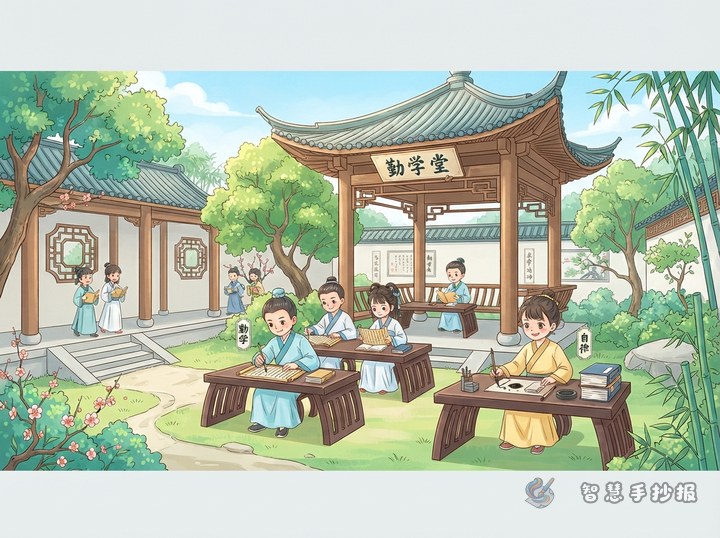
Begin with One Question: How Did Scholars Learn to Understand a Book?
Keep the project focused on reading methods rather than turning it into a biography of Zhu Xi. A short introduction can explain that traditional academies valued not only reading but also careful thinking, steady progress, practical reflection, and a serious attitude toward learning.
Add a small “I Can Try This” box near the introduction. It can connect classical principles with familiar habits such as previewing a lesson, reading aloud, reviewing difficult parts, and setting a weekly goal.
Turn the Six Principles into Student-Friendly Sections
- Learn step by step:Build a strong foundation and understand one stage before rushing to the next.
- Read closely and think deeply:Read important passages more than once and consider what the words truly mean.
- Be patient and open-minded:Spend time with a text instead of making a quick judgment based on the first reading.
- Connect ideas with yourself:Think about how a lesson relates to personal choices, habits, and daily life.
- Work with focused effort:Stay active and determined when a passage or task becomes difficult.
- Keep a respectful purpose:Treat learning seriously and remain committed to a meaningful goal.
Short Passages Ready for the Page
The Spirit of Learning in Traditional Academies
Traditional academies encouraged students to read, reflect, discuss, and improve their character. Genuine learning meant more than remembering words. Students were expected to follow a sensible order, notice questions during repeated reading, and gradually form their own understanding.
My Reading Action Plan
I will begin with small daily actions. After completing my reading, I will mark unfamiliar words, ask questions, and summarize the main idea in my own words. I will also record one useful thought from each reading. With steady practice, I can move from simply finishing a book to truly understanding it.
Brief Lines for Side Boxes
- Strong foundations grow through orderly learning.
- Reading and thinking belong together.
- Knowledge becomes useful when it guides action.
- Stay with your goal and improve a little each day.
Build the Layout as a Walk Through an Academy
Draw a simple path beginning at an academy gate and ending at a lecture hall. Place six scroll-shaped boxes along the path, one for each reading principle. Use the lower left area for the spirit of academy learning and the lower right area for a personal reading plan. This arrangement creates a clear connection between past and present.
Another option is a two-level design. Use six lattice-window panels across the upper area for the principles, then place two short passages and the action plan below. Keep each small section to three or five lines, and highlight only the key terms so the page remains easy to read.
Add Classical Details Without Crowding the Writing
- Place the main title inside a wide open-scroll shape.
- Add small brushes, inkstones, bamboo leaves, or stacked books in the corners.
- Use a cream background with black, brown, and a little muted green.
- Check that all six principles appear and that each has a modern explanation.
To adjust the section count, title position, or color plan, students and parents can continue creating the page in the Zhihui Handwritten Newspaper WeChat Mini Program and adapt the design to the paper size and grade level.