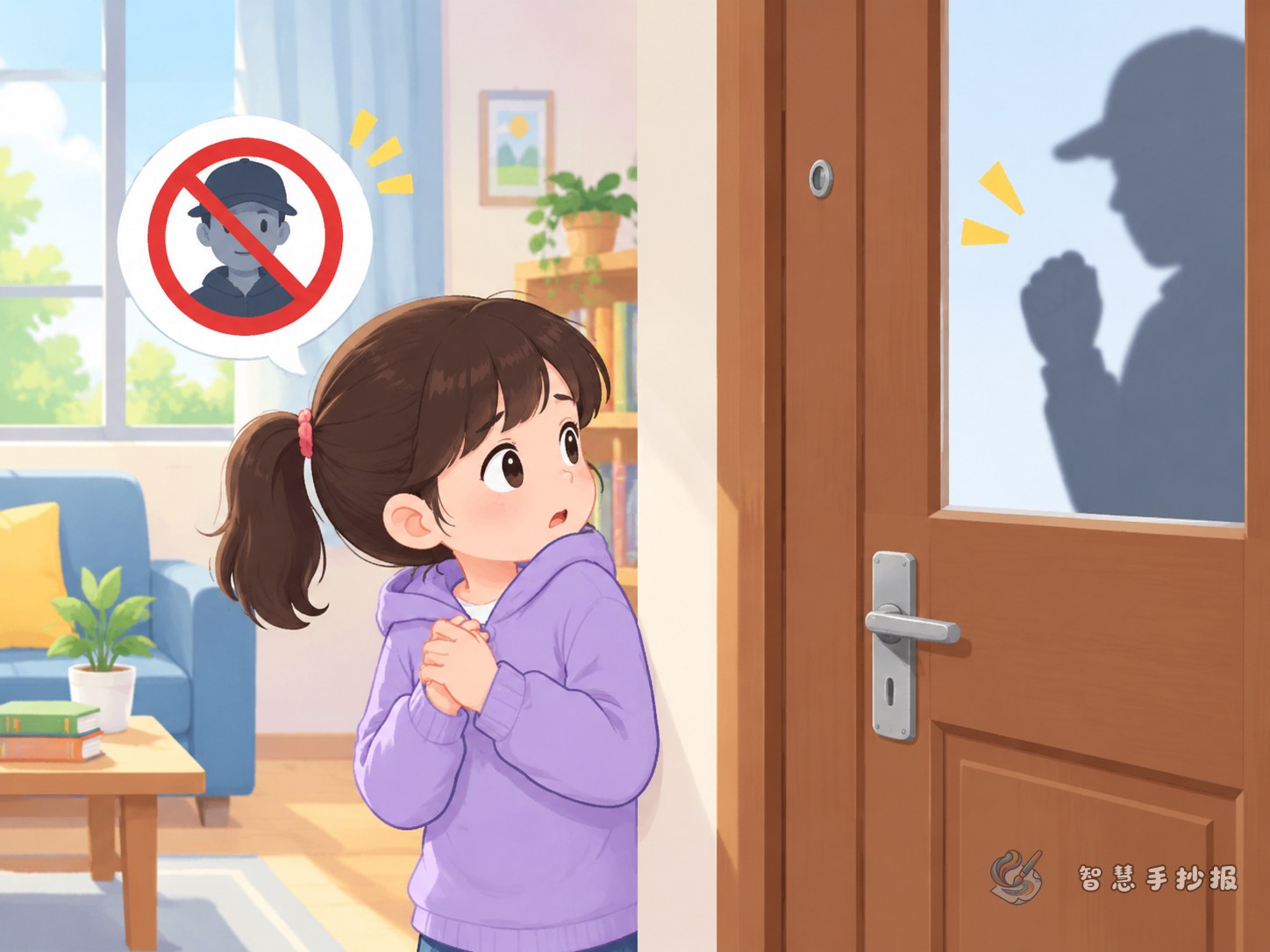
Start with one sentence a child can remember
A poster about hearing a knock while home alone should not be a long list of scary warnings. Use a main title in the child's voice, such as “When I'm home alone, the door stays closed.” Add a subtitle like “Look, ask, then call.” This gives the whole poster a clear center and helps the child know what matters most when copying the text.
Draw a simple door and peephole beside the title to create the feeling of looking out from inside. Keep the title to two lines or fewer and leave room for the situation boxes below.
Three knock-at-the-door situations become three content boxes
The body does not need to cover everything. Split visitors into three types, and for each one write what the child should do. The boxes can sit side by side or step down the page for a more layered look.
Someone claims to be a repair worker or delivery driver
- Do not open the door. Ask through the door who they are looking for and why.
- Say, “Please leave it outside. I will call my parents and collect it later.”
- Call a parent right away and let an adult deal with it.
Someone says they know your parents
- Do not say you are home alone. Say, “My parents cannot come to the door now. Please call them.”
- Do not open the door or go downstairs with the person.
- Note what the person looked like and when they left, then tell a parent.
Someone knocks silently or keeps ringing the bell
- Stay quiet and do not stare through the peephole for a long time.
- Move back inside, check that the door is locked, and call a parent.
- If the person tries to force the door or will not leave, call 110 and give the address clearly.
Use a door as the visual center of the layout
This topic works well with a large door in the middle of the page. Draw the child inside the door and a question mark or shadow outside to show the contrast. Leave three small boxes on the right for the three situations, and place a horizontal chant strip under the door. The page will feel organized.
Use bright yellow or light blue for the background, brown or dark gray for the door, and a small red label for the key warning. Do not color every space; leave some white areas so the text stays readable. Box headings such as “Sounds outside the door,” “My three steps,” and “My help card” are more inviting than a plain “Notes” label.
Short lines and a chant kids can copy
Keep the text short so children will actually read it. These lines can go straight onto the poster:
- The door is my shield. Keeping it closed is safest.
- Don't say I'm alone. Don't go with a stranger.
- Look through the peephole, ask who it is, then call.
- No adults at home means no opening the door.
For a four-line chant, try: “Someone knocks, don't panic; look and ask before you act. Parents away, door stays shut; call for help and stay on track.” Write one line per row and add a small icon beside each line to give it rhythm.
Small details that make the poster work better
First, make the contact numbers specific. Besides 110, include a parent's number and a trusted neighbor's number, but avoid putting the full apartment number in a very visible spot. Second, write the role-play lines the way a child would really speak, not as commands. Third, before finishing, ask the child to read the poster aloud and explain what to do first, next, and last.
If you want to save time on the layout, open the Smart Handwritten Poster mini program in WeChat, choose a suitable column frame, and fill in the short lines and situation boxes above. Then hand-draw the door and peephole to complete a clear and practical safety poster.