Turn the Page into a Lesson in an Ancient Academy
An ancient academy was not only a quiet place for reading. It could also be a place where learners exchanged ideas, asked questions, and thought together. Instead of filling the page with a long history of academies, focus on four steps: listening, questioning, discussing, and reflecting. This gives the handwritten newspaper a clear study theme.
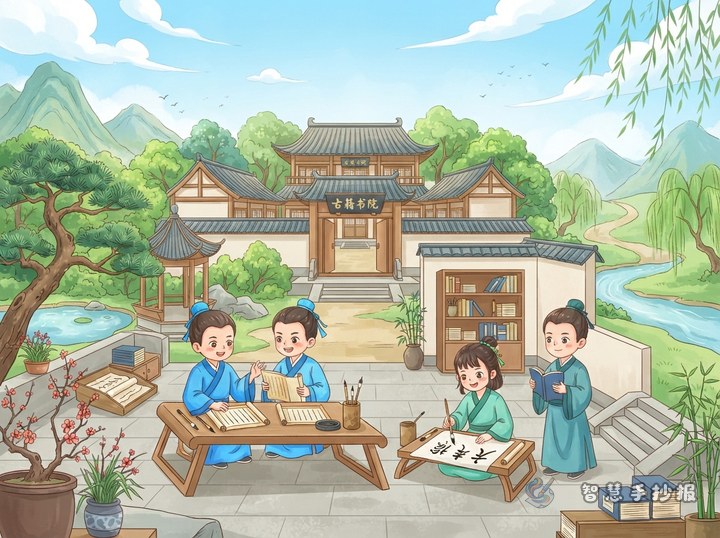
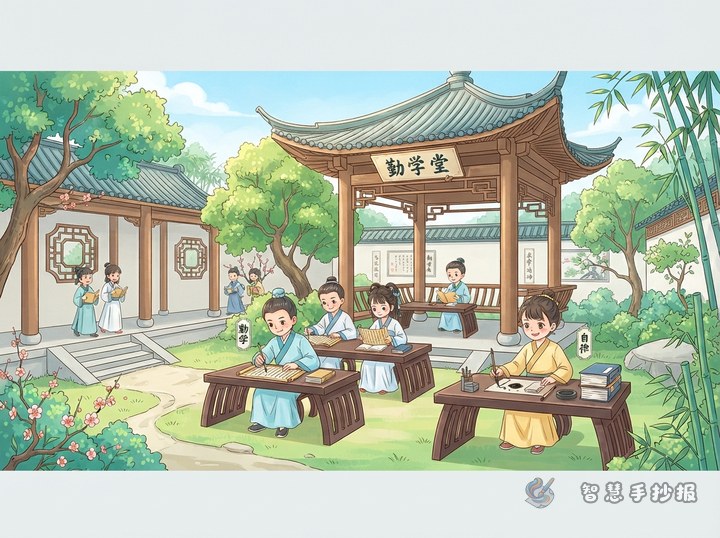
- Main picture: Draw a simple traditional lecture hall with desks, books, and students listening.
- Main path: Connect the four sections with a scroll, arrows, or a line of footprints.
- Decorative details: Add bamboo shadows, window frames, inkstones, and lanterns for a calm academy atmosphere.
Build the Layout Around a Learning Journey
Use a top-to-bottom reading order. Place the title and an academy gate at the top, enlarge the lecture scene in the middle, and put a Question Card and Discussion Notes on the two sides. Finish with My Learning Action at the bottom. This layout feels more like a story than several unrelated text blocks, while showing that learning develops step by step.
- Start with Entering the Lecture Hall to introduce reading and lectures in an ancient academy.
- Continue with My Question to show the courage to seek knowledge.
- Add We Discussed It to show how conversation can make an idea clearer.
- End with Today’s Action to connect the historical theme with daily learning.
Three Text Panels Ready to Write
A Short Lecture Note
In an ancient academy, students listened in the lecture hall and examined ideas through conversation. Reading did not end with memorizing sentences. They first tried to understand, then asked questions, and finally explained the idea in their own words. One lecture could open a new way of thinking, while one discussion could reveal something they had not considered.
Question Cards
- What can I do when I do not understand something I have read?
- How can I listen carefully when a classmate has a different idea?
- After learning something, can I explain it clearly in my own words?
My Learning Action
I will set aside quiet reading time each day. When I meet a question, I will write it down and try to solve it through research, asking for help, and discussion. I will practice explaining my ideas completely while respecting the way others think.
Small Details That Show Discussion
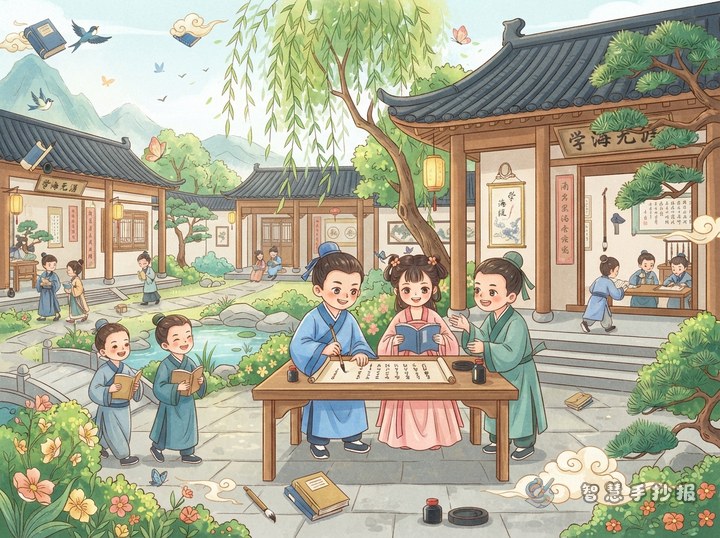
Do not draw every figure facing the same direction. One student can raise a hand, another can look for evidence in a book, and two classmates can talk around a desk. Keep speech bubbles short with words such as “Why?”, “I noticed,” and “Let me think again.” Books, question cards, and a small blackboard can also become borders for the text sections, linking the pictures and writing naturally.
Finish with Calm, Scholarly Colors
Try warm ivory, brown, bamboo green, and soft ink gray. Use dark brown or ink gray for the title, with a small touch of red to highlight key words. Draw the borders and main picture first, then arrange the sections, copy the text, and add small decorations. After sketching, you can continue arranging the page in the 智慧手抄报 WeChat mini program so the lecture scene, question panels, and action plan look neat together.