Begin with a field mystery
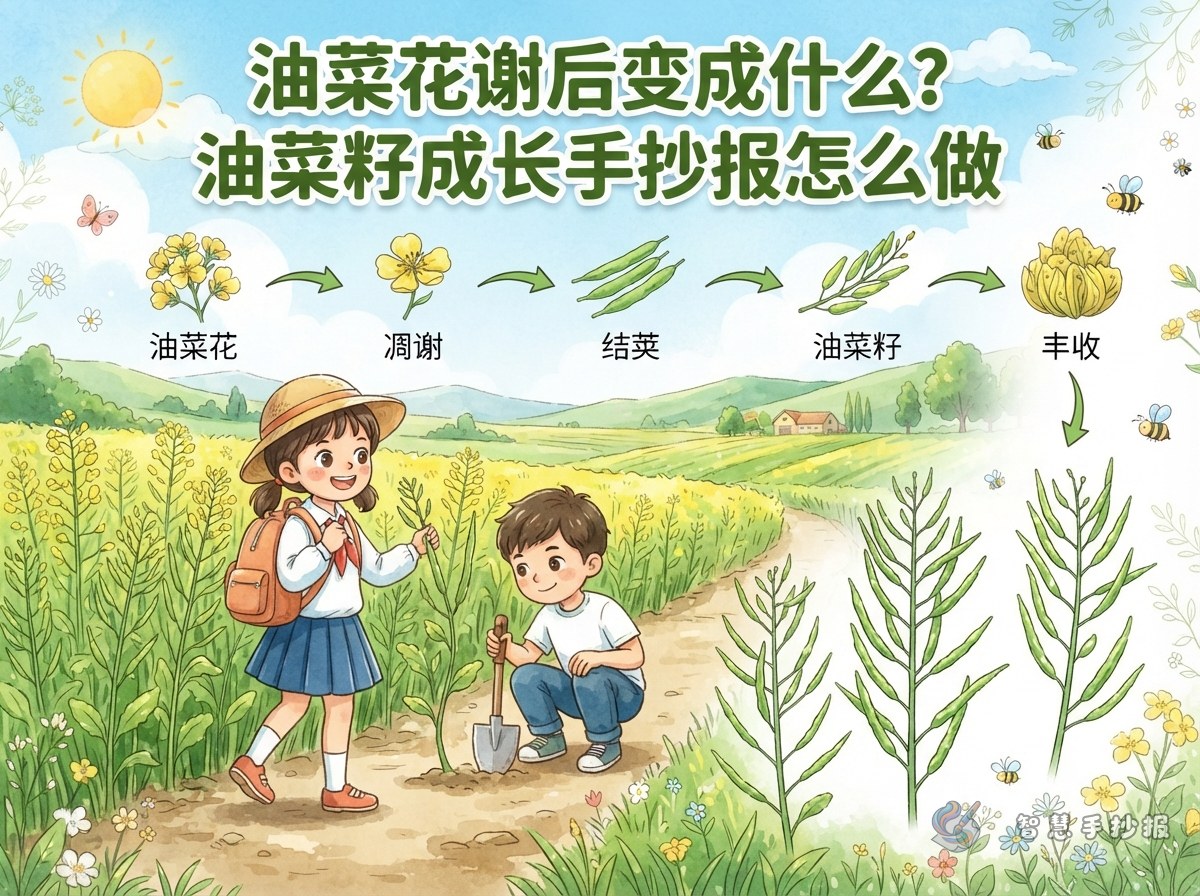
Build the handwritten newspaper around one question: what happens when a field of yellow rapeseed flowers loses its petals? Place the question in a bold title and add a small flower beside a green seed pod. This immediately shows that the page explores a crop’s life cycle rather than simply celebrating spring scenery.
A subtitle such as Following a Flower into a Seed can connect the seasonal landscape with the science story.
Tell the story in four illustrated stops
- Flowering:Clusters of yellow flowers open and attract visiting insects.
- Pollination:After pollination, the petals fade and fall while the fruit starts to develop.
- Pod formation:Long green pods appear where the flowers once grew, and seeds form inside them.
- Ripening and harvest:The pods and plants gradually turn yellow as the seeds mature and become ready for harvest.
Growing seasons vary with local climate, so avoid assigning one exact month to every stage. A broad sequence such as cool-season growth, spring flowering, pod formation, and later harvest is more suitable for a general school project.
Short science notes for the page
Falling petals are not the end
When a pollinated rapeseed flower loses its petals, the plant continues to grow. Part of the flower develops into a slender pod. Inside a nearly mature pod, students can see small seeds arranged along its length.
How people use rapeseeds
Mature rapeseeds contain oil. After harvesting, cleaning, and processing, they can be pressed to make edible oil. This connection helps readers understand how a familiar kitchen product begins with seeds, farmland, and careful farm work.
Observe without harming the field
Students should walk only along permitted paths or field edges, avoid stepping on crops, and never pick flowers or pods without permission. Shapes, colors, and plant height can be recorded with sketches and short notes instead.
Turn the layout into a growth trail
Use a curved line across a landscape page to create a visual trail. Move from a yellow flower field on the left to falling petals, green pods, and dark mature seeds on the right. Add four compact text boxes along the trail.
- Place the main title in the upper-left corner with yellow letters and a green outline.
- Make an enlarged flower and an open seed pod the central illustration.
- Keep paragraphs brief and vary the sizes of the surrounding text boxes.
- Fill small corners with clouds, bees, farm tools, leaves, or field paths.
Because yellow illustrations can become visually strong, leave pale or white spaces behind the writing. Clear spacing will make the facts easier to read.
From rough plan to finished newspaper
Before drawing, list one guiding question, four growth stages, three short science notes, and several illustration elements. Mark each area lightly in pencil, write the text, outline the drawings, and add color last. Students and parents who want help arranging sections or selecting a suitable template can scan the code and continue creating in the 智慧手抄报 WeChat Mini Program.