Why Pair Solar Terms with Farm Work on One Page
Farmland has a rhythm: there is a right moment for digging, watering and harvesting, and each of those moments can be matched to a solar term. Drawing that rhythm makes the changing seasons easier to see than describing one crop on its own.
This theme is friendly to work with because the material is plentiful and the structure is clear. One term, one farming sentence and one small picture will fill a whole page without any struggle over what to write.
A Timeline That Runs from Spring Sowing to Winter Rest
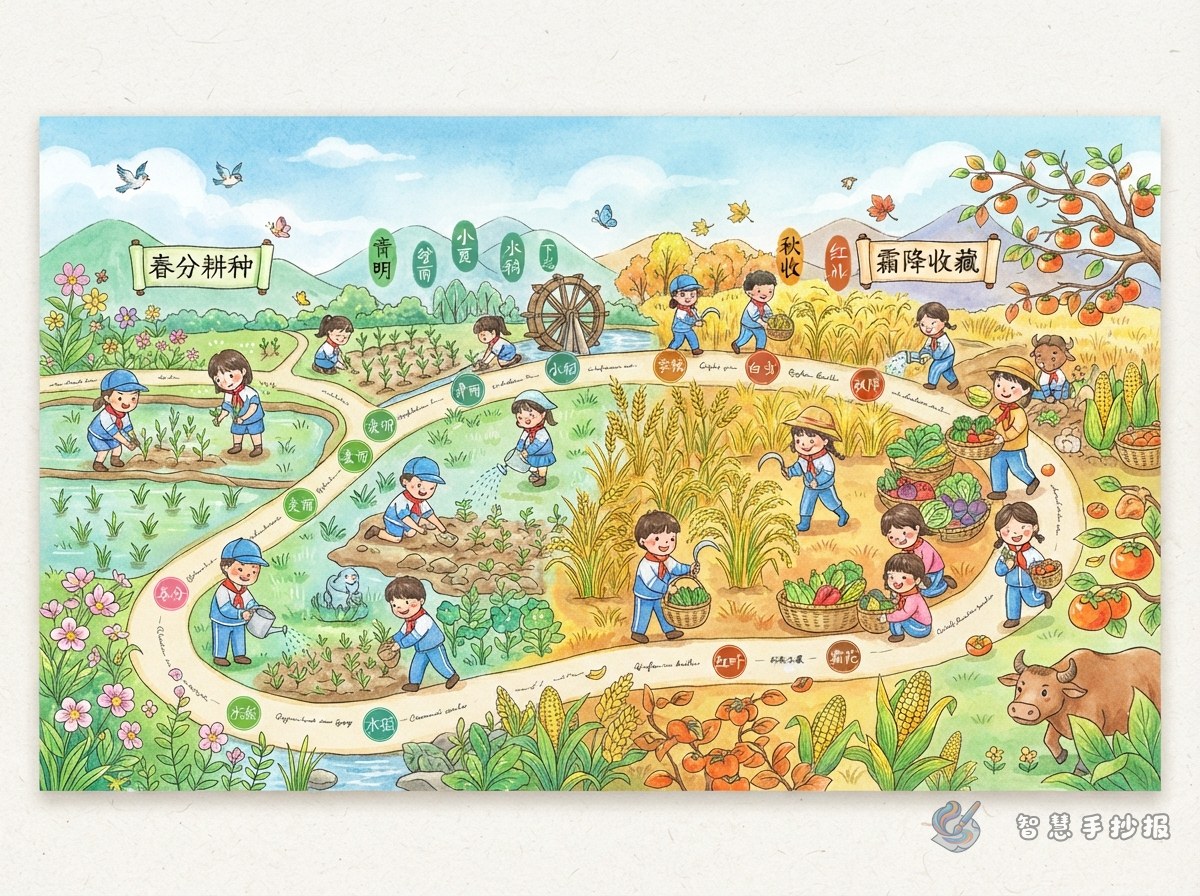
Draw a straight line or a winding path across the middle of the page and hang the four seasons on it. Two or three sentences per season is plenty.
Spring: Sowing and Seedlings
Around the spring equinox the ground softens and digging and sowing begin. Beans, pumpkins and cucumbers can go into the soil at this time. Try a line such as: the seed drank its fill and slowly pushed up through the soil.
Summer: Growth and Care
From midsummer to the hottest days, sun and rain push crops along fast, and the work is at its busiest: watering, weeding, building frames and picking off insects. A good line here is: the vine climbs the bamboo pole and looks different every day.
Autumn: Ripening and Harvest
After early autumn the grain ears bend and the fruit changes colour. Writing that the drying ground is covered with a sheet of gold sounds far better than saying autumn is beautiful.
Winter: Rest and Preparation
From early winter to midwinter the fields go quiet. People mend tools, build compost heaps and choose seeds, while snow lies over the wheat like a blanket. This part is often forgotten, and including it makes the page feel complete.
Five Small Columns You Can Copy Straight Onto the Page
- Term dictionary: use one box to explain that Grain in Ear means wheat with awns is ready to cut and rice with awns is ready to plant.
- One line of farm work: keep each entry to a single sentence, such as beans and melons go in around Grain Rain.
- Tool corner: draw a hoe, a watering can, a basket and a straw hat, then say what each one is for.
- My field notes: save a small space for something you have seen yourself, like planting vegetables or picking fruit.
- Four season Q and A: answer simple questions such as why frames are built in summer or why vegetable plots are covered in winter.
Colour Blocks and Simple Icons to Mark the Seasons
Split the page into four areas. Use fresh green and pale yellow for spring, deep green and sky blue for summer, orange and brick red for autumn, and grey blue and white for winter. Make the blocks different sizes, perhaps narrow spring, wide summer and autumn, narrow winter, so the page looks like a path in motion.
Put one small icon at each boundary: a sprouting seed, a climbing vine, a bending grain ear, a falling snowflake. Keep all icons drawn with the same line weight and the layout will stay calm.
Planning the Layout Before You Write
- Set the title area first with a short heading and give it the top third of the page.
- Leave the middle for the timeline, with one small section per season.
- Place two small columns at the sides or along the bottom: one for farming sayings, one for your own observations.
- Add borders and corner drawings last. Write before you decorate so the text always fits.
Use three lettering sizes: largest for the title, medium for column names, smallest for the body. Keep the same ink colour inside one column for a tidier look.
Tidy Up the Layout in the WeChat Mini Program
If the timeline refuses to sit straight, sketch the four areas on scrap paper first, then open the Smart Handwritten Newspaper WeChat mini program and choose a countryside or solar term style template. Drop in your own text and column names, adjust the sections, and copy it out neatly afterwards. With the wording settled in advance, you will not have to rewrite anything halfway through.