Begin with a simple color code
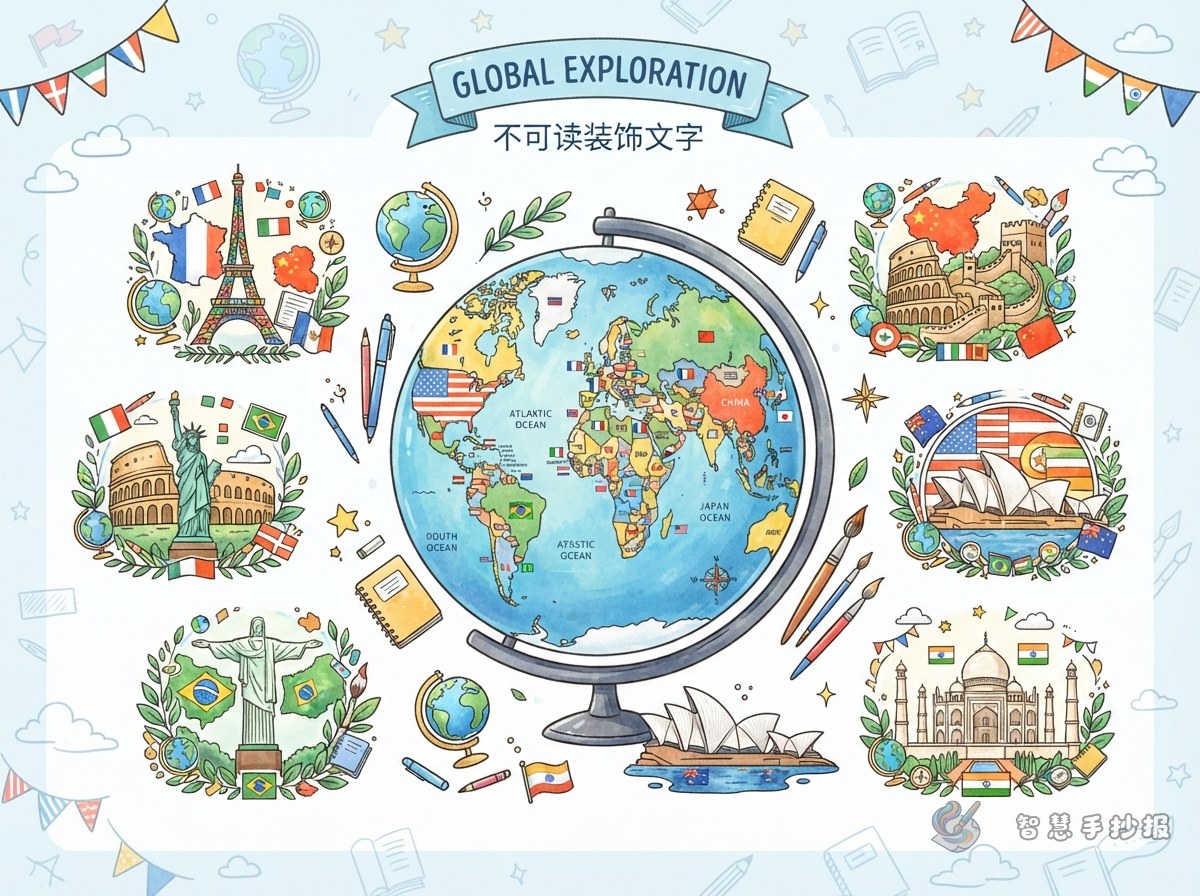
Instead of drawing every country in the same way, let national flag colors guide the design. Use pale blue, cream, or light green for the map background. Then take one or two colors from each flag and repeat them on the landmark card borders, headings, connector lines, and small dots.
- Map background: Keep it light so country names and landmark drawings remain easy to read.
- Accent colors: Use only one or two key colors for each country instead of giving every color equal space.
- Color legend: Add a small legend in one corner to explain which colors mark landmarks, country names, or fun facts.
Five or six countries are enough. China, France, Egypt, India, the United States, and Australia offer a good mix without making the page look like a crowded data chart.
Let the map lead the eye
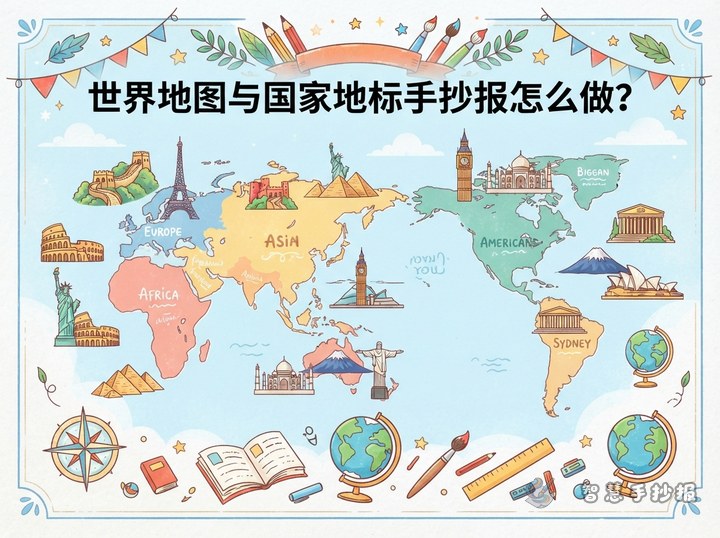
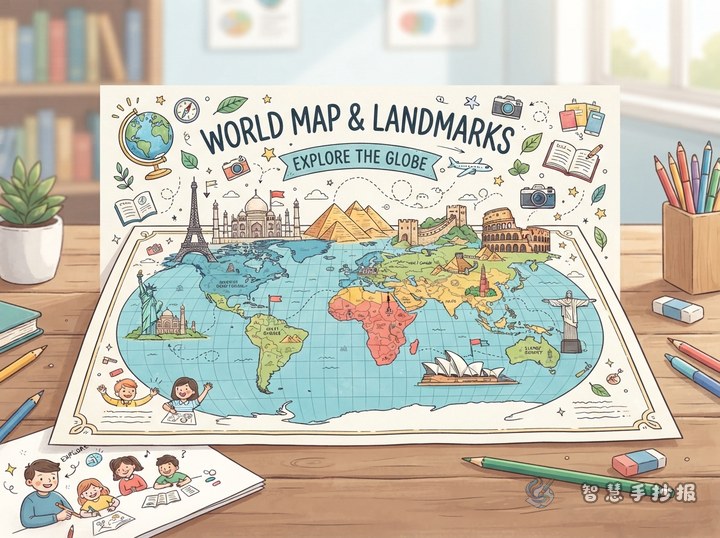
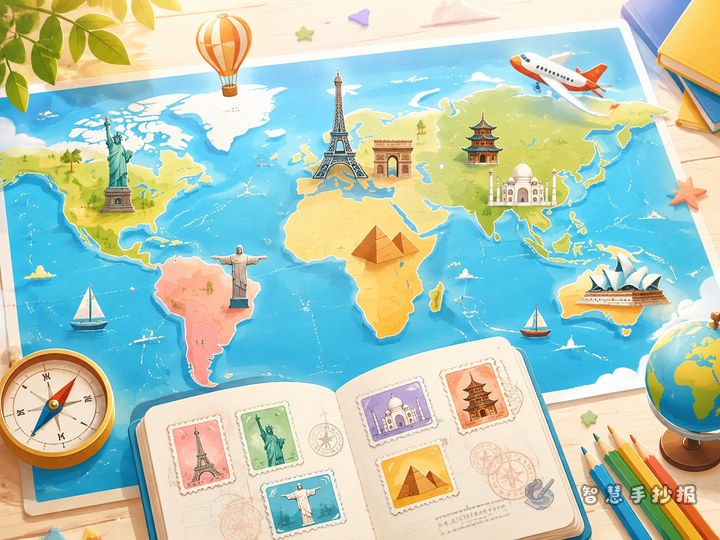
Place a simplified world map in the center of the page. The coastline does not need to be exact; showing the general position of the continents is enough. Arrange small landmark cards around the map and connect each card to the approximate location of its country with a thin line.
A practical page plan
- Write the main heading at the top, such as Explore Landmarks Through Flag Colors, and add a colorful decorative strip.
- Reserve the largest central area for the world map, with a compass, dotted route, or small airplane nearby.
- Place six similar-sized landmark cards around the map, using one main drawing on each card.
- Create a My World Discoveries section at the bottom for a country you would like to learn more about or a short message about cultural exchange.
The cards do not have to form a straight row. A slightly staggered arrangement can feel more lively, as long as the connector lines stay away from the words and the reading path remains clear.
Turn each landmark into a mini fact card
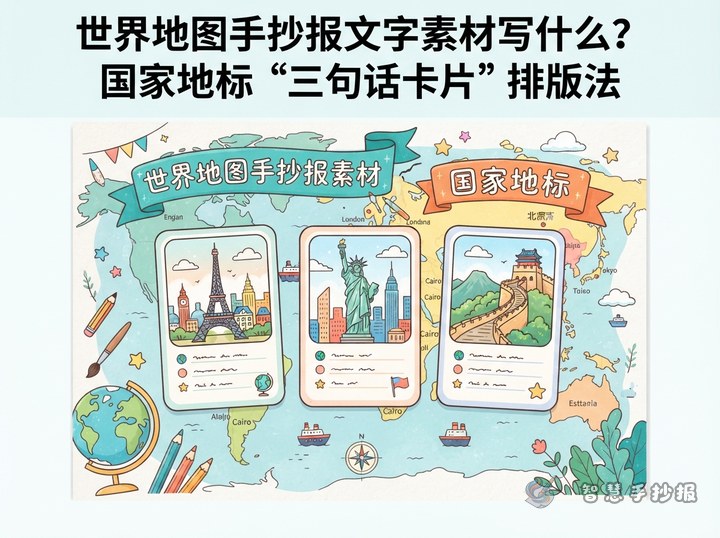
Three or four short lines are enough for each card. A useful order is country, city or region, landmark, and one special feature. These examples can be shortened to fit the page:
- China — Great Wall: Winding ancient fortifications that show the building skills of early Chinese civilization.
- France — Eiffel Tower: A famous Paris landmark with a simple, instantly recognizable iron framework.
- Egypt — Pyramids of Giza: Stone monuments near Cairo and an important reminder of ancient Egyptian civilization.
- India — Taj Mahal: A white marble monument in Agra known for its balanced shape and graceful design.
- United States — Statue of Liberty: A torch-bearing statue in New York Harbor, often associated with freedom and welcome.
- Australia — Sydney Opera House: A Sydney landmark with bright, shell-like roof forms that are easy to recognize.
To make the page feel more interactive, add one small question to each card, such as Which landmark would you like to visit? or What colors can you find on this flag?
Draw recognizable shapes, not complicated details
Young students do not need to copy every architectural detail. Focus on the outline and one memorable feature. Draw the Eiffel Tower as a triangular framework, the pyramids as simple triangles, the Statue of Liberty with its torch, the Opera House with curved white roofs, and the Great Wall with a winding line.
- Sketch the outer shape lightly in pencil, then strengthen the main edges with a black pen.
- Use flag colors as accents on headings, card borders, or small building details rather than filling every area.
- Keep all connector lines similar in thickness and make sure they do not cross country names.
- Leave some blank space for stars, stamp-like labels, or a compass so the page can breathe.
Follow a clear making sequence
- Mark the page boundaries and decide where the title, central map, and six landmark cards will go.
- Sketch the map, landmark outlines, and connector lines in pencil, adjusting the balance before adding color.
- Write the country names and short fact cards, checking that the text fits each card.
- Color the map background first, then apply the flag-based color code to the heading, borders, and selected building details.
- Add the legend, small decorations, and My World Discoveries section, then erase extra pencil marks.
For help arranging headings, short fact cards, and a rough layout, you can continue designing in the 智慧手抄报 WeChat mini program and adjust the content to match your paper size.