Choose a Theme That Invites Guessing
Build the handwritten newspaper around the idea of “A riddle hidden in the lantern light”. Instead of only explaining lantern riddles, let readers follow the page and play a small guessing game. A title such as “Little Riddles in the Lantern Glow” can be paired with the subtitle “Read the clues, think it through, and find the answer.” This works well for a festival activity, a language assignment, or a traditional-culture project.
Organize Clues in Three Ways
Use three short sections to explain common ways of solving a lantern riddle. This gives the page more structure than a simple list of questions.
- Look at the character: Notice the shape, radicals, and strokes. For example, “A person inside a gate” can lead readers to the Chinese character for “flash.”
- Think about the meaning: Use the object’s features, purpose, or action. The riddle “It has an eye but no pearl, and feet but cannot walk” can lead to “needle.”
- Listen to the sound: Some riddles use homophones or wordplay. Add a short explanation so the answer does not feel forced.
Place one brief example beside each clue type. Answers can be hidden inside lantern-shaped boxes or small note labels so readers can guess before checking.
Riddles That Are Easy to Copy
Do not make every riddle difficult. Choose two basic questions and one slightly more challenging question, keeping the answer and hint in separate areas.
- Riddle: “One mouth bites off the cow’s tail.” Answer: “告,” a Chinese character. Hint: Combine “one mouth” with the idea of removing the final part of “cow.”
- Riddle: “A square city with one hundred thousand people inside.” Answer: “图,” a Chinese character. Hint: Observe the outer frame and the strokes inside.
- Riddle: “A tiny boat without a sail, moving across the water by day and resting beside the sky at night.” Answer: the moon. Hint: Think about its shape and when it appears.
When a riddle could have more than one answer, add a short “hint” below it and choose questions whose reasoning you can explain clearly. A few well-explained riddles are better for children than a crowded page.
Turn the Layout into a Guessing Path
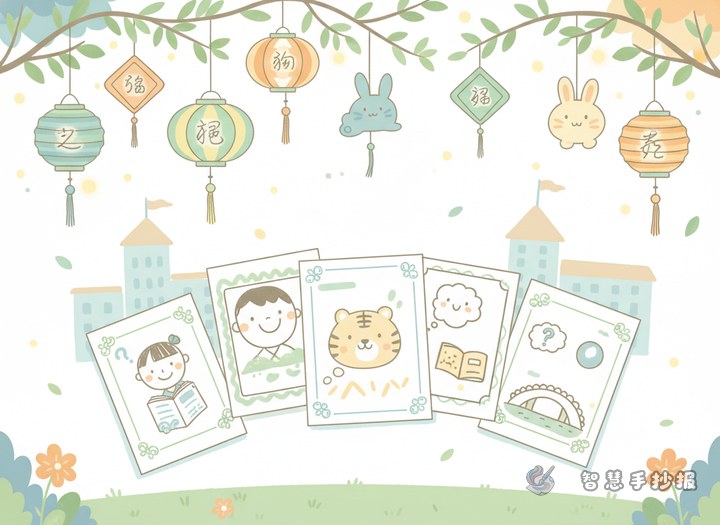
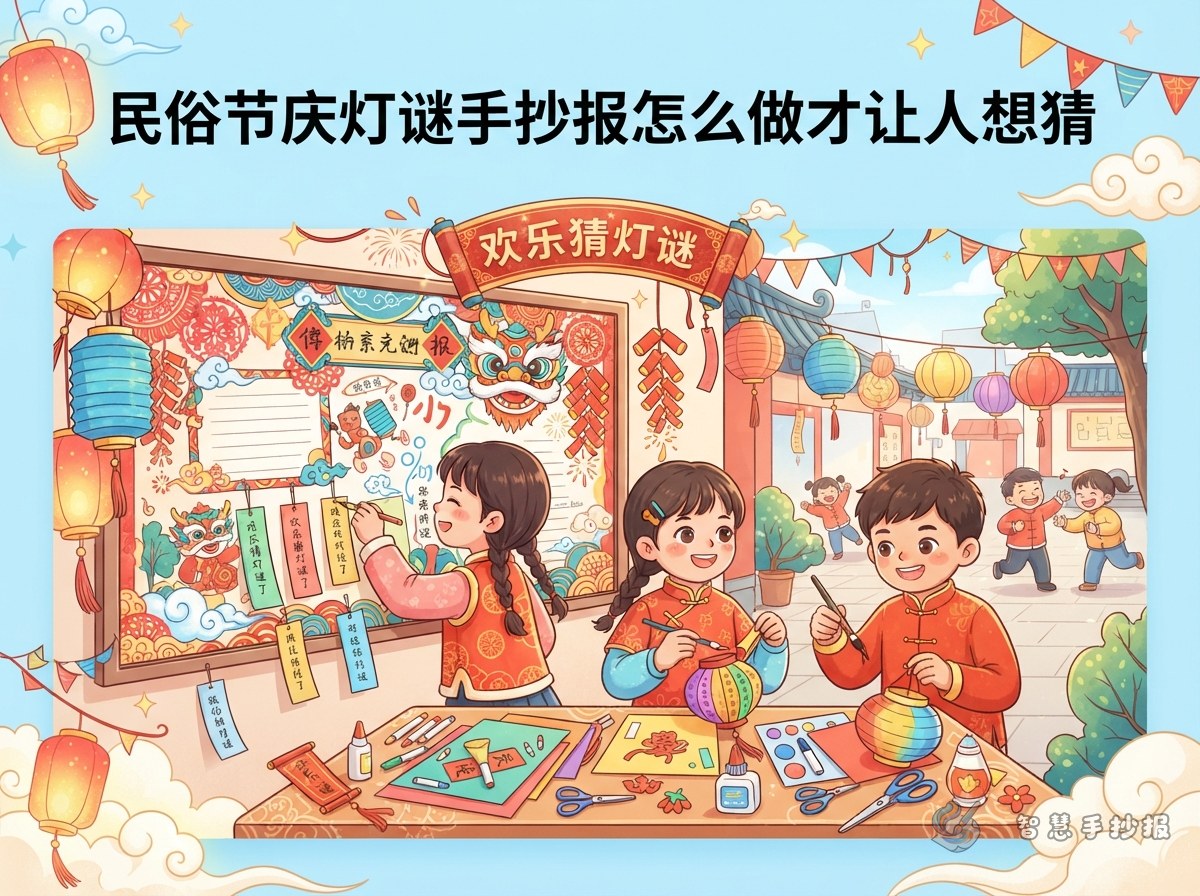
Arrange the page from the upper left to the center and then down to the lower right. Put the title and a moon at the top, a “Riddle Clues” section on the left, three or four lantern-shaped riddle boxes in the center, and “How to Guess” on the right. Finish with “Answers Revealed” at the bottom. Arrows, dotted lines, and small dots can guide the reading order.
Use vermilion, golden yellow, ink black, and a small amount of teal. Lanterns, tassels, paper-cut patterns, and cloud motifs are enough decoration. Make the title largest, keep the riddles more prominent than the explanations, and use small labels to highlight the answers. Leave open space so the borders and illustrations do not crowd the text.
Final Check Before You Finish
- Can readers immediately tell that the theme is festival lantern riddles?
- Does every riddle have a clear and believable answer?
- Is there an obvious reading order between sections?
- Do decorations stay away from the riddle text and answers?
- Have you checked spelling, punctuation, and explanations?
After preparing the text, open the WeChat Mini Program Zhihui Shouchaobao to continue arranging sections, refining the layout, and completing the handwritten newspaper.