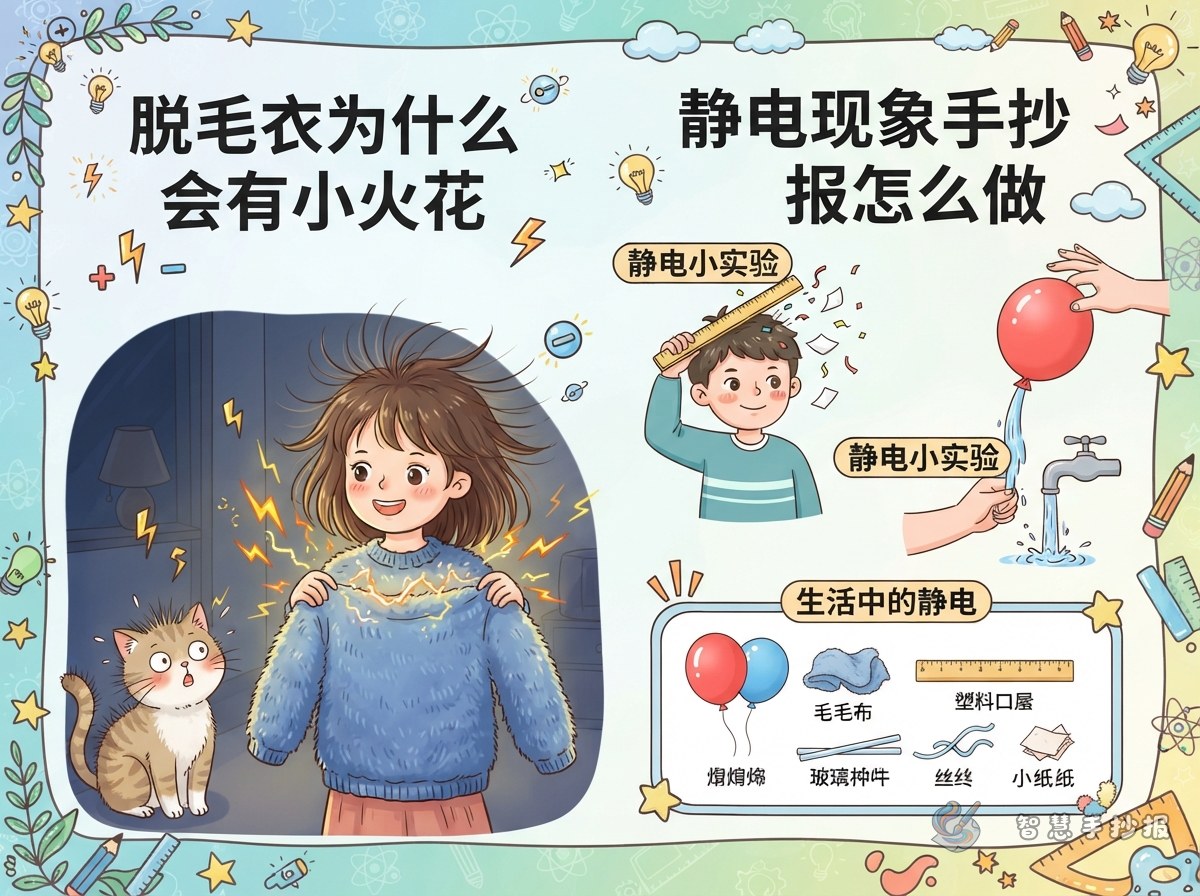
Start With the Little Spark You Hear Every Winter
Pull off a woollen sweater in winter and you often hear a soft crack. Reach for a metal doorknob and your fingertip gets a tiny shock. Almost every pupil has felt this, which makes static electricity an easy handout topic: you never have to invent material, because it happens around you all the time.
Open with one or two sentences about your own experience, such as hair standing up after a sweater comes off, then ask the question: where does this invisible electricity come from? That question gives the rest of the page its thread.
What to Fill the Main Columns With
Rubbing Makes Charges Build Up
When two different materials rub together, one loses electrons and the other gains them, so each ends up with an opposite charge. Bring a charged object near a conductor and the charge jumps across, producing the small spark and the crack you hear. Use the sweater-and-hair example and one sentence is enough.
Why Winter Feels More Electric Than Summer
Winter air is dry, so charge cannot leak away easily and it gathers on clothes and skin. Humid summer air lets charge escape, so the effect is weaker. Synthetic fabrics, blankets and plastic soles all hold charge well. A simple side-by-side drawing of dry and damp air works nicely here.
Lightning: Static Electricity in the Sky
Ice crystals and water droplets inside clouds bump and rub, and charge keeps building until it breaks through the air as a lightning bolt. Adding this column links your page to the wider topic and gives it more depth. A dark cloud with a bright bolt makes a striking illustration.
Three Demos That Look Great on Paper
- Balloon and paper bits: rub a balloon on your hair or a sweater about fifteen times, then hold it near torn scraps of paper and watch them jump up.
- Plastic ruler and hair: rub a plastic ruler quickly through dry hair, then bring it near a thin stream of water or small paper pieces.
- Comb and pepper: spread a mix of salt and pepper on paper, then bring a rubbed plastic comb close and the lighter pepper rises first.
For the layout, show each demo as three small boxes: rub, bring close, watch what happens. Keep charged objects away from sockets and appliances while you test them.
Lay the Page Out Like a Circuit Diagram
Static electricity suits a circuit-style layout. On scrap paper, draw a few short lines and dots as wires and nodes, then fit your text blocks inside the shapes they form.
- Title area: a main heading such as “Snap, Crackle, Static” with a spark or balloon beside it.
- Principle area: rubbing and positive and negative charges.
- Everyday area: winter shocks, synthetic clothing, anti-static rules at petrol stations.
- Demo area: the three experiments in order with simple sketches.
- Tips area: two or three anti-static habits, such as drinking water, keeping a room slightly humid, or touching a wall before a doorknob.
Colours, Titles and Borders That Hold Together
Use blues and purples for electricity and pale yellow or orange for sparks and lightning. The contrast is clear without being harsh. Zigzag or wavy borders suggest current, while a dotted line with small circles suggests charge on the move.
Write the main heading in hollow letters or in bolt-shaped blocks, keep column headings smaller, and leave a finger-width of space between text blocks. That breathing room makes the finished page look neat.
A Quick Check Before You Copy It Out
- Can every column be summed up in one clear sentence? If not, cut it in half.
- Does each demo list the materials, the steps and what you observe?
- Is there a blank margin around all four edges of the sheet?
If you want a tidier result, open the Smart Handout mini program in WeChat, choose a static electricity layout under the electricity and everyday science category, swap in your own text and colours, then copy it onto paper.