Make the Compass the Guide of Your Page
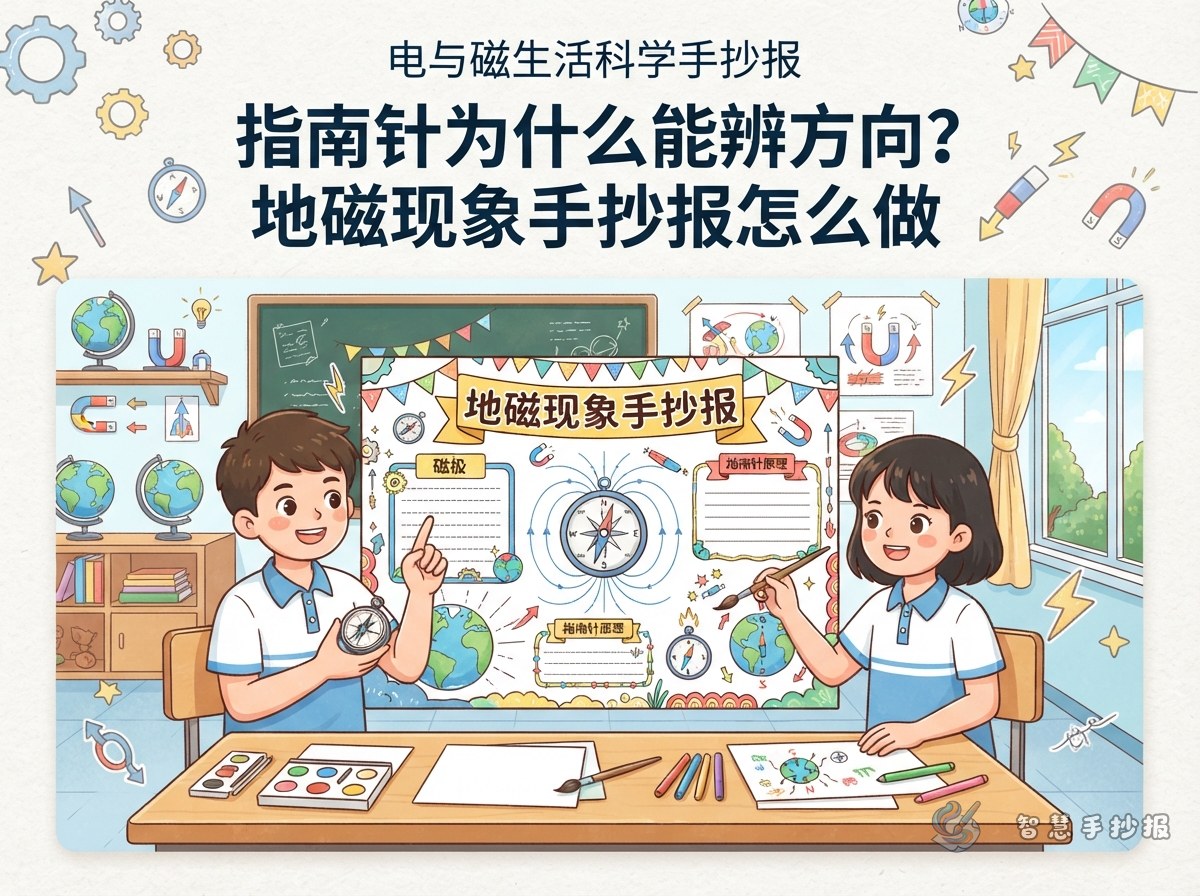
Build the handout around a large compass in the center. Add the four directions, footprints, mountains, and a winding path to create the feeling of a science expedition. A suitable title is Why Can a Compass Find Direction?, with the subtitle “Exploring Earth’s Magnetism in Everyday Life.”
Four Ideas That Explain the Science
- What is a compass? A compass contains a small magnetic needle that can turn freely. Earth’s magnetism makes it settle in an approximately north–south direction.
- Earth as a giant magnet: Earth has a magnetic field around it. Although we cannot see this field, the compass needle responds to it.
- Everyday uses: A compass can help people read maps, find directions while traveling, and observe routes outdoors.
- Why can the needle be disturbed? Magnets, iron objects, and some powered devices may affect the needle, so they should be kept away during use.
A Short Paragraph to Copy
A compass does not “know” where north is. Its small magnetic needle is affected by Earth’s magnetic field and turns until it is roughly aligned with that field. The direction marks on the compass then help us identify north, south, east, and west. This simple tool turns an invisible magnetic force into a direction we can observe.
Quick Question Corner
Question: Can a compass only be used outdoors? Answer: No. It can also be used at home or in the classroom to learn about maps and directions, as long as it is kept away from magnets and metal objects.
Turn the Layout into an Adventure Map
- Sketch the round compass in the center and add clear direction arrows.
- Place an “Earth’s Magnetism” section in the upper-left corner with a globe and curved field lines.
- Use the right side for “Compasses in Daily Life,” illustrated with a map, backpack, tent, or school route.
- Add a small observation section at the bottom describing how the compass direction may change near different objects.
- Use blue, green, and orange as the main colors. Highlight key conclusions with borders and leave enough space between lines.
Observation and Final Checks
If you include a simple observation, compare the compass on a desk, near a window, and near a metal object with adult supervision. Do not open the compass or keep a strong magnet close to the needle for a long time. Before finishing, check that the title stands out, the explanation is clear, and the direction labels are correct. You can also continue arranging the page in the 智慧手抄报 WeChat mini program.