Start with a Kitchen Mystery
An induction cooker is an excellent subject for a science poster because it turns invisible electricity and magnetism into heat that we can feel in a pan. Put this question at the center of the page: How can a pan get hot without a visible flame?
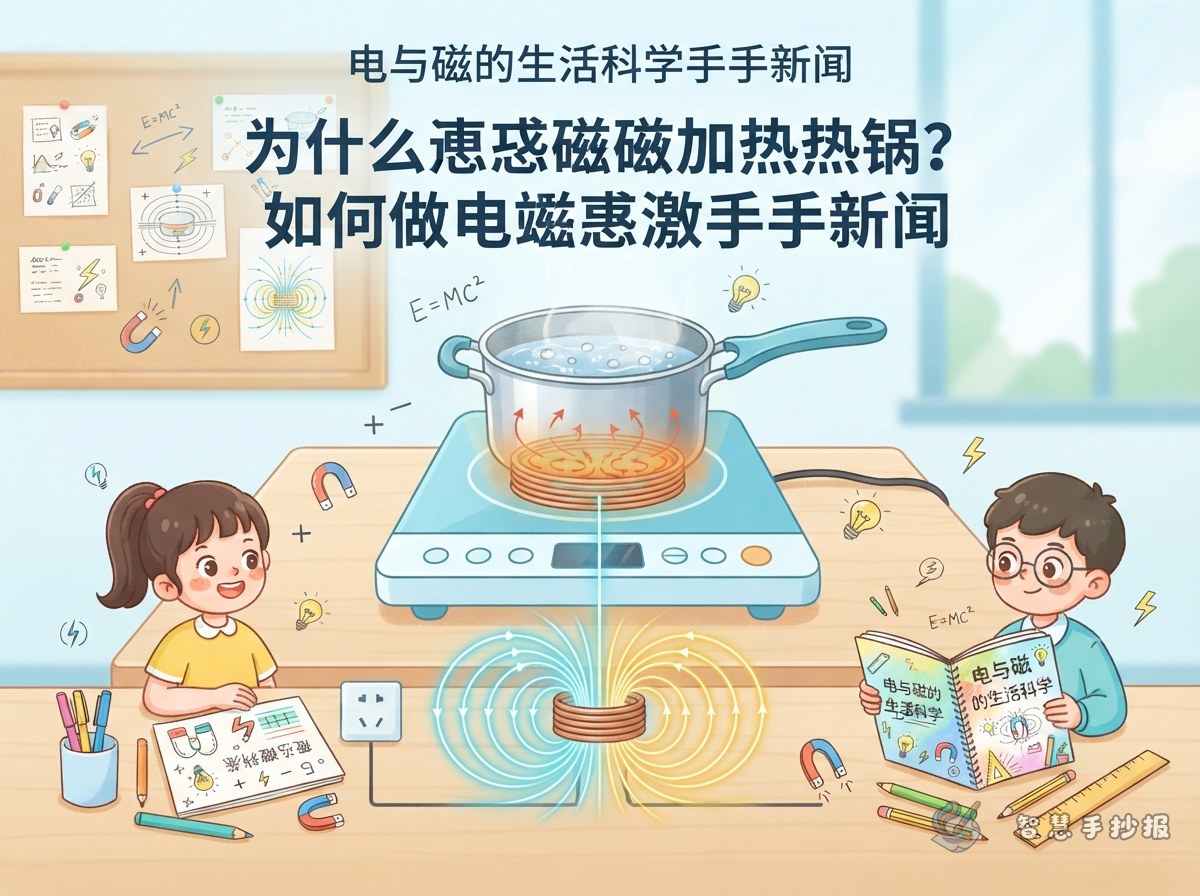
There is no need to fill the poster with difficult terms. Follow one clear chain: a coil creates a changing magnetic field, the pan bottom develops an induced current, and the metal changes electrical energy into heat. This helps readers connect electromagnetic induction with everyday life.
Draw the Invisible Process in Three Steps
- The coil receives electricity: A coil inside the cooker carries alternating current and creates a magnetic field that keeps changing.
- The pan bottom responds: When a suitable metal pan is placed on the surface, the changing magnetic field creates induced currents in the metal bottom. These circulating currents are called eddy currents.
- Electricity becomes heat: The metal resists the current, producing heat in the bottom of the pan. That heat then warms the water or food inside.
Use curved lines to show the changing magnetic field, circular arrows to show eddy currents, and rising heat lines to show the warming pan. Connected together, these three drawings become the main scientific explanation of the poster.
Text You Can Put on the Poster
A Quick Science Question
Question: Does an induction cooker heat food with a flame? Answer: No. It mainly uses electromagnetic induction between the coil and the metal pan, so the pan bottom heats up without the open flame seen on a gas stove.
The Principle in One Sentence
Alternating current creates a changing magnetic field, the pan bottom develops an induced current, and the resistance of the metal changes electrical energy into heat.
Everyday Observation
Pans are made from different materials and may have different bottom structures. Usually, only pans that meet the cooker's requirements, such as suitable iron or stainless-steel cookware, will heat properly. Check the instructions for both the cooker and the pan instead of judging by appearance alone.
Turn the Page into a Science Mystery Map
- At the top: Write “Why Does an Induction Cooker Heat a Pan?” and draw a small pan with steam rising from it.
- In the center: Draw the circular cooking surface and a cross-section of the pan bottom. Label the coil, changing magnetic field, induced current, and heat.
- On the left: Add a “Make a Guess” box with the question “Can a pan get hot without a flame?”
- On the right: Create a “Three Steps” section with three connected circles showing the scientific process.
- At the bottom: Add a “Safety Guide” box and a “What I Observed” box for reminders and conclusions.
Use orange to represent heat, blue for current and magnetic fields, and black to outline the cookware. Keep the text boxes limited and leave space around the arrows and diagrams so the page stays bright and easy to read.
Make Safety Part of the Science
Add a short set of practical reminders: do not open the cooker to inspect the coil; do not place unrelated metal objects such as coins or keys on a powered surface; use suitable cookware and keep its bottom dry; unplug the cooker before cleaning or moving it; and ask an adult to supervise children during observations.
For a safe observation activity, a child can ask an adult to help bring a small magnet near the bottoms of several pans and record whether each one is easily attracted or only weakly attracted. Add a note that actual compatibility must be checked in the product instructions. This is a static observation only: do not take the cooker apart or test an unfamiliar pan on a powered surface.
A Five-Point Final Check
- Does the title ask a clear question about everyday life?
- Does the drawing connect the coil, changing magnetic field, and induced current in the pan bottom?
- Does the text explain why the pan heats instead of only saying that the cooker is convenient?
- Have you included cookware guidance and electrical safety reminders?
- Is there enough white space, with the key information easy to find?
Once the central diagram and sections are planned, scan to enter the “智慧手抄报” WeChat mini program and continue arranging the layout, adding the text, and finishing your electricity-and-magnetism science poster.