How Lightning Forms: Two Key Words Are Enough
A handout does not need deep physics. Two words — friction and discharge — explain most of it. Water drops and ice crystals inside clouds rub against each other as they swirl, separating positive and negative charges. When enough charge builds up, the air breaks down and the charges balance in an instant. That flash is lightning, and the sudden heating and expansion of the air gives us thunder.
- Cloud friction → charges separate → air breaks down → lightning and thunder
- We see lightning before we hear thunder because light travels faster than sound
- Lightning is a discharge, not the sky being angry
Why Trees, Flagpoles, and Tall Buildings Get Chosen First
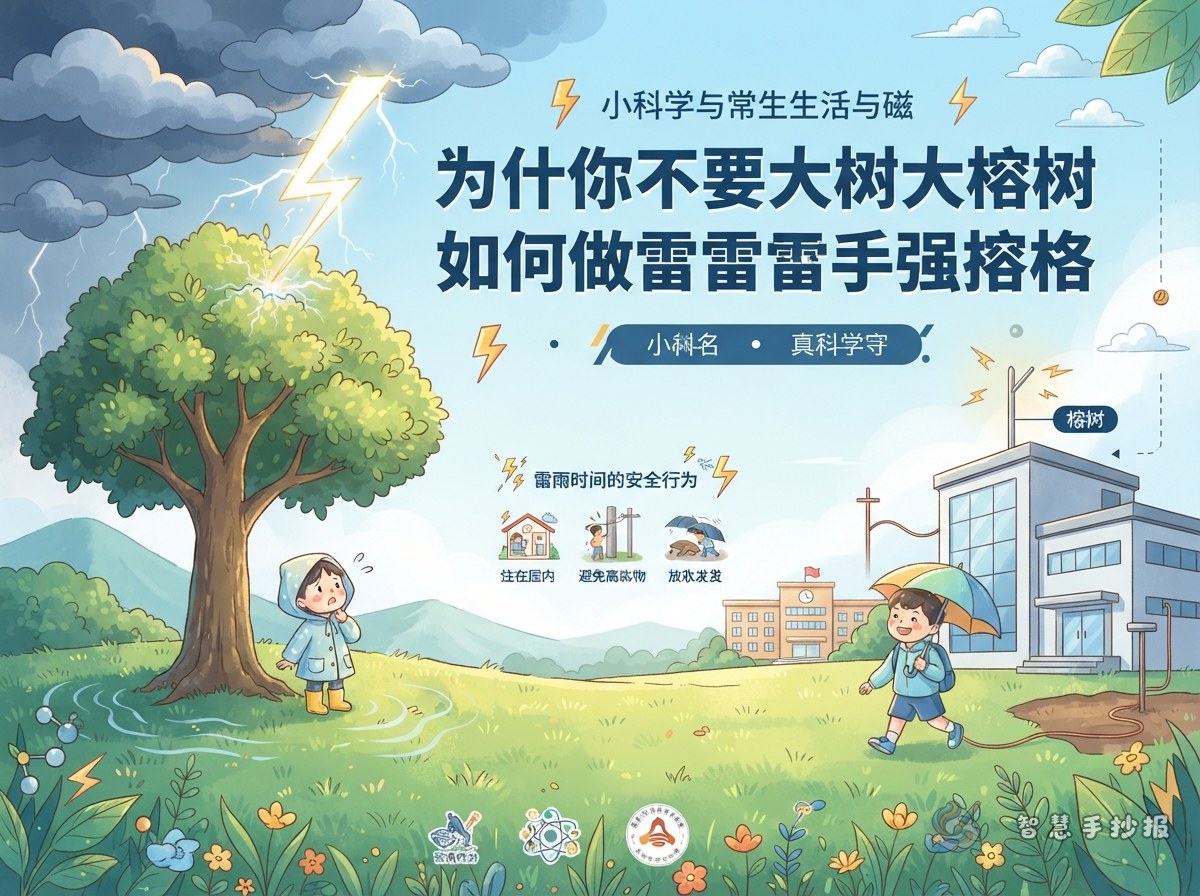
Lightning takes the shortest path. Tall objects on the ground are closer to charged clouds, and their pointed tips collect charge more easily, so trees, flagpoles, towers, and high buildings often become the path for the current. As the current travels down the tree or building, a voltage difference appears in the ground around it. Standing too close can be dangerous, and broken branches can fall as well.
For the handout, draw a simple comparison: a small figure crouching in an open field on one side, and a red cross under a tall tree on the other. One look explains the rule.
A Lightning Rod Does Not Block the Strike — It Leads It Down
Many students think a lightning rod stops lightning. Its real job is to guide the current into the earth. A complete system usually has three parts:
- Air terminal — the pointed metal rod on the roof that takes the strike first.
- Down conductor — the metal wire running down the outside wall.
- Grounding body — the metal part buried in the soil that spreads the current into the earth.
Number the three parts in your diagram, color them differently, and add one short sentence for each. This is easier to read than a long paragraph and makes a strong center piece for the page.
Safety Rules You Can Copy Onto the Handout
- Go indoors into a building with lightning protection as soon as thunder starts. Stay away from trees, utility poles, and billboards.
- If you are caught in the open, crouch down with your feet together to lower your height and reduce the risk from step voltage.
- Close windows and doors indoors, unplug unnecessary appliances, and keep away from water pipes and metal window frames.
- Do not use corded phones, do not take a shower, and do not shelter under a tree or eaves during a storm.
Layout Plan: Let a Lightning Bolt Split the Page
This theme suits a top-to-bottom design. Draw a long lightning bolt down the middle of the page. Put "how lightning forms" on the left and "the parts of a lightning rod" on the right. Leave the pointed top of the bolt for your big title. Use deep blue to purple for the stormy sky, and bright yellow for the bolt, the title, and the borders. Cloud-shaped or raindrop-shaped text boxes with white space inside are easy to write in.
- Title area: “Lightning and Lightning Rods” or “Thunder Is Here — What Should I Do?”
- Left column: how lightning forms, with a simple cloud discharge picture.
- Right column: the three parts of a lightning rod, numbered and labeled.
- Bottom strip: safety reminders in small numbered circles.
Short Sentences for the Text Boxes
“Lightning is a discharge in the clouds; the flash and the thunder happen almost at the same time.” “A lightning rod leads the current into the ground and protects the building.” “The safest place during a storm is inside a building, not under a tree.” These short lines work well as openers in small boxes. If you want more templates and layout styles, open Smart Handwritten Newspaper in WeChat Mini Program, choose an electricity-and-magnetism design, and fill in your text. You save time on drawing the grid and spend it on writing and decorating instead.