Start with a Tiny Kitchen Mystery
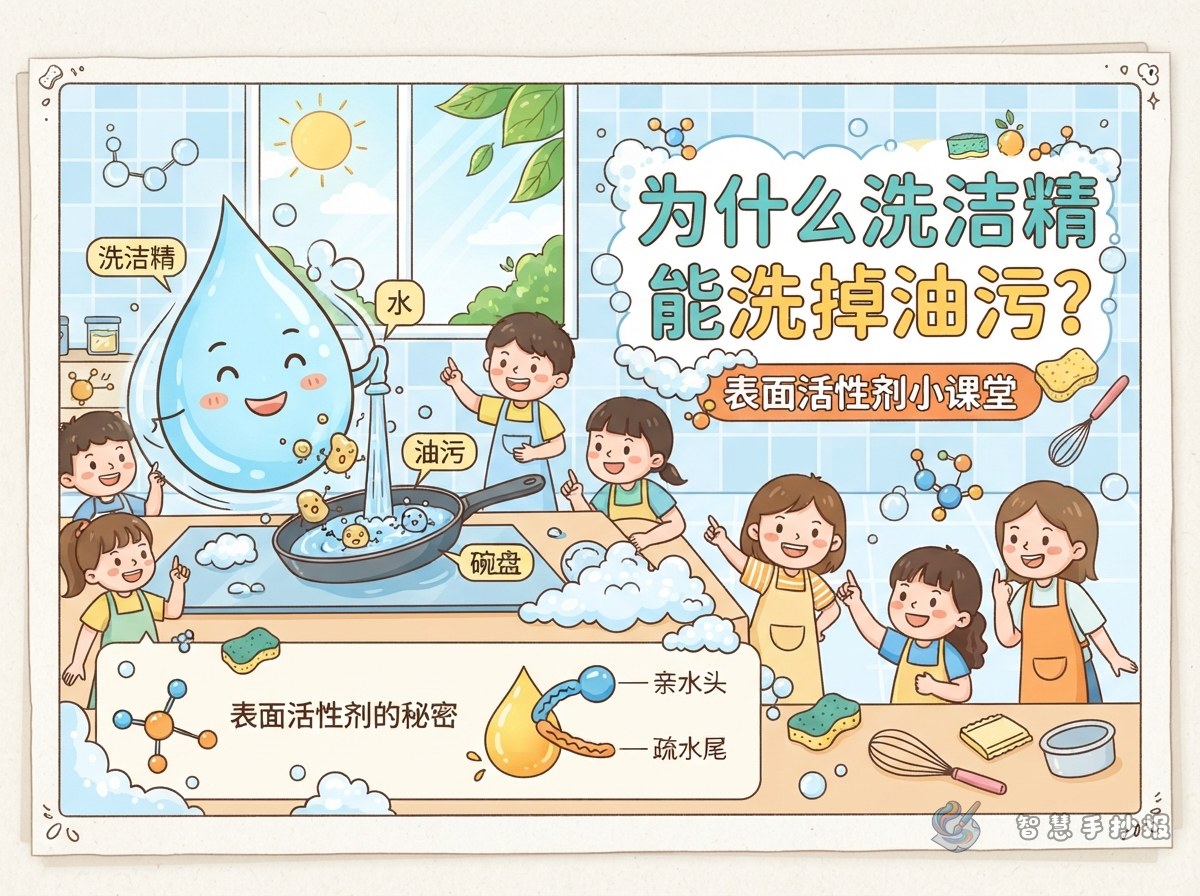
This handwritten newspaper can begin with a question children see in daily life: why does plain water struggle with grease on a plate, while a little dish soap makes it easier to wash away? Build the whole page around the story of oil and water, with surfactants acting as the helpful link between them.
Suggested headline: Why Can Dish Soap Remove Grease?
Opening text: Oil and water do not mix well. Surfactants in dish soap can approach both grease and water, helping the grease break into smaller droplets that can leave with the flowing water. A kitchen sink can be a small classroom for chemistry.
A strong central illustration
Draw a greasy plate in the middle of the page. On one side, show separate yellow oil drops and blue water drops; on the other, show soap bubbles and a stream of water. Connect three scenes with arrows: oil and water separate, soap surrounds the grease, and rinsing carries it away.
Turn an Invisible Process into Three Pictures
- Scene one: oil stays apart. Draw water drops and yellow grease drops moving away from one another. Add the caption “Oil and water do not mix evenly.”
- Scene two: two ends, two jobs. Draw surfactant molecules as tiny sticks or characters. Label one end “water-loving” and the other “oil-loving.” The oil-loving end points toward the grease while the water-loving end faces the water.
- Scene three: rinse it away. Show many small grease droplets moving along with the water. Add the key sentence: “Dish soap does not turn grease into water; it helps disperse the grease so water can carry it away.”
For a lively look, give the grease drops worried faces, the water drops blue smiles, and use a curved stream of water to connect all three scenes.
Four Short Sections to Fill the Page
- Everyday observation: Mention grease on bowls, pans, or lunch containers, then compare rinsing with water alone and washing with a small amount of dish soap. A useful sentence is: “We can see the grease, but we cannot see the molecular teamwork.”
- Mini chemistry dictionary: Explain surfactant in one sentence: it is a substance that helps water and oil interact more effectively and allows grease to disperse.
- Simple observation: With an adult nearby, put water and a little cooking oil in a clear cup. Observe the separate layer, then add one drop of dish soap and gently swirl. Record what changes without turning the activity into a complicated lab report.
- Safety corner: Dish soap is not for eating and should be kept away from the eyes. Use only a small amount, wash hands afterward, and never mix dish soap with other household cleaners.
Plan the Page Like a Moving Stream of Water
Try a landscape layout. Place the question-style headline across the top, the three-step illustration in the center, and the observation notes and safety corner along the bottom. Use pale blue for the background, yellow or orange for grease, and white or light green for soap bubbles. This color system makes the science easy to follow without making the page crowded.
Bubbles, plates, sponges, faucets, and water drops make useful decorations, but leave enough white space around the text. Put key words such as “water-loving,” “oil-loving,” “disperse,” and “rinse away” inside colored boxes so readers can find the main ideas quickly.
A Simple Finishing Checklist
- Sketch the headline, central picture, and four text areas with a pencil.
- Write the explanations and observations before adding decoration.
- Draw the plate, grease drops, bubbles, and arrows that show the process.
- Finish with consistent outlines and colors, keeping open space around the important points.
When you are ready to arrange the page, continue in the 智慧手抄报 WeChat mini program to organize these materials into a neat and cheerful chemistry handwritten newspaper.