Begin with the Question: Why Does Ice Float?
Use “Why can ice float on water?” as the opening question of the handwritten newspaper. When water freezes, its volume expands, and ice has a lower density than liquid water, so it stays on the surface. This everyday observation introduces children to changes in matter and the idea of density.
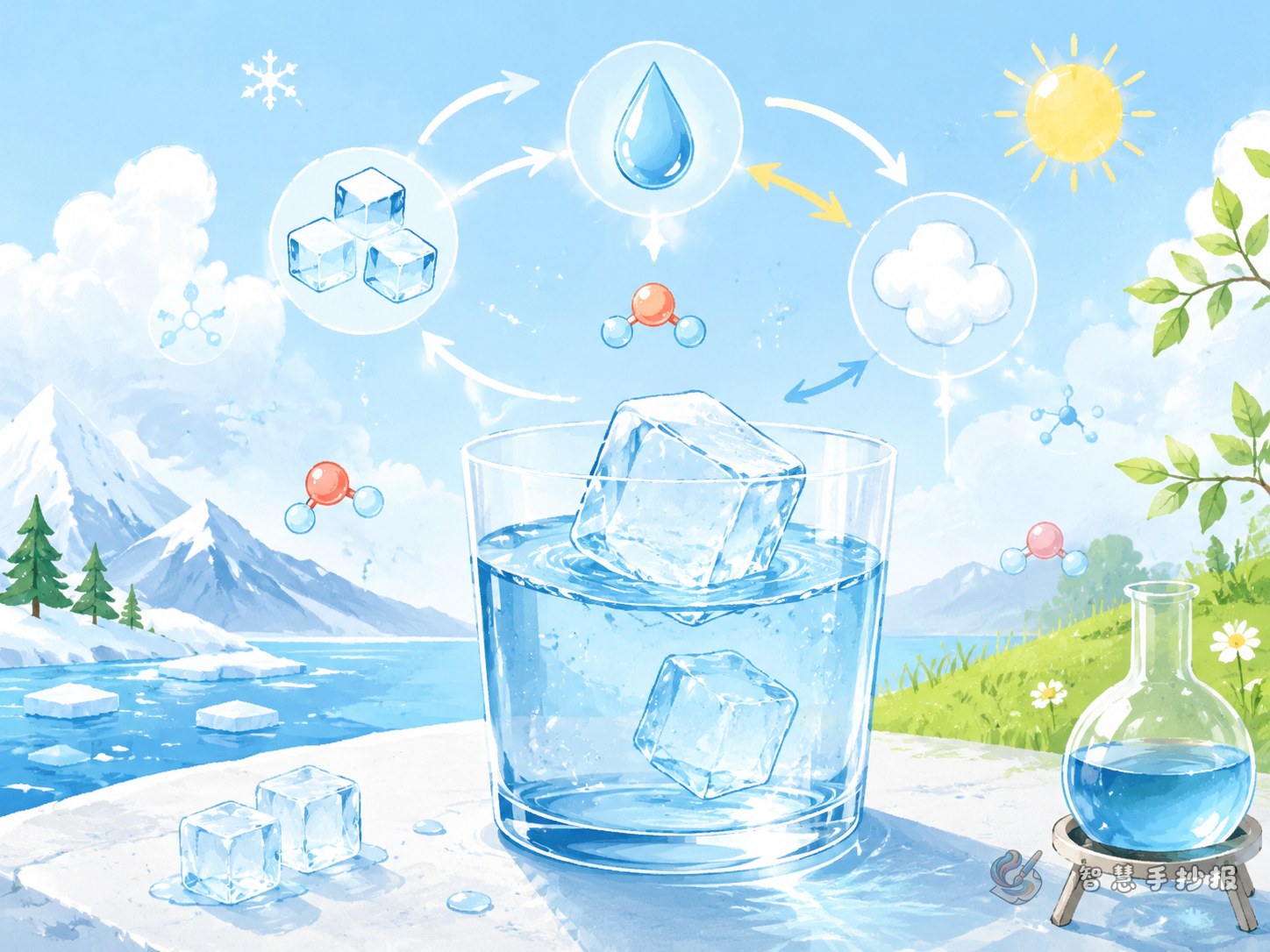
Draw a clear glass containing water and ice beside the opening text. Blue drops, white snowflakes, and small arrows can show the observation at a glance.
Turn the Three States of Water into a Journey
- Solid: Ice has a fairly fixed shape and volume, and it feels hard and cold.
- Liquid: Water can flow and takes the shape of its container while keeping a certain volume.
- Gas: When water is heated, it becomes water vapor. Vapor is usually invisible and can form droplets when cooled.
Create a cycle with “ice melts into water,” “water becomes vapor,” “vapor cools into droplets,” and “water freezes into ice.” Label the arrows with melting, evaporation, condensation, and freezing.
Everyday Observations to Add
Make a “Look Around” section featuring ice in a freezer, droplets on the outside of a cold cup, a foggy bathroom mirror, and clothes drying in the sun. These examples show how water changes state when temperature changes.
You can also include a simple observation with adult supervision: place an ice cube in a clear glass and watch it float, become smaller, and finally mix into the water. Record three moments—at the beginning, after a while, and after it has melted—and describe each change in a short sentence.
Design the Page Like a Small Water Cycle
Try a layout with the question at the top, a central illustration, and small knowledge cards below. Make the clear glass the visual focus. Put ice and snowflakes on the left, water drops and vapor on the right, and connect them with curved arrows to form a cycle.
- Use dark blue for the title to create a cool, scientific mood.
- Use pale blue and white for solids, lake blue for liquids, and light purple for gases.
- Keep each knowledge card to one or two sentences so the page does not feel crowded.
- Add “Observe everyday life and discover change” as a short footer message.
Check the Science Before Decorating
Make sure the key idea is clear: water expands when it freezes, and ice has a lower density than liquid water. Also distinguish water vapor from mist. Water vapor is usually invisible, while cooled droplets are easier to see. Add snowflakes, raindrops, a thermometer, and small clouds for a complete look. After planning the title, sections, and layout, you can continue making the page in the WeChat mini program “智慧手抄报”.