Turn the Four Seasons into Four Reading Zones
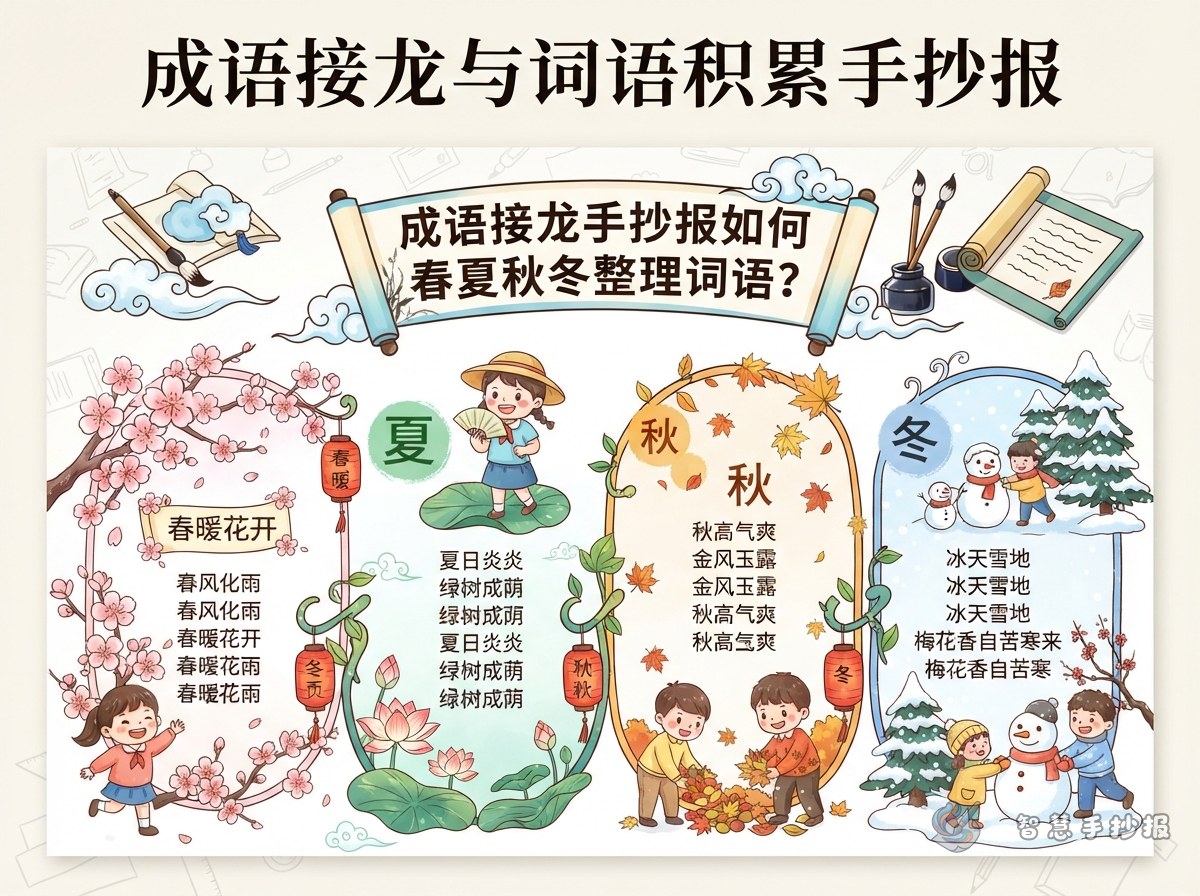
The four seasons provide a natural way to organize idioms and vocabulary because each one has its own scenery and colors. Divide the handwritten newspaper into spring, summer, autumn, and winter sections. Instead of forcing the entire page into one very long chain, let each section contain a short idiom chain of its own.
- Spring: Use idioms such as “春暖花开” and “花红柳绿,” with sprouts, flowers, and swallows.
- Summer: Use “骄阳似火” and “烈日炎炎,” with sunshine, lotus flowers, and cool waves.
- Autumn: Use “秋高气爽” and “硕果累累,” with leaves, fruit, and a harvest basket.
- Winter: Use “冰天雪地” and “白雪皑皑,” with snowflakes, scarves, and a small house.
Give Each Season Three Kinds of Vocabulary
To keep the page from becoming a simple list of idioms, give every season three small sections: seasonal words, a short chain, and my notes. For example, the spring section can show “春暖花开—开门见山—山清水秀,” followed by the meaning and a sentence for one selected idiom. The autumn section can use “秋高气爽—爽心悦目—目不转睛.” This shows the chain while also showing real understanding.
- Seasonal vocabulary: Choose three to five idioms or four-character expressions connected with the scene.
- Short chain: Connect two or three words with clear arrows.
- Learning note: Add a meaning, a related expression, or a sentence written in your own words.
Design Key Idioms as Vocabulary Cards
Important idioms can be presented as small cards. Write the idiom at the top, a short explanation in the middle, and a sentence about school life at the bottom. Add a small icon beside it. For example, “硕果累累” can be explained as having many valuable results or a rich harvest. A sentence might describe pumpkins and sunflowers recording the results of students’ work in an autumn school garden. Leave enough blank space around each card.
If the page feels crowded, choose only one key idiom from each season for a detailed explanation and arrange the remaining words as colorful labels. Readers can then see the seasonal groups first, follow the arrows to the chains, and read the meanings and examples afterward.
Use Seasonal Color Bands to Guide the Eye
A practical layout is a central title surrounded by four sections. Write “My Four-Season Idiom Vocabulary Book” in the middle, with spring, summer, autumn, and winter in the four corners. Use light green and pink for spring, blue and yellow for summer, orange and brown for autumn, and light blue and purple for winter. Branches, breeze lines, or falling leaves can connect the areas, but avoid heavy borders that cover the words.
- Make the main title large and add a subtitle such as “Link, learn, and discover something new in every season.”
- Point the chain arrows in a consistent direction so the reading order is easy to follow.
- Let illustrations explain the vocabulary and reserve a complete text area beside each drawing.
- Use black or dark blue for body text and seasonal colors only to highlight key idioms.
Check the Words Before Copying the Final Version
Before writing the final version, check each character and the order of every idiom. Make sure explanations are brief and sentences are smooth. Keep the four sections similar in size. If one area has too much empty space, add an “Other words I know” note instead of squeezing too much into another section. After the draft is ready, use the 智慧手抄报 WeChat Mini Program to continue adjusting the title, sections, and colors.