Build the poster around “observing the sky to tell time”
Guo Shoujing was a famous astronomer, hydraulic engineer, and mathematician of the Yuan Dynasty. For this handwritten newspaper, use “how Guo Shoujing observed the sky” as the main thread connecting the person, his instruments, and his achievements. This keeps the page focused on science and avoids turning it into a plain biography.
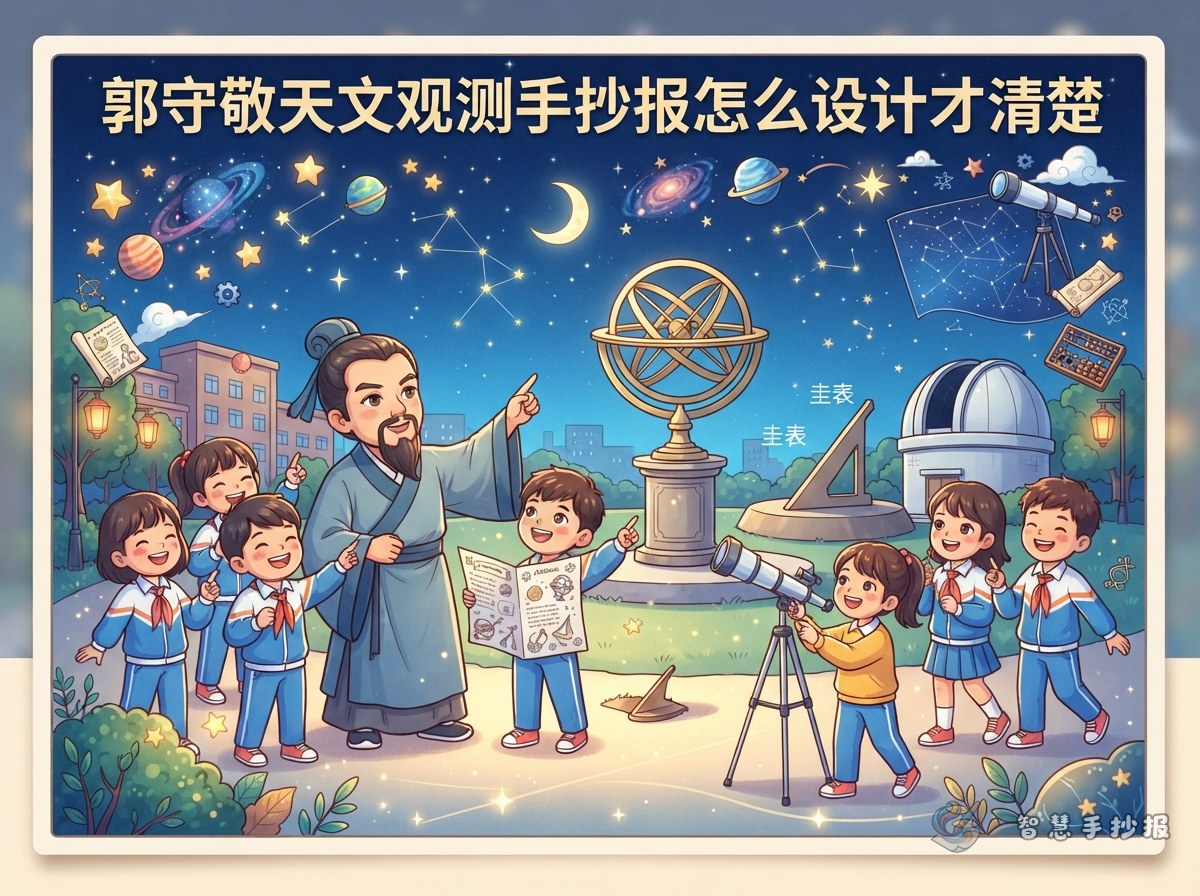
Place the title “Guo Shoujing: Measuring the Sky More Clearly” in the center or at the top. Add a short introduction explaining that Guo improved and developed astronomical instruments, carried out extensive observations, and provided important support for the creation of the Shoushi Calendar. His story shows the value of observation, measurement, and practical exploration.
Use three sections to explain his contribution
- Quick profile: Introduce Guo Shoujing as a Yuan Dynasty scholar who worked in astronomy, hydraulic engineering, and mathematics, combining practical observation with calculation.
- Observation instruments: Present the simple armillary sphere, known as the Jianyi, and the Yangyi. Explain that such instruments helped measure the positions and heights of celestial bodies.
- Calendar achievement: Focus on the Shoushi Calendar. Show the process with arrows: “observation—calculation—calendar making.”
Keep each section to two or three sentences. For young students, the sequence “finding a problem, making tools, observing for a long time, and producing a result” is clearer than a long list of difficult terms.
Ready-to-copy writing material
About the person: Guo Shoujing studied science through practical problems. He valued accurate observation and improved instruments, combining astronomical knowledge with mathematical calculation.
Scientific method: Ancient astronomers did not have modern electronic equipment, but they could still record the sky with carefully designed instruments. Guo Shoujing’s work shows that careful observation, accurate measurement, and repeated checking are important ways to understand nature.
Main message: Guo Shoujing represents a spirit of truth-seeking, practice, and innovation. The closing line can be: “Look up at the stars, but keep your feet on the ground; find a question, then test it with your hands.”
Make the instrument drawing the visual focus
Try a layout with the title at the top, an instrument sketch in the middle, and text sections below. Draw a simplified ring-shaped instrument with different line weights for the circles, marks, and viewing direction. Add short labels such as “measuring the position of a celestial body” and “supporting observation.” A simplified drawing is enough; the key is to make its connection with sky observation obvious.
Use deep blue, indigo, or dark green for the night sky, with yellow stars and light-colored borders. Put the main text inside white or pale yellow boxes so the page remains easy to read. Orange, red, or gold can highlight headings and key words, creating a traditional yet lively science theme.
Check the content before finishing
- Make sure the title clearly connects Guo Shoujing, astronomical observation, and the handwritten newspaper theme.
- Check that the page includes the person, instruments, Shoushi Calendar, and scientific spirit.
- Give each text box one clear idea instead of squeezing a long paragraph into it.
- Leave enough space around the instrument, arrows, and headings before adding stars, scale marks, and borders.
For help organizing sections, adjusting colors, and completing the layout, continue making the page in the WeChat mini program Zhihui Shouchaobao, then copy the finished content onto paper.