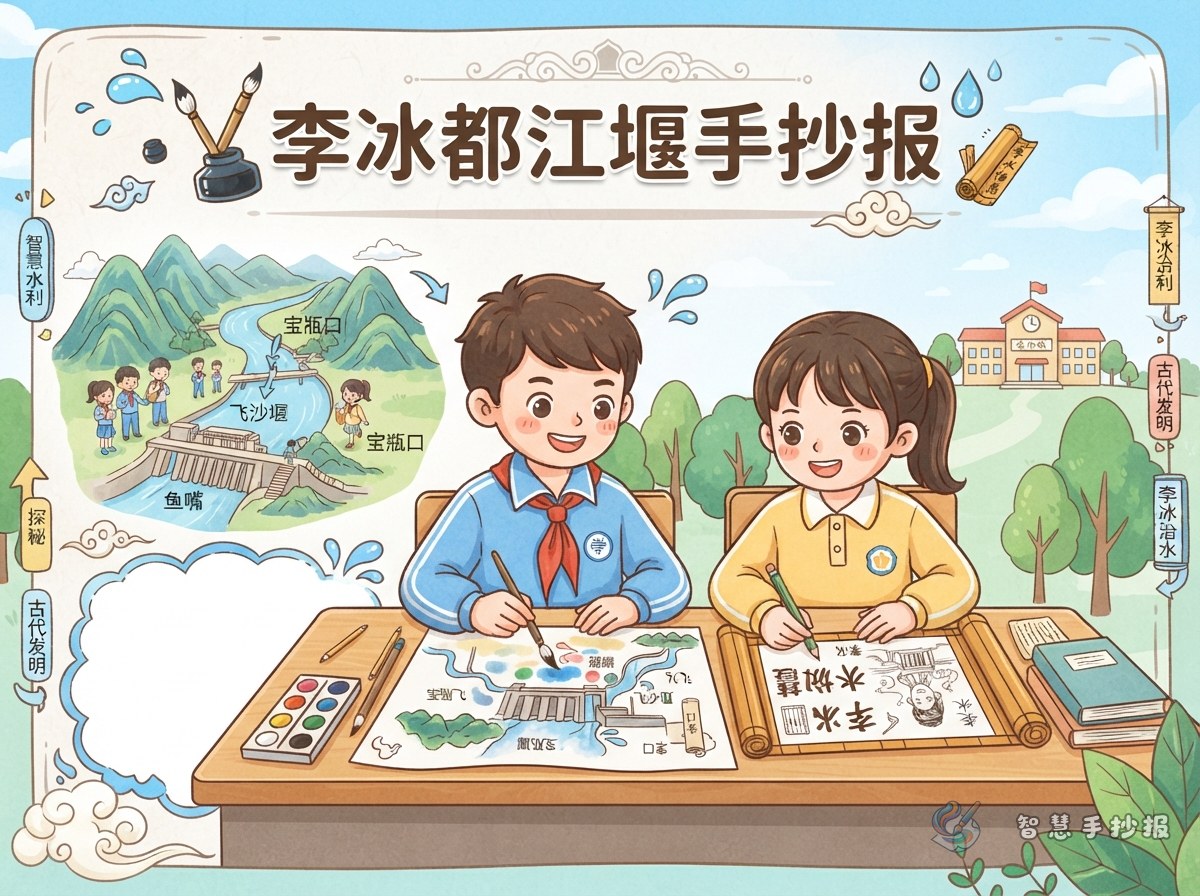
Turn the Dujiangyan Project into a Visual Story
Build the poster around one clear idea: how Li Bing worked with the natural flow of the Min River. Instead of filling the page with biography, draw the river across the sheet and connect the Fish Mouth Levee, Flying Sand Weir, and Bottle-Neck Channel with arrows.
Useful sections include “Who Was Li Bing?”, “Three Key Structures,” “Managing Water Without a Dam,” and “Lessons from an Ancient Project.” This combination keeps the focus on both the historical figure and the engineering ideas.
Background Text for the Poster
During the Warring States period, Li Bing, governor of the Qin state’s Shu Commandery, directed the construction of the Dujiangyan irrigation system. He and the local workers responded to flooding and irrigation problems by using the land and the river’s natural movement to divide water, remove sediment, and guide water toward farmland. The project demonstrates careful observation, practical design, and the importance of long-term maintenance.
Explain the Three Main Structures
- Fish Mouth Levee: This divide splits the river into inner and outer channels, helping balance irrigation and flood discharge.
- Flying Sand Weir: It helps release excess floodwater and sediment, reducing the risk of buildup in the inner channel.
- Bottle-Neck Channel: This narrow passage controls the water entering the Chengdu Plain.
Add a simple diagram beside these notes. Use blue for water, yellow for sediment, and green for fields. Clear arrows are more useful than complicated drawings.
Short Lines You Can Copy
- Dujiangyan shows the wisdom of guiding water according to natural conditions.
- Li Bing did not simply block the river; he managed it through diversion, sediment control, and irrigation.
- A great engineering project needs both an ingenious design and continuous care.
- Dujiangyan combined flood control, irrigation, and local geography in one remarkable system.
Plan a River-Shaped Layout
Try a horizontal layout with Li Bing’s profile in the upper left, a river diagram in the center, and explanations on the right. Decorate the borders with waves, rice stalks, stone patterns, or bamboo-slip shapes.
Divide the writing into four to six neat blocks and keep each paragraph short. Blue, turquoise, and pale yellow work well as the main colors, while dark blue or orange can highlight key terms. After organizing the material, students and parents can use the 智慧手抄报 WeChat Mini Program to choose a layout, adjust the sections, and continue making the poster.