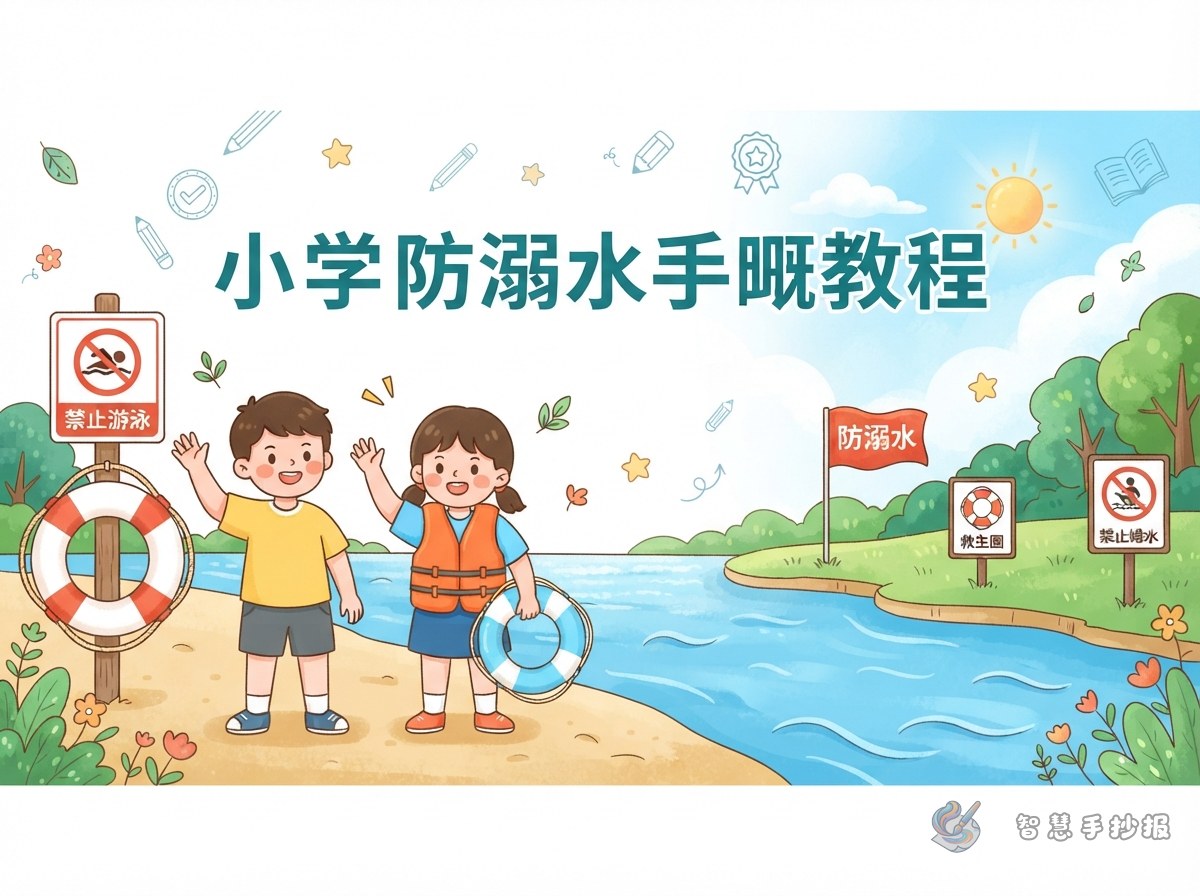
Choose One Main Picture That Communicates Safety
A water safety poster does not need complicated artwork. The goal is to make the subject clear at first glance. Place a large orange-red lifebuoy beside the title, then add a few short wave lines and a triangular warning sign. Keep the main picture to about one quarter of the page so there is enough room for safety information.
Possible titles include “Stay Safe Around Water,” “Prevent Drowning,” and “Safe Swimming Starts with Me.” Use thick, readable letters in blue with a light outline to connect the heading with the water theme.
Draw the Lifebuoy and Life Jacket Step by Step
Simple lifebuoy
- Draw a large horizontal oval, then add a smaller oval inside it to form a ring.
- Divide the ring into four sections and color alternating parts orange-red.
- Add a thin rope around the outside and use short curved lines for the knots.
- Draw two or three loose wave lines underneath instead of coloring the entire water area dark blue.
Simple life jacket
- Draw two rounded vertical panels and leave an opening for the neck.
- Add two horizontal buckles in the center and widen the lower edges slightly.
- Color the jacket orange or yellow, then use dark blue for the outline and buckles.
Turn Small Icons into Section Labels
Small drawings can organize information instead of merely filling space. Put a warning sign beside Stay Away from Dangerous Water, a whistle beside Call for Help First, and a life jacket beside Swim with Adult Supervision. Matching each icon to a message makes the poster easier to understand.
- Safety reminder: Do not play alone near rivers, ponds, reservoirs, or pools.
- Swimming preparation: Choose a safe place and stay with a responsible adult.
- Emergency response: If someone falls into water, shout for help and find an adult instead of entering the water yourself.
- Important rule: Do not run, push, or cross warning barriers near water.
Add Short Messages Students Can Copy
“Beautiful water can still be dangerous, so put safety first.”
“Stay away from unfamiliar water and never take a risky shortcut.”
“If a friend falls in, call for help and find an adult.”
“Follow swimming rules and use proper safety equipment.”
These lines can go under the title, at the end of a section, or inside a warning box. A tiny water-drop doodle can accompany each line, but avoid repeating too many icons in one area.
Build a Clean Layout with Blue and Orange
Divide the page into a narrow left column and a wider right section. Place the lifebuoy and a short safety checklist on the left. Use the right side for two larger sections about swimming preparation and emergency response. Add a pale blue wave border and rounded boxes, then highlight key words in orange-red.
Sketch the title, main illustration, and content boxes in pencil first. Add the text next, then outline and color the artwork. Leave open space around each illustration to keep the poster bright and readable. To adjust the sections, text length, or page arrangement, follow the page prompt and scan the code to continue creating in the 智慧手抄报 WeChat Mini Program.