Choose One Clear Angle First
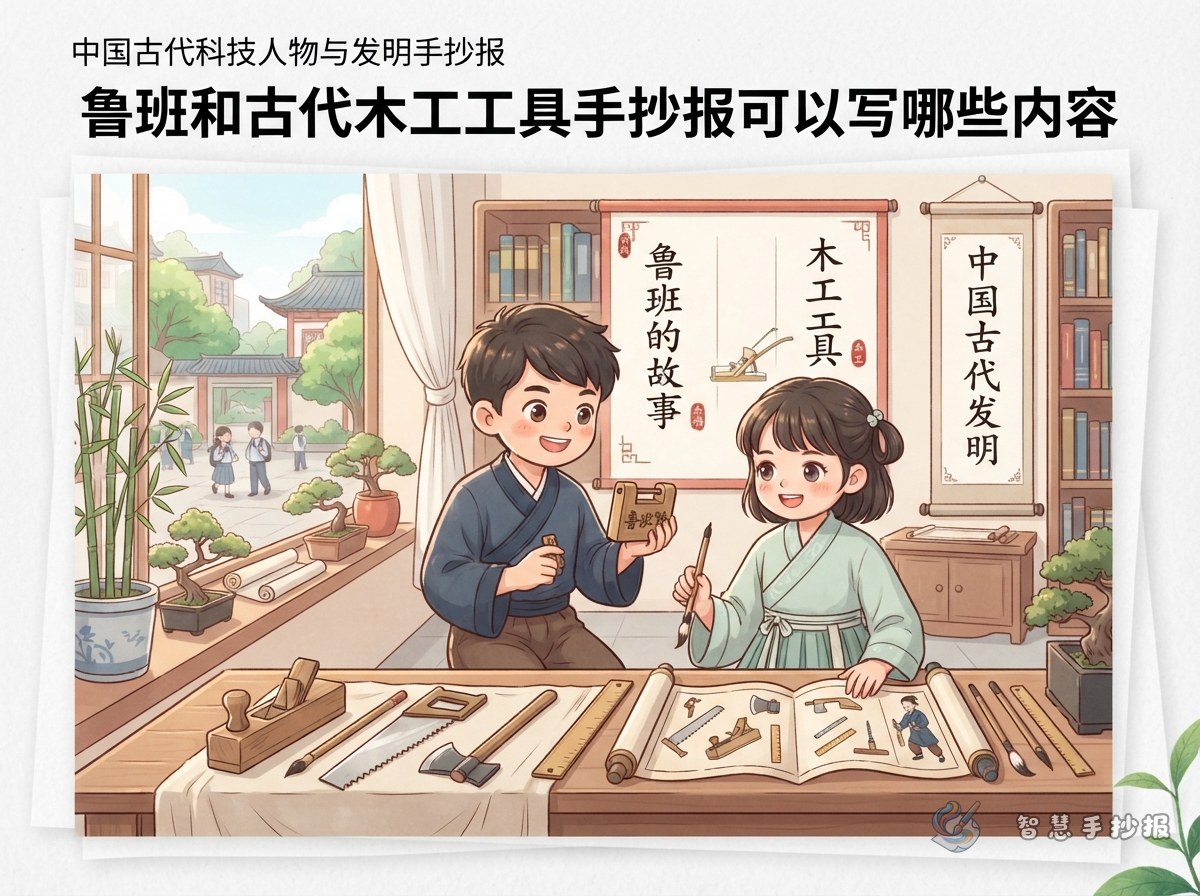
Many people in ancient China worked with technology, but Lu Ban stands out because he is linked with tools. Instead of writing only “Lu Ban is the founder of carpentry”, narrow the theme to Lu Ban and the invention of ancient woodworking tools. Then the whole page has a single thread: one person, a group of tools and a hands-on spirit.
A good storyline for primary school students starts with a question: how did a tree trunk become furniture or a house? From there, look at the tools people used for cutting, marking, measuring, drilling and joining.
A Short Character Card That Says Enough
The character card is the easiest part to write and often the first thing readers notice. Put it in the top left corner or under the title, and frame it with a simple box.
- Name: Lu Ban, originally known as Gongshu Ban, from the state of Lu in the late Spring and Autumn period.
- Role: a famous ancient craftsman and inventor, honoured later as the founder of carpentry.
- Key words: woodworking tools, mortise and tenon, showing off before an expert, always improving.
If there is space, add one line such as “his skill came from watching closely and trying again and again”, which leads nicely into the invention stories.
Invention Stories: The Saw, the Ink Line and the Square
The story section does not need to be long. A hundred words that follow “what problem appeared, what idea came up, what tool was made” is enough.
The legend of the saw
It is said that while climbing a mountain Lu Ban cut his hand on a leaf with tiny teeth. He looked closely at the edge, thought of using a toothed iron strip to cut wood, and the saw was born. A small drawing of a leaf beside a saw makes this paragraph easy to understand.
The ink line and the square
The ink line snaps a long, straight mark on wood, while the square checks and draws right angles. Together they make woodworking more accurate. You can describe them this way: without them, the edges would not be straight and the corners would not be square.
Mortise and tenon joints
A mortise and tenon joint holds two pieces of wood together without nails, and it gives ancient carpentry a strong technical feel. It suits a small knowledge box, explaining that the part sticking out is the tenon and the part cut in is the mortise.
Build a Mini Tool Gallery
Pick three to five tools and turn them into small cards. Each card gets one simple sketch and one sentence about its use, which is easier to read than a long block of text.
- Saw: cuts wood; the finer the teeth, the smoother the cut.
- Plane: flattens and smooths the surface of wood.
- Chisel: cuts holes and grooves in wood.
- Ink line: marks a long, straight line so the wood can be measured accurately.
- Square: checks and draws right angles.
- Lu Ban lock: a puzzle made of wooden pieces that shows the idea of mortise and tenon joints.
Add Some Language Flavour
A few idioms and sayings make the page feel like a real newspaper rather than a pile of facts.
- Showing off before an expert: displaying skills in front of someone far more skilled.
- Original craftsmanship: describing clever thinking and fine handwork.
- Always striving for better: not stopping when something is good enough, which fits the spirit of a craftsman.
You can also add a personal sentence, for example “Lu Ban did not become a master in one day; he practised each time he worked with wood”.
Layout Ideas with a Woodworking Feel
- Border: run a saw-tooth pattern around the whole page; it is simple and eye-catching.
- Background: use a light wood or cream colour, then set the title area in dark brown or deep green.
- Title lettering: draw block letters with a carved wood look and add short wood-grain lines along the edges.
- Sections: place one large tool drawing in the centre and arrange the character, story, tool gallery and idiom blocks around it.
- Decorations: add wood shavings, small sawdust dots and tiny joint squares, but leave enough blank space for writing.
If you want the columns to line up and the border to look neat, open the WeChat mini program “智慧手抄报”, choose an ancient technology template, arrange the text and layout first, and then copy the design onto paper.