Start with a clear idea: a moving magnet makes the page more interesting
A magnet experiment poster works best when it is built around simple questions such as “Why can a magnet pick up paper clips?” “Can it still work through paper?” and “Which objects are attracted to a magnet?” Instead of listing facts only, it is better to show the process of discovery. That makes the poster feel like real science exploration.
You can open with one or two simple lines: A magnet may look quiet and ordinary, but it can move small objects, help us sort materials, and show us an invisible force.
Good section ideas for a student poster
- Experiment goal: Learn which objects a magnet can attract and observe simple magnetic effects.
- Materials: A bar magnet, paper clips, nails, coins, an eraser, wood pieces, paper, and a small plastic spoon.
- Steps: Move the magnet close to different objects and record whether each one is attracted or not. Then try picking up a paper clip through a sheet of paper.
- What I discovered: Not every metal is attracted to a magnet. Objects that contain iron are more likely to stick. Magnetic force can sometimes work through thin paper.
- Safety note: Keep magnets away from electronic devices and from small items that need careful storage.
Short writing materials students can use directly
The most interesting part of a magnet poster is putting your prediction next to your result. You can write a line like this: “At first I thought all metal objects would stick to the magnet, but my experiment showed that this was not true.” That sounds natural and scientific at the same time.
You can also add short observation sentences: The ends of a magnet often attract small objects more strongly. A paper clip may still move through a thin sheet of paper. Light iron objects are easier to observe in the experiment. Keep each paragraph short so the poster stays neat.
How to design the layout so it looks like a science record
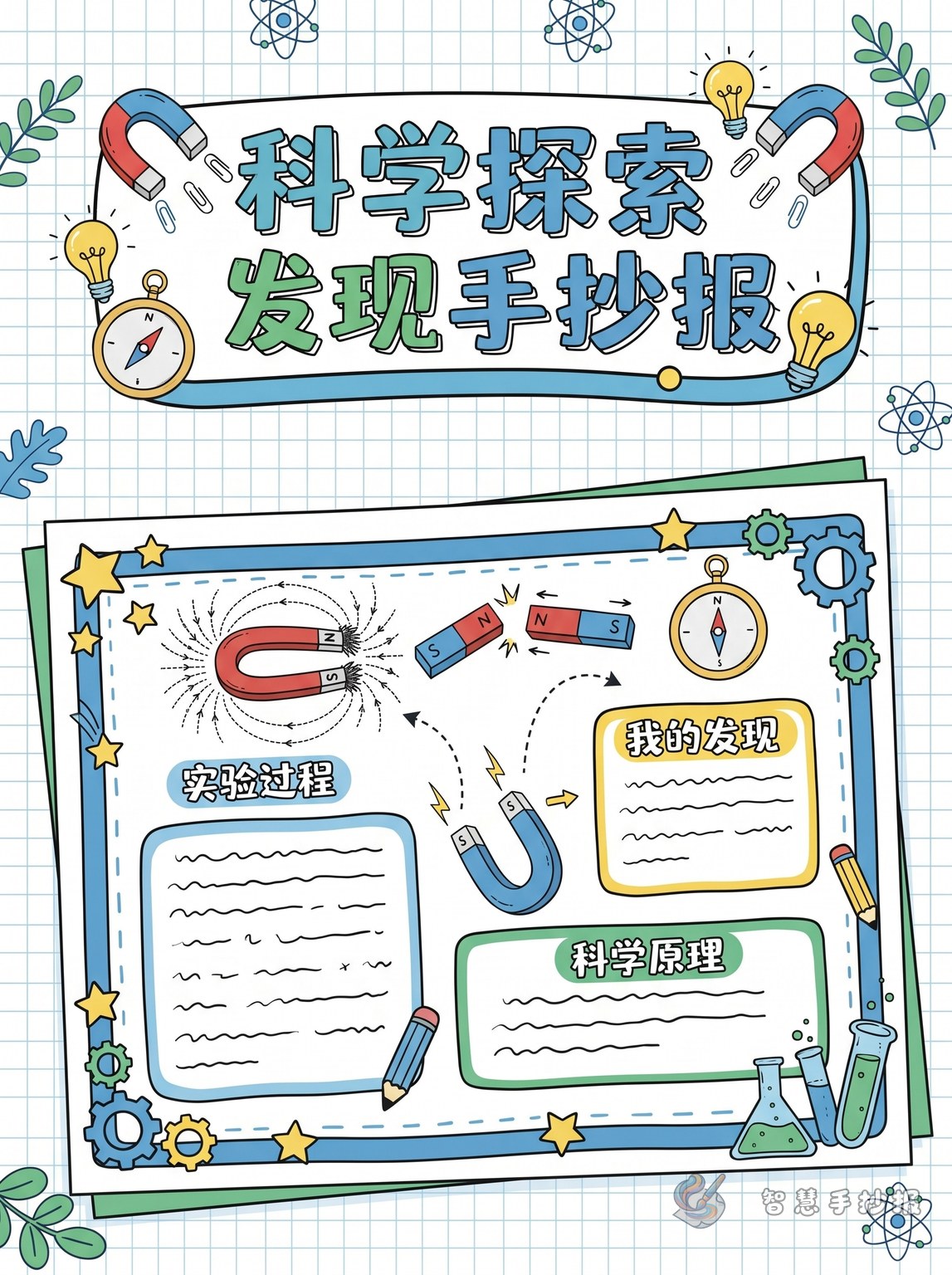
A good layout is to divide the page into four areas: question, experiment, results, and conclusion. The title can be lively, such as “Why Is a Magnet So Amazing?” Put the experiment steps in the center, place materials and discoveries on the sides, and write the conclusion at the bottom.
For colors, blue, green, and orange create a bright science theme. Small decorations like paper clips, magnets, arrows, and stars make the page lively without making it crowded. If you want to continue polishing the layout and adjusting the text, you can also use the Zhihui Shouchaobao WeChat mini program to keep making your poster.
A simple ending that completes the poster
The ending does not need to be long. You can finish with “What I learned.” For example: Through this magnet experiment, I learned that scientific discovery begins with observing, comparing, and recording. Many interesting science ideas can be found in everyday objects.
This kind of ending matches the theme of science exploration and makes the whole poster feel like a student’s own learning result.