Start with a clear idea: turn a rainbow into a science story
A rainbow experiment poster works best when it explains light dispersion in a simple way. The theme can focus on questions like “How is a rainbow formed?” “How can I make a rainbow experiment?” or “Why does white light split into many colors?” This makes the page feel both scientific and friendly for children.
You do not need a long introduction. A short opening is enough: sunlight looks white, but when it passes through water droplets, a prism, or a clear container, it can separate into different colors. That is one of the main reasons we see a rainbow.
Useful sections to place on the page
1. Simple rainbow facts
- Sunlight is made of many colors, not just one.
- When light enters water, it bends. This is called refraction.
- Different colors bend by different amounts, so they spread out.
- You can list the colors as red, orange, yellow, green, blue, indigo, and violet.
2. An easy home experiment
- Prepare a glass of water, a small mirror, and sunlight or a flashlight.
- Place the mirror at an angle in the water.
- Shine light onto the mirror and reflect it onto white paper or a wall.
- Watch for a colored light band and record what you see.
This section looks great as a step box or an observation box, making the poster feel like a real science inquiry project.
3. What I discovered
- Steady light makes the colors easier to see.
- A white background helps the rainbow stand out.
- Changing the angle changes the position of the rainbow.
- Always stay safe and never look directly at strong light.
How to write text that fits a school poster
Use short, clear sentences instead of textbook language. For example: “I learned that white light is made of many colors.” “A rainbow is not magic. It is a result of light and water working together.” These lines sound scientific but still feel child-friendly.
You can also add a closing thought such as: “Science begins when we observe nature and then test our ideas with experiments.” This kind of sentence fits well at the end of the page.
A layout idea that looks lively and neat
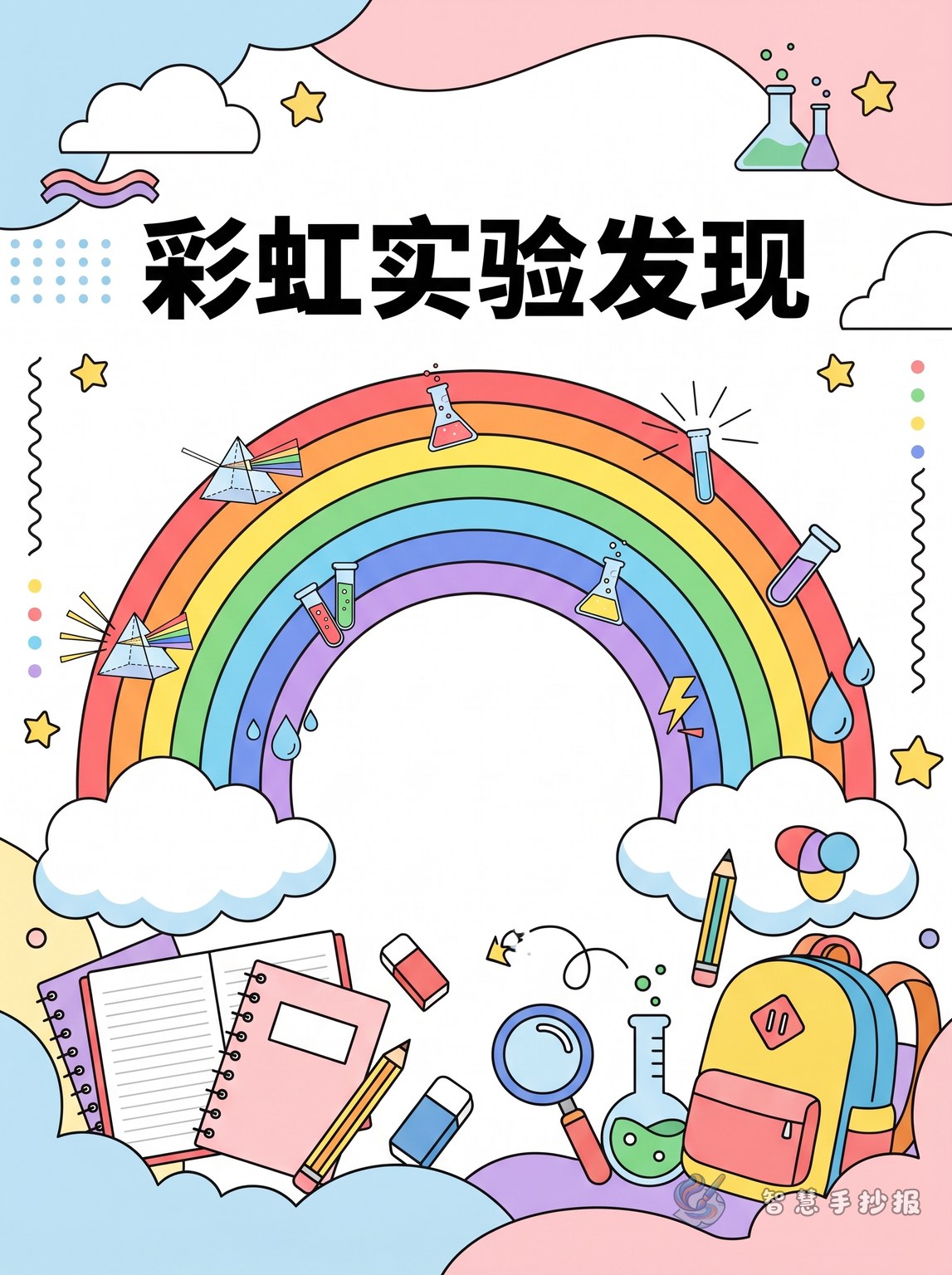
This theme works very well with a curved rainbow layout. Put the main title at the top, draw a rainbow across the page, and divide the content into two parts: one side for the science idea, the other side for the experiment and results. Leave a small area at the bottom for “What I learned.”
- Use light blue, yellow, and rainbow colors for a bright feeling.
- Decorate with clouds, raindrops, sunshine, or prism shapes.
- Keep subheadings short so the page stays tidy.
- Leave some blank space so the poster does not look crowded.
A ready-to-use ending
Through this rainbow experiment, I learned that beautiful natural sights have science behind them. By observing carefully and trying simple experiments, we can discover more secrets in daily life. If you want to keep improving the layout, colors, and decorations, you can also continue making your poster in the WeChat mini program by Zhihui Shouchaobao.