Build the theme around an ancient acupuncture map
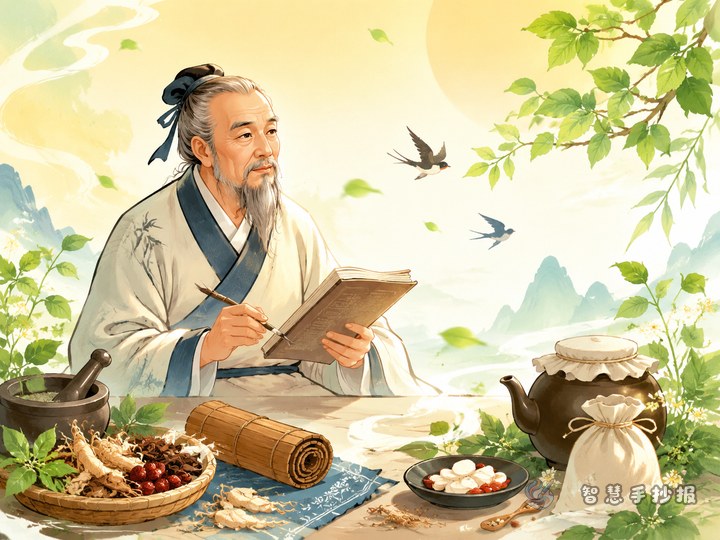
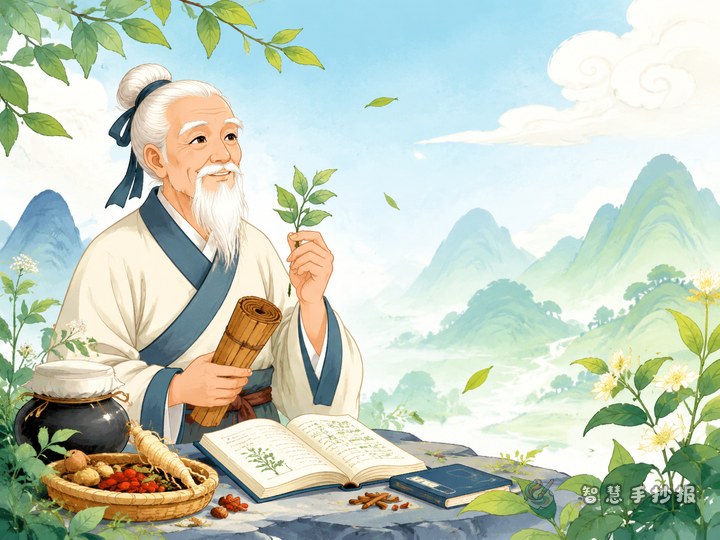
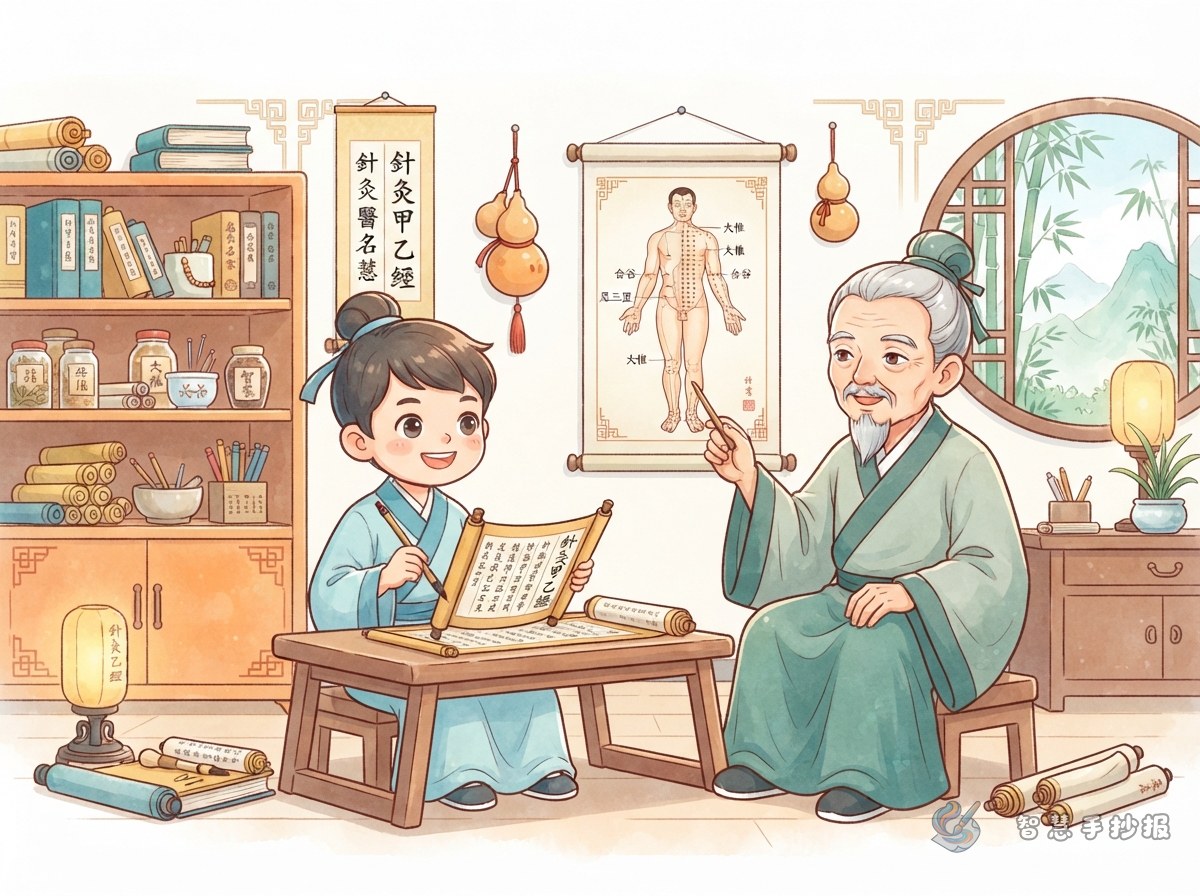
This handwritten newspaper does not need to present Huangfu Mi as a distant historical figure. Instead, it can explore how people in ancient China observed the body and thought about health. Use Huangfu Mi and the Yellow Emperor’s Classic of Acupuncture and Moxibustion as the main title, with “Exploring traditional acupuncture culture through an ancient medical text” as a subtitle. Draw an open book in the center and connect it to simple meridian lines, a stylized acupuncture tool, and study labels.
Huangfu Mi was an important medical scholar of the Wei and Jin period. The Jia Yi Jing is a representative ancient work on acupuncture and moxibustion. The poster can emphasize his effort to organize medical knowledge and record information about acupuncture points without filling the page with difficult terms.
Introduce the person and the book with three cards
Character card: Who was Huangfu Mi?
You may write: Huangfu Mi lived during the Wei and Jin period and devoted himself to studying and organizing medical knowledge. By arranging ideas about acupuncture in a more systematic form, he left valuable material for later generations.
Book card: What does the Jia Yi Jing discuss?
You may write: The book covers meridians, acupuncture points, acupuncture methods, and related medical conditions. It is useful for understanding the structure of ancient acupuncture knowledge. For a primary-school poster, it is enough to explain that the book recorded acupuncture points and related medical culture.
Wisdom card: Organization makes knowledge clearer
You may write: Huangfu Mi’s story shows that learning is not only about memorizing conclusions. It also involves classifying information, organizing notes, and checking ideas carefully. This message connects ancient medicine with everyday study habits.
Turn acupuncture points into cultural symbols, not a treatment chart
Draw a simple human outline and place decorative dots near the shoulder, hand, or foot. Connect the dots with dotted lines to words such as “observation,” “recording,” and “curiosity.” To keep the poster suitable for school, show the ancient habit of observing and recording knowledge rather than presenting treatment instructions. Do not treat the illustration as a guide for acupuncture.
- Book elements: bamboo slips, a thread-bound book, a brush, and an inkstone.
- Medical elements: acupuncture-point dots, flowing lines, and an ancient physician’s desk.
- Learning elements: a magnifying glass, sorting cards, and question bubbles.
Use four sections to create a real feature poster
- Short biography: Introduce Huangfu Mi’s period and contribution in three or four sentences.
- Decoding the book: Explain the title, main subjects, and why the work is worth learning about.
- Questions and answers: Ask questions such as “Why did ancient scholars record acupuncture points?” and “Why is organizing medical texts useful?” Then answer them briefly.
- Lessons for today: Write messages such as “Respect knowledge,” “Keep careful records,” and “Ask a professional about health concerns.”
Choose calm colors for an antique book atmosphere
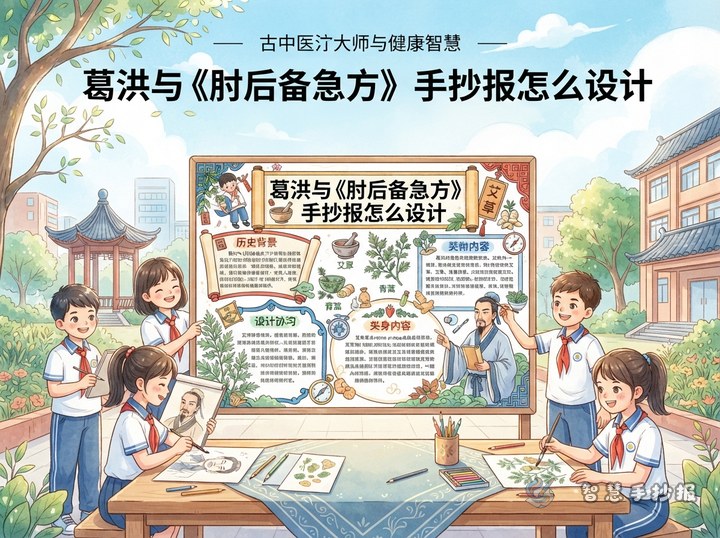
Try ivory, light brown, blue-green, and vermilion to suggest paper, bamboo slips, and seals. Use dark brown for the title, divide the writing into clear sections, and highlight key words with small color blocks. Keep the border light so the book illustration and character cards remain the visual focus.
First sketch the central book and four sections in pencil. Then copy the text neatly and add lines, seal patterns, and small decorative details. If you want to try different layouts, you can continue in the WeChat mini program Smart Handwritten Newspaper to arrange the sections and refine the design.
Keep an important health boundary in mind
This is a handwritten newspaper about the history and culture of ancient Chinese medicine, not a guide to acupuncture or medical treatment. Do not imitate needling on yourself, classmates, or family members, and do not use the poster to handle physical discomfort on your own. End with a message such as “Learn from history, respect professional knowledge, and live healthily” to make the work both meaningful and safe.