Start With a Story Line, Not a Pile of Facts
Mars is a big topic, and a page can quickly become messy if one block is about the planet, another about rockets and another about astronauts. A clearer approach is to treat the poster as a journey from Earth to Mars and answer four questions in order: Why do we go? How do we get there? What do we see? What is my own Mars like?
Once you choose this story line, every column has a place, and the drawings of Mars, spacecraft and orbit lines are easier to arrange.
Mars Facts You Can Turn Into Text Blocks
Why Mars Looks Red
Mars is often called the Red Planet because its surface contains a lot of iron oxide, which gives it a red-orange color. Its air is much thinner than Earth's, the temperature changes a lot between day and night, and huge dust storms can appear. You can add a short question such as "What would I need to solve first if I went to Mars?" to make the fact more personal.
What to Say About Tianwen-1 and Zhurong
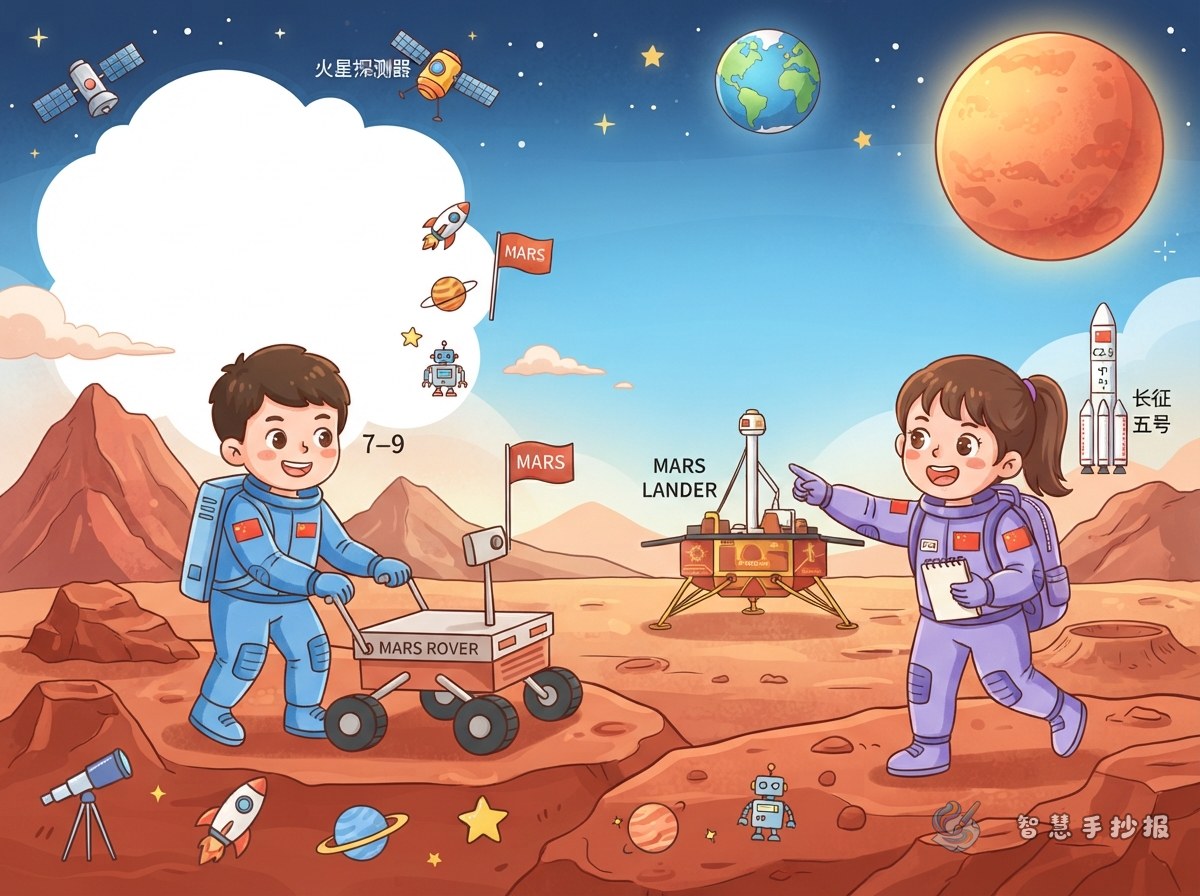
- Mission order: leave Earth, travel a long way, and arrive near Mars.
- Orbit: circle Mars first and observe its surface and atmosphere.
- Landing and roving: the lander touches down and the rover begins to move and explore.
- Sending data: images and information are sent back to Earth for scientists to study.
Why People Want to Explore Mars
- To look for clues about water and possible signs of life.
- To study how Mars has changed and learn more about planets.
- To gain experience and technology for deeper space exploration.
Build a Layout That Looks Like a Mission Map
Put one large round Mars in the center or near the top corner as the main image. Then draw a curved orbit line that links the columns together, so readers can tell at once that this is a space topic.
- Planet File: color, air, temperature and dust on Mars.
- Mission Timeline: five small boxes for launch, flight, orbit, landing and roving.
- Rover Card: the shape, wheels and task of Zhurong.
- Question Corner: two or three small questions, such as "Could we grow vegetables on Mars?"
- My Mars Base: draw an imagined base and label the oxygen, water and energy it needs.
How Much to Write in Different Grades
Lower Grades: More Pictures, Fewer Words
Keep just three sentences, such as "Mars is red", "A rover moves on Mars" and "I want to visit Mars", then fill the rest of the page with planets, stars, rockets and small flags.
Upper Grades: Add Subtitles and Fact Cards
Use three subtitles: "Mars File", "The Journey of Tianwen-1" and "Why We Explore Mars". Write three or four lines under each one, then finish with a short personal thought to give the poster more depth.
Finishing Touches for a Neat Look
- Use red-orange and deep blue as the main colors: red for Mars, deep blue for space.
- Choose a title such as "Visitor to the Red Planet", "From Earth to Mars" or "Tianwen-1 Goes to Mars".
- Vary the frames: a round planet can sit beside square fact cards, with small stars and orbit lines filling the gaps.
- Leave some white space so the text blocks are not too crowded and are easy to read.
If you want your columns to look even neater, open the Smart Handwritten Newspaper mini program, choose a space and aviation template, and place your Mars facts into the boxes. Then adjust the title and frames to finish your own Mars exploration poster.