Choose a Clear Story for the Poster
Qian Yi was a physician of the Song dynasty who became well known for his work related to children's illnesses. He is often honored by later generations as a leading figure in the history of Chinese pediatrics. For a school poster, center the story on three ideas: understanding children's special needs, observing symptoms carefully, and recording useful medical experience.
A strong main heading is “An Ancient Physician Who Cared for Children.” A smaller subtitle such as “Meet Qian Yi of the Song Dynasty” immediately tells readers who the poster is about.
Tell His Story Through Four Feature Cards
Profile Card
Qian Yi was a Song dynasty physician and an important figure in the development of pediatric medicine in ancient China. He devoted close attention to children's conditions and recognized that young patients required particularly careful observation.
Book Spotlight
After Qian Yi's death, his student Yan Xiaozhong compiled his medical experience in a work commonly known in English as Key to Therapeutics of Children's Diseases. The book is an important source for understanding Qian Yi's historical contribution.
Careful Practice
Children may not be able to describe discomfort clearly. A physician therefore needs patience and close attention. This section can highlight careful observation, cautious judgment, and concern for young patients rather than listing technical treatments.
What I Learned
Qian Yi's story represents patience, responsibility, and a practical attitude toward learning. His example reminds students to observe first, think carefully, and treat others with kindness.
Use Short, Ready-to-Read Text
Keep each section brief so the page does not become crowded. Students can select from the following lines according to the available space:
- One-sentence profile: Qian Yi was a Song dynasty physician who made an important contribution to ancient pediatric medicine.
- Book fact: Yan Xiaozhong compiled Qian Yi's experience in Key to Therapeutics of Children's Diseases.
- Theme line: Careful observation and responsibility help protect every young patient.
- Safety note: Ancient medical texts are part of cultural and medical history, not instructions for self-treatment today.
Design It Like a Historical Case File
Divide the page into four areas of different sizes. Place the title and a portrait of Qian Yi at the upper left, with the profile card on the upper right. Use an open-scroll frame in the center for the book feature, then place “Careful Practice” and “What I Learned” along the bottom.
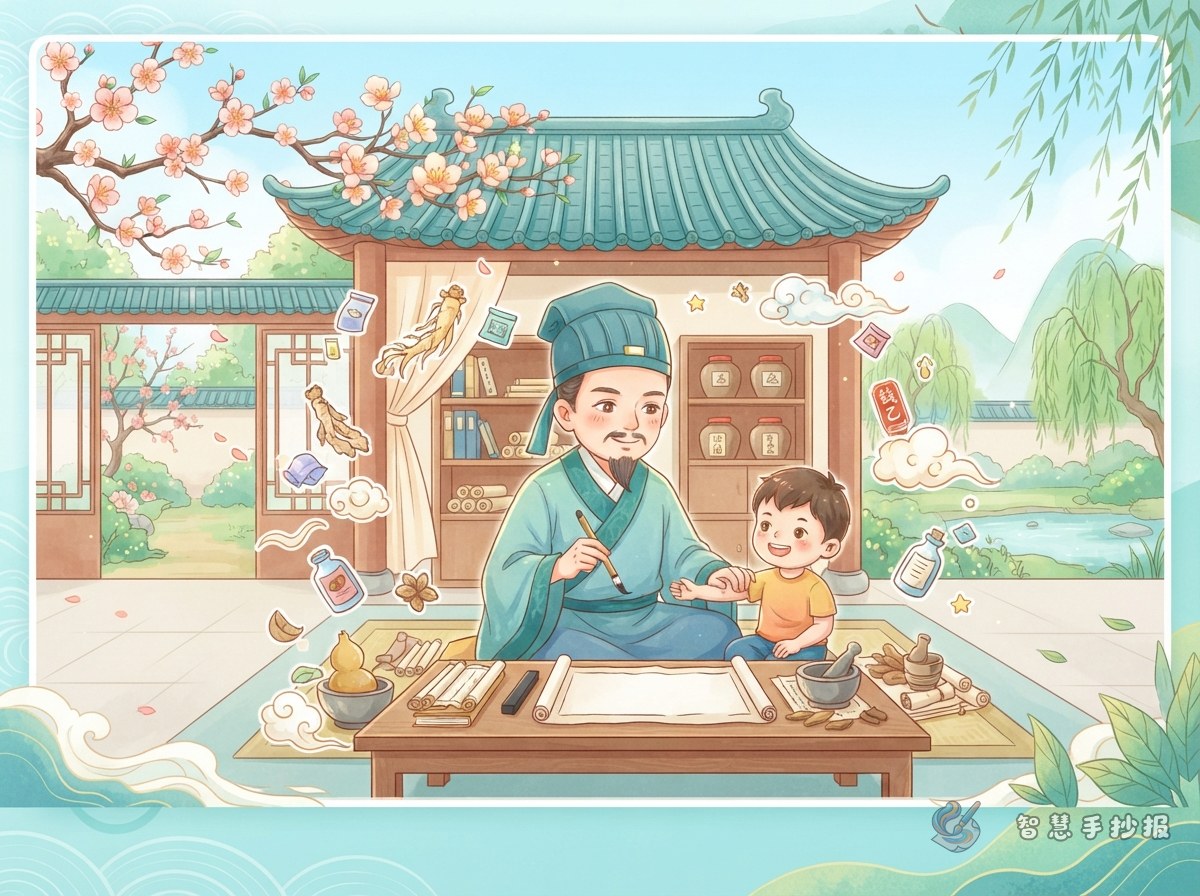
Warm cream, pale green, and muted red create a traditional but bright palette. Alternate scroll patterns, clouds, and small leaves around the borders instead of filling every space with herbs. A gentle consultation scene can be the main illustration, while books and a medicine case serve as smaller decorations.
Review Before Finishing
- Check the dynasty, book title, and compiler's name for accuracy.
- Make sure the main title is easy to see and every section has its own heading.
- Remove unexplained technical terms, prescriptions, and dosage information.
- Leave enough white space around the text before adding small decorative patterns.
To continue arranging sections, selecting a template, or refining the text, scan to open the 智慧手抄报 WeChat Mini Program and create a poster based on Qian Yi and stories of traditional Chinese medicine.