Why generation names make a strong surname newspaper
Most surname projects start with origins and famous figures. Those facts are easy to find, but they also look the same in every classroom. Generation names are different: they describe how one family orders its generations, so the content is personal and rarely repeats what a classmate has written.
They also look good on paper. A row of single characters is naturally tidy and eye-catching, which makes it much easier to design around than a long block of text.
Three terms to keep separate
- Generation characters: the characters a family agrees on to mark each generation. People who share one character usually belong to the same generation.
- Seniority: where a person sits in the family order, which shows up in the titles you use, such as grandparent, parent or same generation.
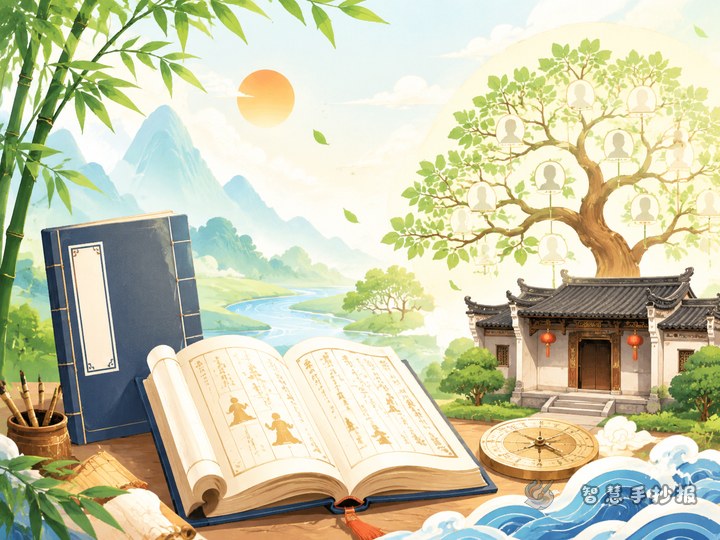
- Generation poem: a set of generation characters joined into readable lines, often recorded in a family genealogy book so later generations can remember them.
Explaining these three terms clearly is already enough for one section, and it is far more reliable than copying text whose source you cannot check.
Where to find your family's generation characters
The best material comes from home. Try this order:
- Ask older relatives, especially grandparents, who often still remember several characters.
- Look through a family genealogy book or the notes on the back of old photographs.
- Notice characters that repeat in the names of relatives of the same generation.
- If you truly cannot find any, switch to explanatory content about how generation names came about and why people with the same surname can differ so much in seniority.
One important rule: do not invent a set of characters just to fill the space, and do not copy a random list online as if it were your own family's.
Build the layout around a generation timeline
Generation characters have a clear order, so a timeline is the natural structure. A simple version works well:
- Draw a line with an arrow, running from the earlier characters toward the more recent ones.
- Place each character in its own small box or circle along the line.
- Add a short note beside each one, such as which family title that generation uses.
- Leave the space on both sides for smaller sections, like surname origins, hall names or a famous figure.
With one clear main line, readers immediately understand what the page is about, and the layout never turns into a crowded pile of text.
A small column about your own name
Content about your own family is usually the part people remember. Set aside a box in one corner for the meaning of the characters in your name and the generation you belong to. If one of your name characters is a generation character, circle it and add a short note such as "this character marks my generation".
If your name does not use one, there is no need to force it. Writing about why your parents chose your name is just as interesting and keeps the page warm and personal.
Common mistakes to avoid
- Wrong order. Generation characters follow a fixed sequence, so double-check before writing them down instead of starting in the middle or reversing them.
- Too much text. One timeline plus a few small boxes is enough for this topic. Leave the rest of the space for the title and illustrations.
- Treating legends as history. Surname stories often include legends, so phrases like "according to legend" keep the writing accurate.
To keep everything straight, sketch the timeline and section borders lightly in pencil first and only write once the positions look right. If you would rather start from a ready-made layout, open the 智慧手抄报 mini program in WeChat, choose a surname culture template and fill in your own family details.