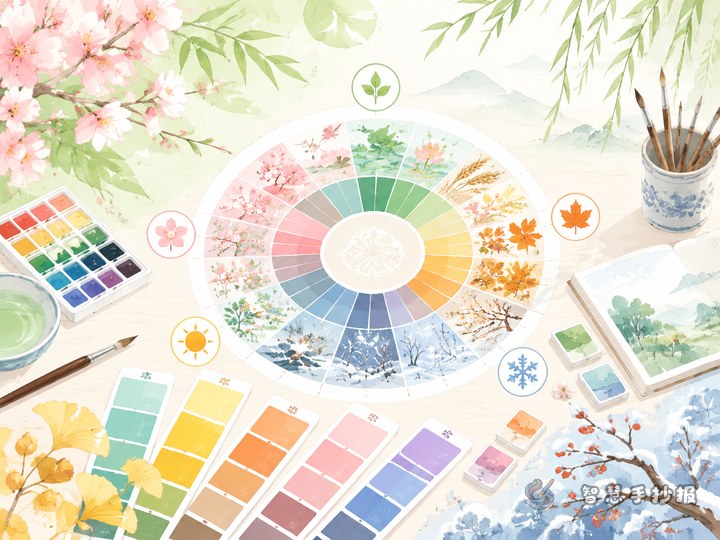
Why Classical Poetry Works So Well for a Color-Themed Handwritten Newspaper
Many Chinese poems already describe colors in a single line. A line about red flowers and green river water gives you two colors at once, while a line about yellow orioles, green willows, white egrets and blue sky gives you four. Pull those color words out of the poem, and your handwritten newspaper has ready-made text that also shows a little literary knowledge.
Choose the Colors First, Then Find the Lines
To keep the page tidy, decide on two or three colors before you search for poems.
- Reds: peach pink, rouge and cinnabar go well with lines about lotus flowers or maple leaves.
- Greens: bamboo green, willow green and pine green suit lines about new leaves and lotus ponds.
- White and blue-green: moon white, sky blue-green, crow blue and ink blue match lines about egrets and evening rivers.
- Yellows: goose yellow, apricot yellow and autumn yellow pair nicely with lines about orioles.
Simple Sections: One Line, One Color, One Explanation
You do not need to fill every corner. Three to five small sections are plenty.
- Poem window: copy one or two lines in slightly larger writing so they become the focus of the page.
- Color card: write the color word on its own, paint a matching block beside it and add a short note such as bamboo green, the fresh green of new bamboo.
- Color matching notes: explain why certain colors look good together, for example red with black feels formal while blue-green with white feels light.
- My palette: leave a box for three color combinations that you like best.
Three Layout Rules That Keep the Page Clean
First, choose one main color and let it appear in the title, the border and the color blocks, while other colors stay as small accents. Second, leave space between color blocks instead of pressing them together, so the paper underneath can breathe. Third, keep writing areas on light backgrounds and save dark colors for titles and small decorations.
Make a Poem-and-Color Card You Can Display
If time is short, make just one card: copy the poem line on the left, paint a color block in the middle and write the color name and a short note on the right, then frame it with thin lines in the same color family. Several finished cards can be joined together into a full page. To save time on borders and grids, open the Zhi Hui Shou Chao Bao WeChat mini program, pick a layout template and replace the words with your own poem lines and color names.