Start with a Voyage Route as the Backbone of the Page
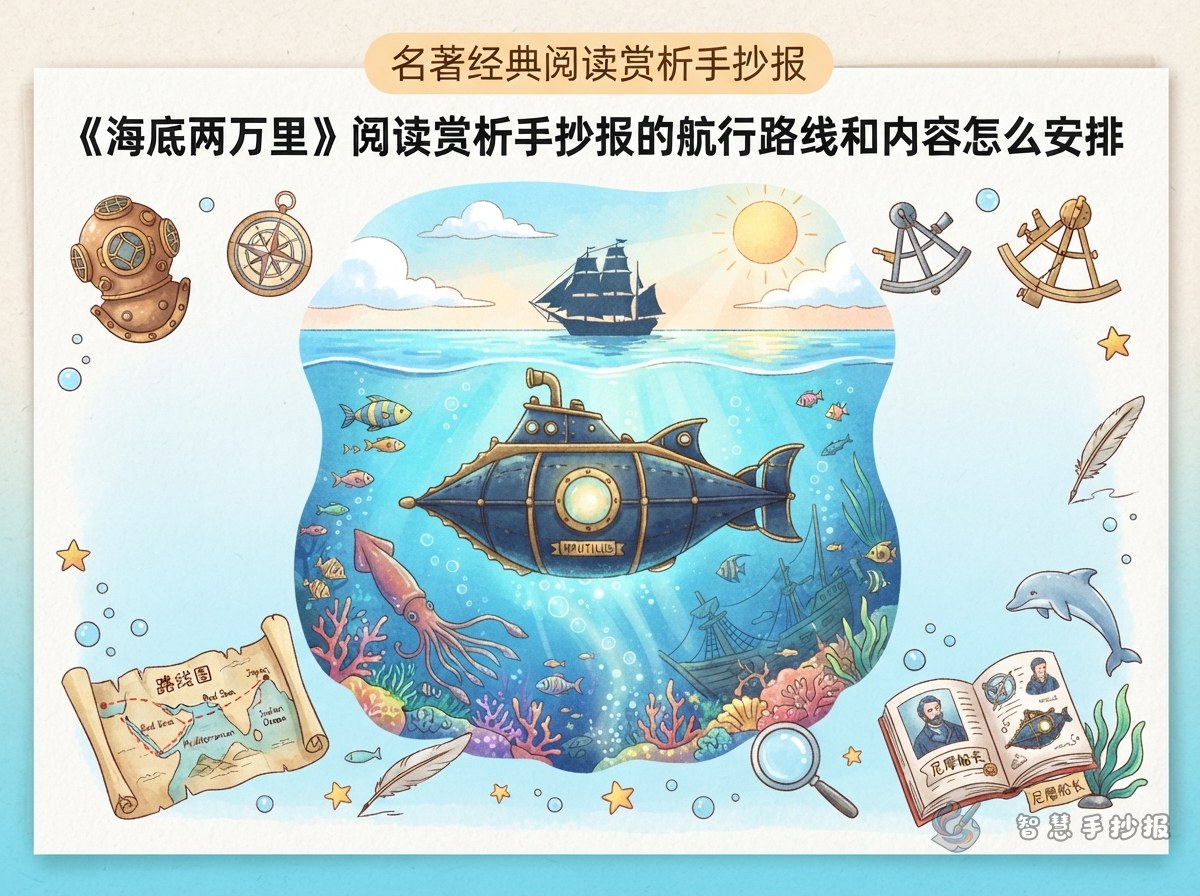
Twenty Thousand Leagues Under the Sea moves forward scene by scene, so the poster does not need to give every chapter the same amount of space. Draw a curved route from the top left to the bottom right and place the key scenes along it.
- The start: a sea monster appears and Professor Aronnax is invited to investigate.
- The middle: hunting in the underwater forest, a coral funeral, rescuing a pearl diver, being trapped in Antarctic ice.
- The peak: the attack of the giant squid and the narrow escape from the great whirlpool.
- The end: the three companions slip away in a small boat, while Nemo and the Nautilus remain a mystery.
Write only two or three key words beside each stop and add a small drawing. Readers can then follow the whole story along the route without the page becoming crowded.
Four Panels That Give Every Kind of Content a Home
Divide the sheet into four areas shaped like portholes, submarine cabins or reef rocks, so the different kinds of writing do not clash.
- Character cards: Captain Nemo, Professor Aronnax, Conseil and Ned Land, each with one word for personality plus one detail from the book.
- Plot highlights: board the ship, explore, face danger, leave. Keep each step to three lines or fewer.
- Quotations: copy one or two short lines, such as a description of the undersea world, and add your own comment underneath.
- Science predictions: list the submarine, diving suit, undersea cable and deep-sea lighting that Verne imagined, then compare them with today's technology.
Write Real Appreciation with Three Threads: People, Events, Ideas
Many students only write that a book is wonderful or exciting. Following three simple threads makes the writing specific and easy to read.
- People: Nemo is learned and calm, yet also full of grief and loneliness. He saves a pearl diver but also sinks ships, and that contradiction is exactly what makes him worth writing about.
- Events: in the Antarctic ice, the author describes time, breathing and strength in detail. The tension comes not from a monster but from running out of air.
- Ideas: Verne wrote a complete undersea journey before real submarines existed, which shows that imagination can run ahead of technology.
Layout Tricks for a Clean Ocean Look
Ocean themes are easy to overfill. Remember one rule: the sea is the background, the writing is the main character.
- Draw two or three wavy lines of different depths along the top and bottom edges, and leave the middle blank for text.
- Keep the main colours to blue, cyan and white, with a bright yellow or orange accent for important headings.
- Use porthole circles, bubbles and rock-shaped boxes to frame text blocks, but do not put every single line inside a frame.
- Choose only two or three decorations such as fish, jellyfish, seaweed or coral, and repeat them for rhythm.
- Give the title a dark blue outline with a light blue edge to suggest underwater light.
Openings and Closing Lines You Can Adapt
Open with a question that pulls the reader under the sea, for example: if a ship could take you across the whole ocean floor, would you get on board? Instead of ending with I like this book, try something like: after reading it, I realised the ocean is not just blue, it also holds courage and questions. Then add one sentence about who you would recommend the book to.
If you would rather not spend all your time ruling lines and planning the layout, open the Smart Handwritten Newspaper mini program in WeChat, choose a classic reading template, type in your prepared text, and then hand-draw the route and small undersea pictures. You will have a finished poster with your own style in no time.