Turn “Save Water” Into Something You Can Actually Try
Water-saving posters often turn into a pile of slogans that are lively to read but hard to remember. Switch to an experiment angle and the page suddenly has something to observe: one drop, one cup of muddy water, one round of tooth brushing. No special equipment is needed — a cup, a plastic bottle, a paper towel, and some cotton will do.
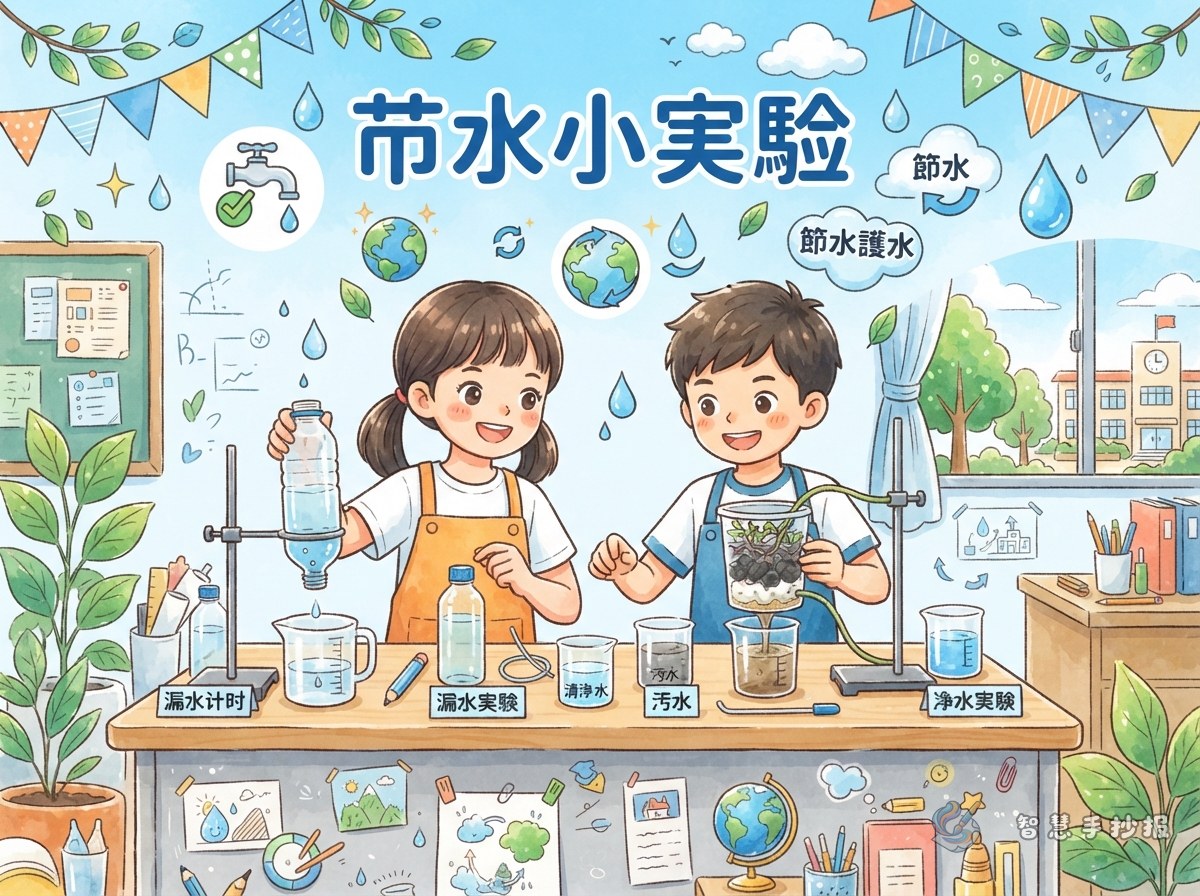
Treat the whole poster like a lab record sheet. Put the main experiment in the middle and place smaller experiments, data tables, and action pledges around it. The result looks like a science log while still staying firmly on the water protection theme.
Three Water Experiments You Can Draw on the Page
Timing a Dripping Faucet
Turn the faucet until it is almost closed but still dripping. Catch the water in a cup for one minute and count the drips, then estimate how many there would be in an hour and in a day. On the poster, draw a timeline with “one minute” on the left and “one day” on the right, leaving space for your own numbers. The point is not to waste water but to turn an invisible leak into a visible figure.
Filtering Muddy Water
Cut a plastic bottle into a funnel and layer it with paper towel, cotton, and clean fine sand. Pour a little muddy water in slowly and watch what comes out. Draw the layers as a cross-section on the poster, label each material, and add a line such as “clean water does not come easily”. Remind readers that filtered water is only for观察 and watering plants, never for drinking.
Comparing How Much Water Everyday Tasks Use
Use the same cup to measure how much water is used when the tap runs while brushing teeth compared with filling a cup first. You can also compare hand washing, dish washing, and watering a plant. Show the results as a bar chart or a row of cup icons; the difference is instantly clear and far more convincing than simply writing “save water”.
Layout: Making Experiment Data Clear and Good-Looking
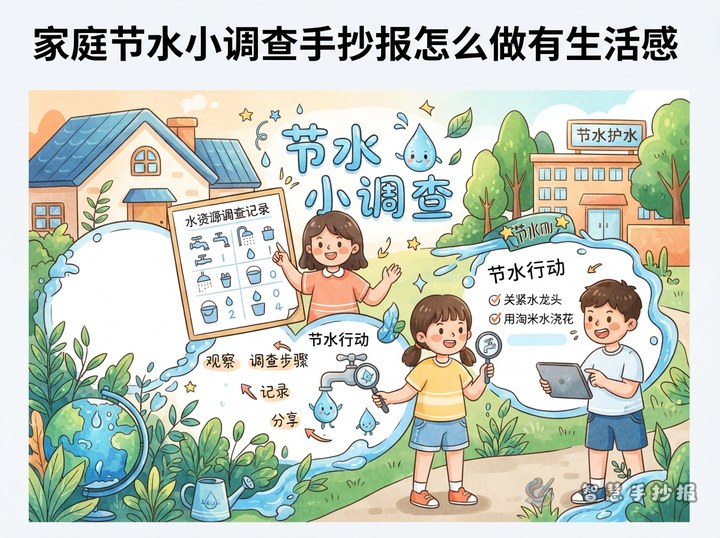
Divide the page into five zones and separate them with different frame shapes.
- Experiment title box: Place it at the top or top left, write the experiment name clearly, and add a small icon such as a dripping faucet, a funnel, or a measuring cup.
- Materials and steps box: Use numbers or arrows to show the order. Keep it to four steps or fewer and write in short sentences.
- Data record box: Draw a two-column table with time or attempts on the left and results on the right, highlighting numbers in a different color.
- What I found box: Write two or three sentences about how your thinking changed, for example “I thought dripping was tiny, but after recording it I see it matters”.
- Action pledge box: Put it in the bottom right corner with three things you can do right away, such as closing the tap tightly, using a cup when brushing teeth, and telling an adult about leaks.
If there is still space, add a small “water word corner” that explains words like fresh water or recycled water to round out the content.
Short Lines to Write Under the Numbers
An experiment poster does not need long paragraphs. Short sentences plus numbers work better. Try these:
- “Drip, drip — one drop is small, but a whole day is long.”
- “Muddy water needs several layers to become clear; clean water is not naturally clean.”
- “One cup is enough for brushing teeth.”
- “Tightening a tap takes only a second.”
Beside each line, add a small comparison drawing, such as a wide-open tap next to a closed one, or a cup of muddy water next to a cup of clear water.
Color and Layout Reminders
Blue suits a water theme, but do not fill the whole page with dark blue or it will feel heavy. Use light blue as the background, deeper blue for the text, white for breathing space, and a little green for plants and life. Make the title large and keep the steps and notes smaller. Circle data and conclusions with colored frames. Borders can be water droplets, wavy lines, pipes, or ripples — pick one main style instead of a different pattern in every box.
When you finish, check for overlapping boxes, crowded text, or empty frames. White space is part of the design too.
Keep Building It in the WeChat Mini Program
If the experiment data is ready but the boxes will not line up or the columns feel too small, search for “智慧手抄报” in the WeChat mini program, choose a water-saving or water protection template, and drop the experiment name, steps, data table, and action pledge into separate frames. Adjust the fonts and colors, print it out, and add hand-drawn illustrations. The result is a poster that shows both your observation process and your own numbers.