Why Footprints Stay on the Moon So Long
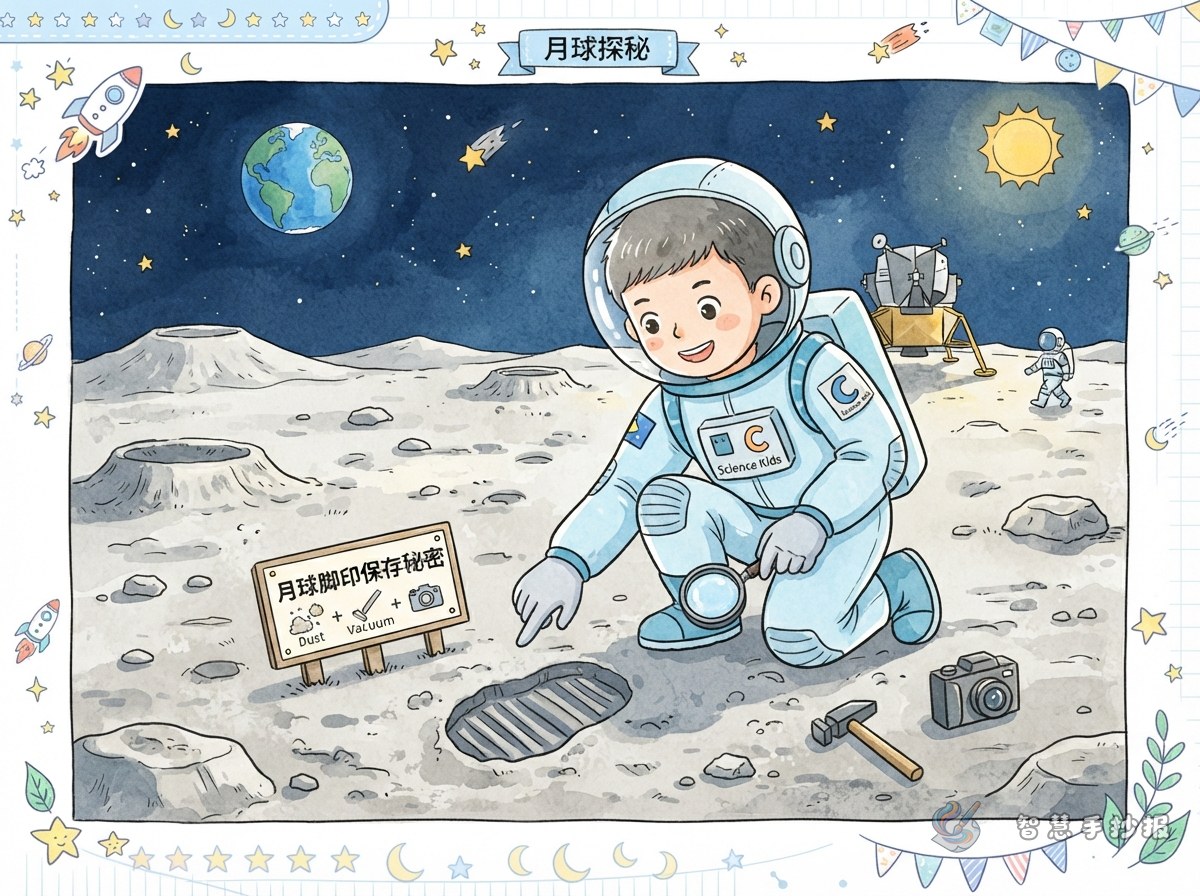
On Earth, a footprint in soil does not last. Wind blows dust over it, rain washes it away, plants push through it and other feet trample it flat. The Moon works differently. It has almost no air, which means no wind, no clouds and no rain. When an astronaut's boot presses into the soft grey surface, hardly anything is left to smooth the print away, which is why marks made during the first Moon landings can still be seen today.
Keep one detail in mind: the prints are not frozen forever. Lunar days and nights swing between extremes of heat and cold, tiny meteorite grains keep striking the ground, and the solar wind slowly wears the surface down. Saying the prints “last a very long time” is far more accurate than saying they never disappear.
Use an Earth and Moon Comparison as Your Main Panel
The quickest way to make the idea clear is to place two worlds side by side, with a dotted line or a trail of stars between them.
- Earth: air, wind and rain, so prints vanish quickly.
- Moon: almost no air, no wind and no rain, so prints stay for ages.
- Same rule on both: the ground has to be soft dust or mud for a print to show at all.
Drawing it is simple. On the left, add a little green, some water ripples and a small tree. On the right, fill the space with grey dust, a few craters and scattered stars.
Plan the Columns Before You Draw
Three or four sections are plenty. Clear information beats a crowded page every time.
- Question title: a big heading such as “Why do footprints stay on the Moon?”
- Comparison panel: Earth on one side, Moon on the other, two or three short lines each.
- Fact card: add one line explaining that the Moon has no wind, so it has no weather.
- Did you know: leave a small question for classmates to look up later.
Sentences You Can Copy Straight onto the Page
- The Moon has almost no air, so it has no wind, no rain and no clouds.
- Without wind and rain, footprints are never blown flat or washed away.
- The prints are not permanent; they slowly fade year after year.
- On Earth, nature erases our footprints. On the Moon, that eraser is switched off.
Colour, Spacing and Finishing Touches
- Use deep blue or purple for headings, black for body text, and leave the lunar surface mostly white.
- Draw a row of small footprints instead of one giant boot print; it looks far more natural.
- Sketch your boxes lightly in pencil first, then colour and write once the sizes feel right.
- One idea per column, and keep sentences short so they read well from a distance.
If you would like a ready-made layout, open the 智慧手抄报 mini program in WeChat, pick a space theme, and copy these lines into the boxes before drawing your final version on paper.