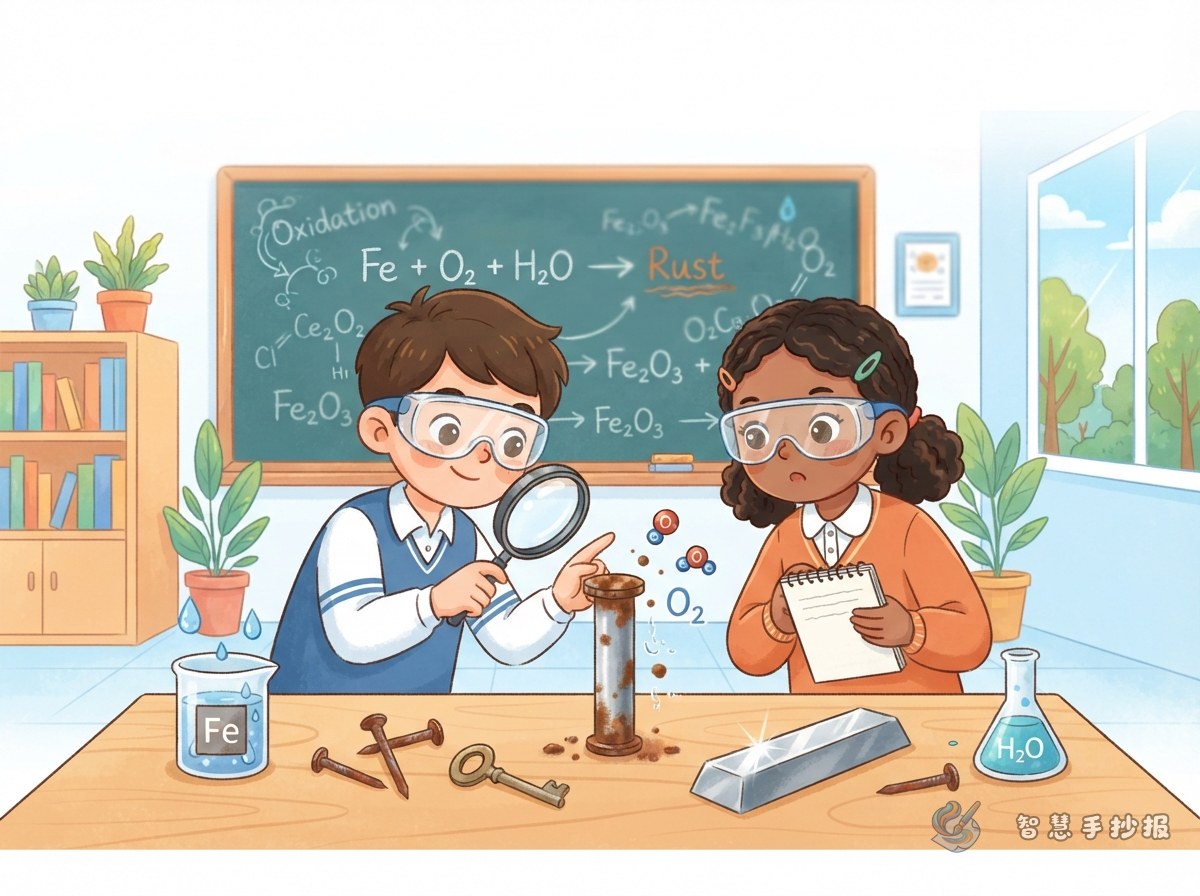
Turn Rusting into a Science Question
This handwritten newspaper can explore the question “Why does iron rust?” Use familiar objects such as iron gates, nails, and bicycle chains as observation subjects. A suitable title is Why Does Iron Rust? Let Chemical Elements Show Us the Answer, with the subtitle “When Iron Meets Oxygen and Water.” This angle connects everyday life with iron, oxygen, and hydrogen.
Begin with a question that catches the reader’s attention: why do iron objects in dry places stay cleaner, while damp objects soon develop reddish-brown spots? Iron changes more easily when water and oxygen are both involved, producing rust.
Introduce the Three Element Characters
- Iron: Iron is an important material in nails, cookware, bridges, and bicycles. Its element symbol is Fe.
- Oxygen: Air contains oxygen, which takes part in the rusting process. Its element symbol is O.
- Hydrogen: Water is made of hydrogen and oxygen. Moisture helps iron come into contact with oxygen in the air. The symbol for hydrogen is H.
There is no need to use a complicated chemical equation. A simple arrow diagram, “iron + moisture + oxygen → rust,” can explain the process. Label it as a simplified expression for easy understanding.
An Observation Corner for the Handwritten Newspaper
Create a small “Let Me Observe” section. With adult or teacher supervision, place three iron nails in different conditions: one in a dry sealed container, one in ordinary air, and one in a moist environment. Observe them for several days and record color changes. Do not put the nails in your mouth, and wash your hands after observing them.
- Record the original color and surface of each nail.
- Check daily for reddish-brown spots.
- Compare the dry, ordinary-air, and moist conditions.
- Write the conclusion: iron rusts more easily when moisture and oxygen are both present.
Design the Page as an Iron-Nail Detective Map
A three-part horizontal layout works well. Draw a large nail and a magnifying glass on the left for “Finding the Question.” In the middle, draw water drops, oxygen bubbles, and element symbols for “What Changes?” On the right, draw a painted gate, a bicycle chain, and simple protective tools for “Everyday Solutions.” Use reddish brown for rust, blue for water drops, and light yellow for emphasis.
Add small element cards, rust textures, and arrows around the edges, but keep them away from the main text. Limit each section to three to five sentences. Sketch the divisions in pencil first, outline them in black, and finish with two or three main colors.
From Rusting to Protection
End with everyday ways to prevent rust: paint iron surfaces, coat them with oil, cover them with another metal, or keep them dry. Bicycle chains need suitable lubrication, while gates and tools should be wiped and stored in dry places. Close with this idea: understanding changes in elements helps us care for everyday objects more wisely.
After planning the text and sections, continue in the WeChat mini program “智慧手抄报” to choose a layout, organize the content, and finish the handwritten newspaper.