Start With a Two-Minute Color Trick
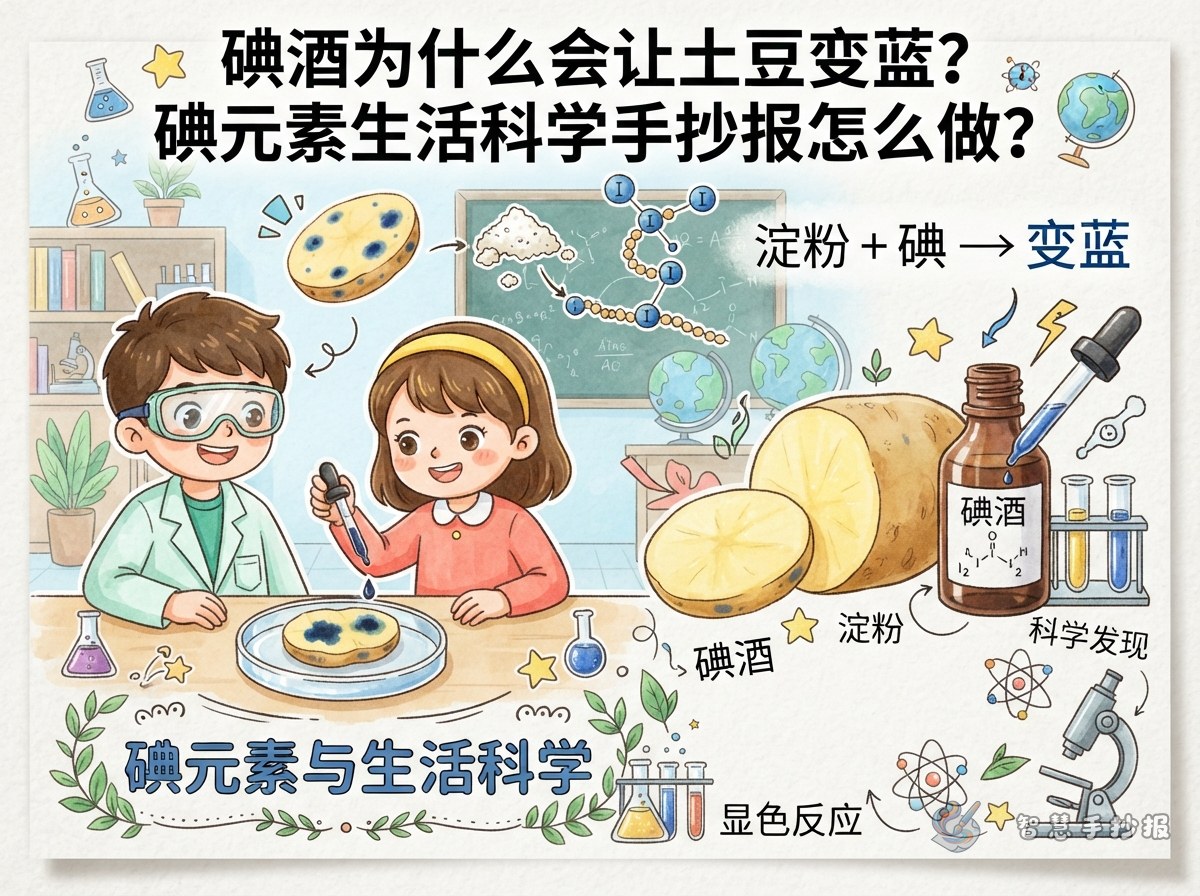
A great way to open this poster is a quick experiment: put a drop of iodine tincture on a slice of potato, a grain of cooked rice, or a piece of bread. Within seconds the light brown spot turns blue-purple. The change is easy to see and easy to time, so it works well in an "experiment corner" and can even be shown to the class.
One safety note: iodine tincture is a skin medicine, not food. Wash your hands after the test and throw away the potato or rice you used.
What Iodine Really Is
- Iodine is a chemical element with the symbol I, a non-metal in the periodic table.
- Iodine tincture is iodine dissolved in alcohol, used to clean small skin wounds.
- Iodine is also a trace element our body needs to make thyroid hormones.
If you want one more line, add this: iodized table salt contains potassium iodate rather than pure iodine, and seaweed, kelp, and sea fish are naturally rich in iodine.
The Reason Starch Turns Blue
Starch looks like a plain white powder, but its molecules are built like tiny spiral staircases. Iodine molecules slip inside these spirals and get trapped, so the color changes from brown to deep blue. The blue is not paint; it is a new color formed by iodine and starch together.
This trick works in reverse too: if you want to know whether a food contains starch, one drop of iodine gives you the answer.
How to Divide Your Poster
- Big title area: use "The Iodine That Turns Blue" or "Little Secrets of Iodine".
- Experiment corner: list the materials, three steps, and what you observed.
- Young scientist box: explain the blue color in two or three sentences.
- Iodine in daily life: draw a salt jar, seaweed, kelp, and an iodine bottle.
- Friendly reminder: iodine tincture is for skin only; keep iodized salt sealed and out of light.
- Mini quiz: add one or two questions, such as "What happens if we lack iodine?"
Color, Borders, and Finishing Touches
Since the theme is "turning blue", deep blue makes a strong main color, with cream and white as the background. Use thick bubble letters or boxed letters for the title, rule lines between text blocks, and shape the experiment corner like a dropper bottle or test tube.
- Draw three small icons — potato, rice, and bread — in a row under the experiment corner.
- Use an arrow to show "add iodine → turns blue"; it reads faster than a long paragraph.
- Leave a small box in the lower corner labeled "My conclusion" for readers to fill in.
If you are short on time, finish the title, the experiment corner, and the daily-life section first; that is already a complete poster. To skip the lettering and layout work, open the 智慧手抄报 mini program on WeChat, choose a theme, swap in your own text, and print it or copy it by hand.