Find the Science in a Burst of Fireworks
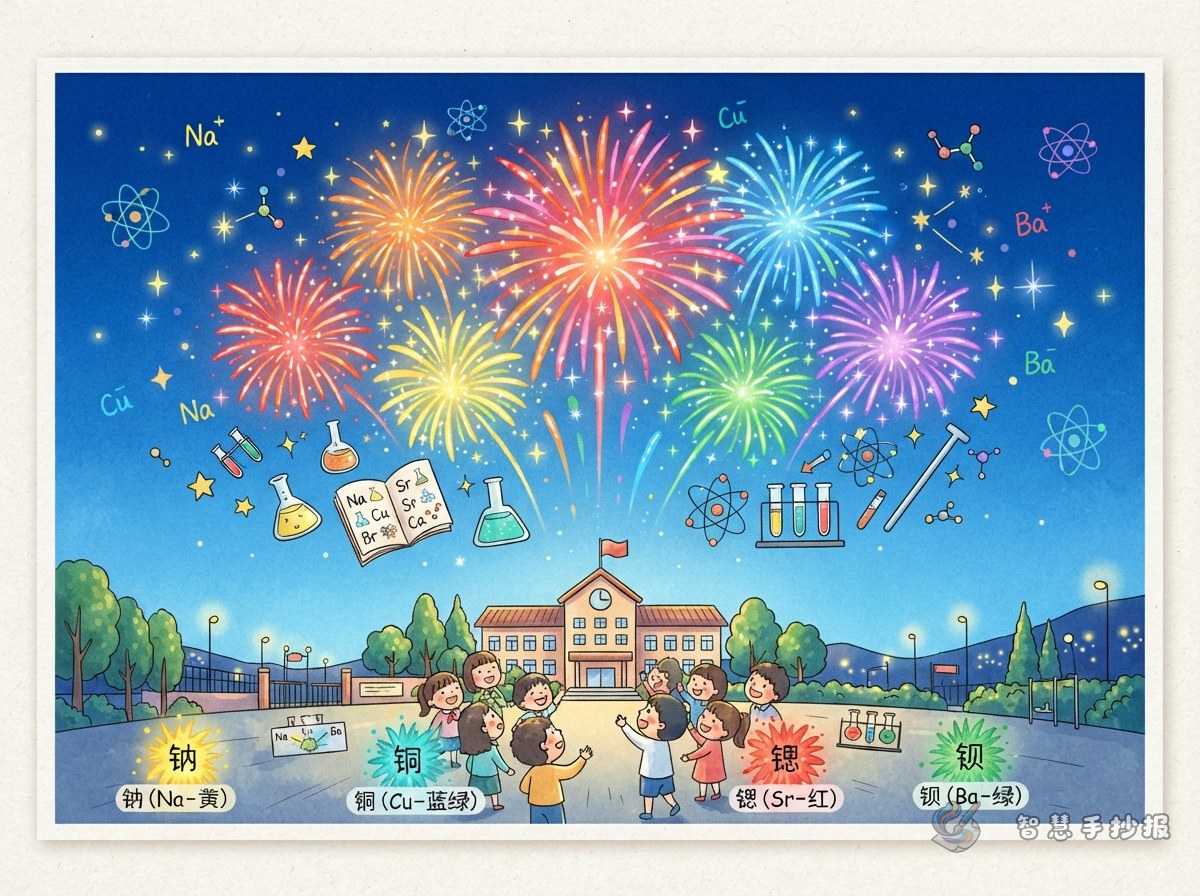
“Why do fireworks appear in different colors?” is a vivid theme for a handwritten science newspaper. Place a large burst of fireworks in the center, then explain that fireworks may contain compounds of different metal elements. When heated, these substances can produce characteristic colors of light, creating red, yellow, green, and blue effects in the sky.
A suitable title is “The Color Code of Fireworks”. A subtitle such as “How Do Metal Elements Make the Night Sky Glow?” can make the topic clear and inviting.
Different Colors Come from Different Elements
When fireworks burn, they release heat. Electrons in metal elements absorb energy and then release light as they return to a lower energy state. Young students do not need complex formulas; it is enough to explain that different elements can produce different colors of light.
- Sodium: often produces a bright yellow glow.
- Strontium: is commonly associated with red or deep red fireworks.
- Copper: can create blue or blue-green effects.
- Barium: is often linked with green fireworks.
- Calcium: can help produce orange or orange-red light.
Add a small note beside the list: the final color can also be affected by the mixture, temperature, and burning conditions, so one element does not always produce exactly one color.
Turn the Facts into Three Easy Sections
Section One: A Color File
Draw five small fireworks in different colors. Next to each one, write an element and its commonly associated color, such as “sodium—yellow,” “strontium—red,” or “copper—blue-green.” This can become the most eye-catching knowledge section.
Section Two: Why Do Fireworks Glow?
You can use this short passage: Metal elements in fireworks glow when they are heated. Different elements release different wavelengths of light, so we see different colors. A fireworks display is a performance created by heat and the light patterns of elements.
Section Three: A Science Quiz
- Question: Why are fireworks not all the same color? Answer: Their mixtures may contain compounds of different metal elements.
- Question: Does having more colors mean that fireworks are safer? Answer: No. Safety depends on proper production, storage, and approved use.
- Question: Can we make fireworks at home? Answer: No. Fireworks should be handled by trained professionals in approved locations.
Build a Night-Sky Reading Path
- Use dark blue or purple for the sky. Put the largest fireworks burst in the center and place the main title nearby.
- Draw five colorful rays extending from the center. Place the sodium, strontium, copper, barium, and calcium notes at the ends of the rays.
- Set aside two lower sections for “How Light Is Produced” and “Science Quiz.” Use light borders so the writing stays easy to read.
- Add stars, a moon, or a telescope in the corners, but keep the decorations light enough that they do not cover the science content.
Use dark blue and purple as background colors, then highlight key facts with yellow, red, green, and blue-green. Leave enough blank space around the text, and use thicker pens for the title and element names.
Safety Notes for the Finished Page
The purpose of this project is to observe the science of fireworks, not to conduct a dangerous experiment. Do not dismantle, ignite, or mix fireworks materials at home. Instead, use colored paper, markers, and bright lines to show the light trails safely.
After finishing the draft, check the element names, color descriptions, and quiz answers. Add your name, class, and a simple border. If you would like help arranging the page and choosing decorations, you can continue creating it in the 智慧手抄报 WeChat mini program.