Start with a Titles Column Instead of Full Biographies
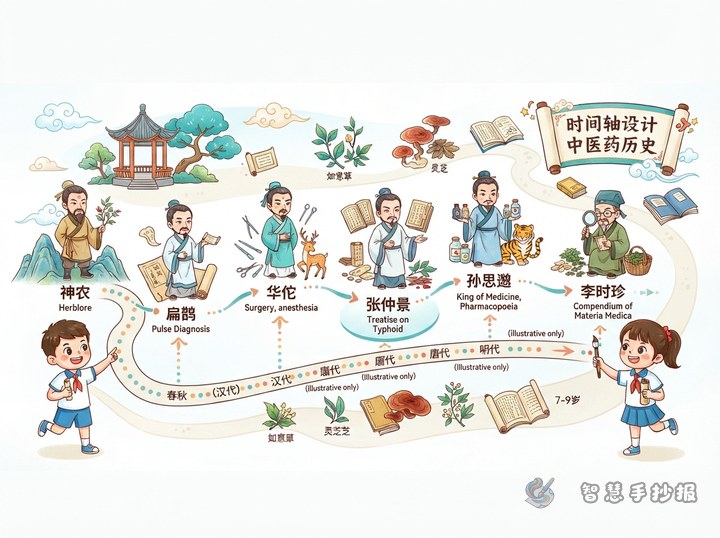
The most common problem in an ancient doctors handwritten newspaper is writing a long paragraph about every doctor. The page becomes crowded and the reader remembers nothing. Try using the title as the name of each small section. Titles such as founder of pulse diagnosis, founder of surgery, Medical Sage, King of Medicine and Sage of Materia Medica catch the eye immediately.
Keep only four pieces of information in each section: title, name, dynasty and one-line contribution. Fewer words are easier to lay out and easier to read.
Title Material You Can Copy Straight onto Name Cards
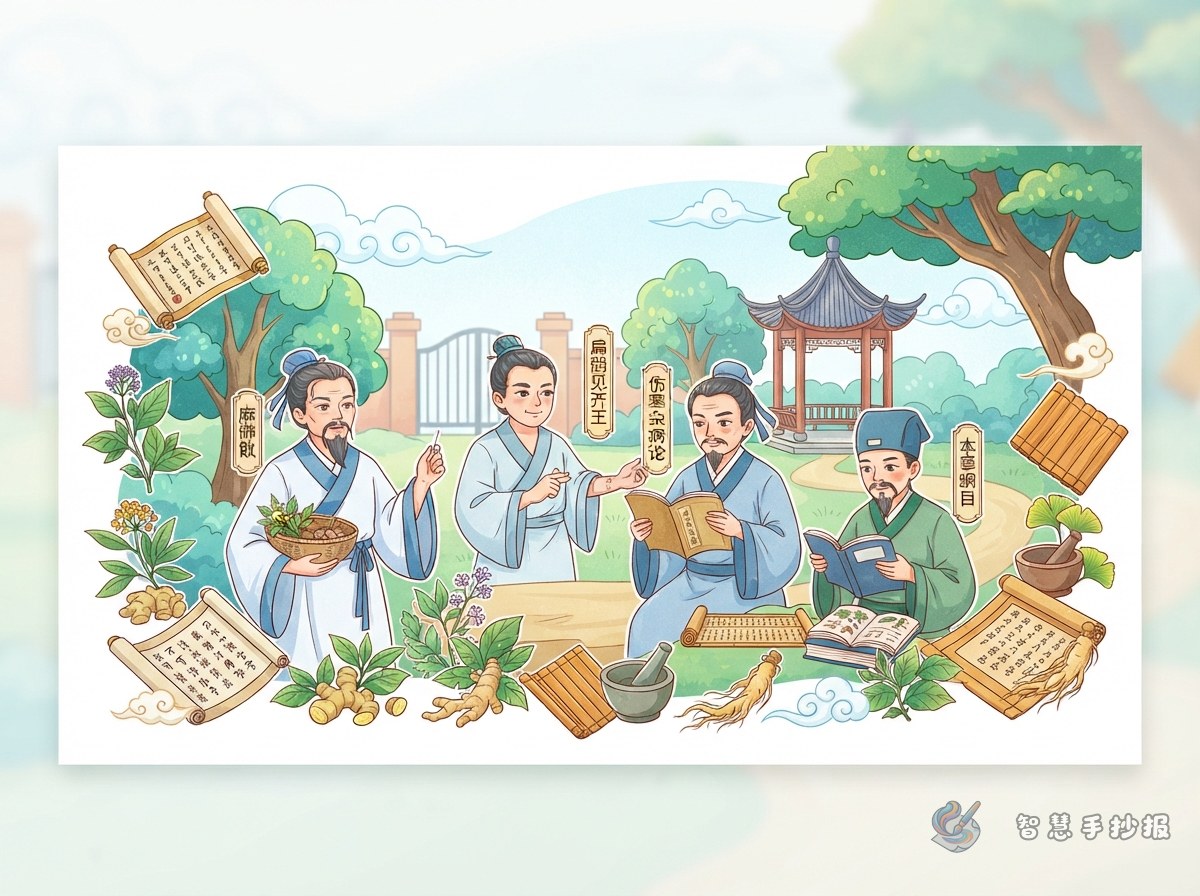
- Bian Que: often called the founder of pulse diagnosis, best known for diagnosing illness by looking, listening, asking and feeling the pulse.
- Hua Tuo: called the founder of surgery, said to have used an anaesthetic powder and to have created the Five Animal Frolics exercises.
- Zhang Zhongjing: the Medical Sage, author of the Treatise on Cold Damage, a key work in pattern-based diagnosis.
- Sun Simiao: the King of Medicine, author of the Thousand Golden Remedies, where the idea of the sincere great physician appears.
- Li Shizhen: the Sage of Materia Medica, who travelled to collect herbs and wrote the Compendium of Materia Medica.
- Huangfu Mi: the founder of acupuncture, compiler of the Classic of Acupuncture and Moxibustion.
- Ge Hong: author of the Handbook of Emergency Prescriptions, which records simple first-aid methods.
- Shennong: the legendary figure said to have tasted hundreds of herbs, whose name is attached to the Divine Farmer's Materia Medica.
You do not need every entry. Four to six cards fill a column nicely, and a little white space makes the page look cleaner.
Turn Each Masterwork into a One-Line Comment
When you introduce books such as the Treatise on Cold Damage or the Compendium of Materia Medica, copying the textbook introduction puts a heavy block of text on the page. A one-line comment works better: first say what problem the book solved, then say why it still matters.
Three sentence patterns that work
- It organised ... into ..., so later readers had something to rely on.
- The book records not empty ideas, but ways to ...
- Even today people still look in this book for answers about ...
For the Compendium of Materia Medica you could write: Li Shizhen grouped hundreds of herbs by category and checked their appearance himself, so later readers could look them up more easily.
Two Layouts That Fill the Page Neatly
The name-card wall
Divide the main area into four or six boxes, each shaped like a card: title on top, name and dynasty in the middle, one-line contribution at the bottom. Separate the cards with a thin line or a cloud pattern so they look like a row of small windows.
The open-book page
Draw an open book in one corner. Put the book title on the left page and two short lines about its content on the right. Colour the title edge, but keep the lettering clearly larger than the name cards so the page has a main focus.
If there is still room, add a quotes strip with a line such as the sincere great physician in the centre of the page and leave space around it.
Small Details That Earn Extra Points
- Keep the dynasty order tidy: Bian Que, Hua Tuo and Zhang Zhongjing first, Huangfu Mi and Ge Hong in the middle, Sun Simiao and Li Shizhen later.
- Use one main colour per card, with a bolder title and a smaller name.
- Separate legend from history by writing that Shennong is said to have tasted hundreds of herbs.
- Read the finished page aloud. If any card runs past three lines, cut it in half.
Once the five items, title, name, dynasty, masterwork and one-line contribution, are ready, the writing is basically done. If you want to skip layout trial and error, open 智慧手抄报 in WeChat Mini Program, choose a doctor-themed layout, fill in your prepared card text, and then print or copy it onto paper.