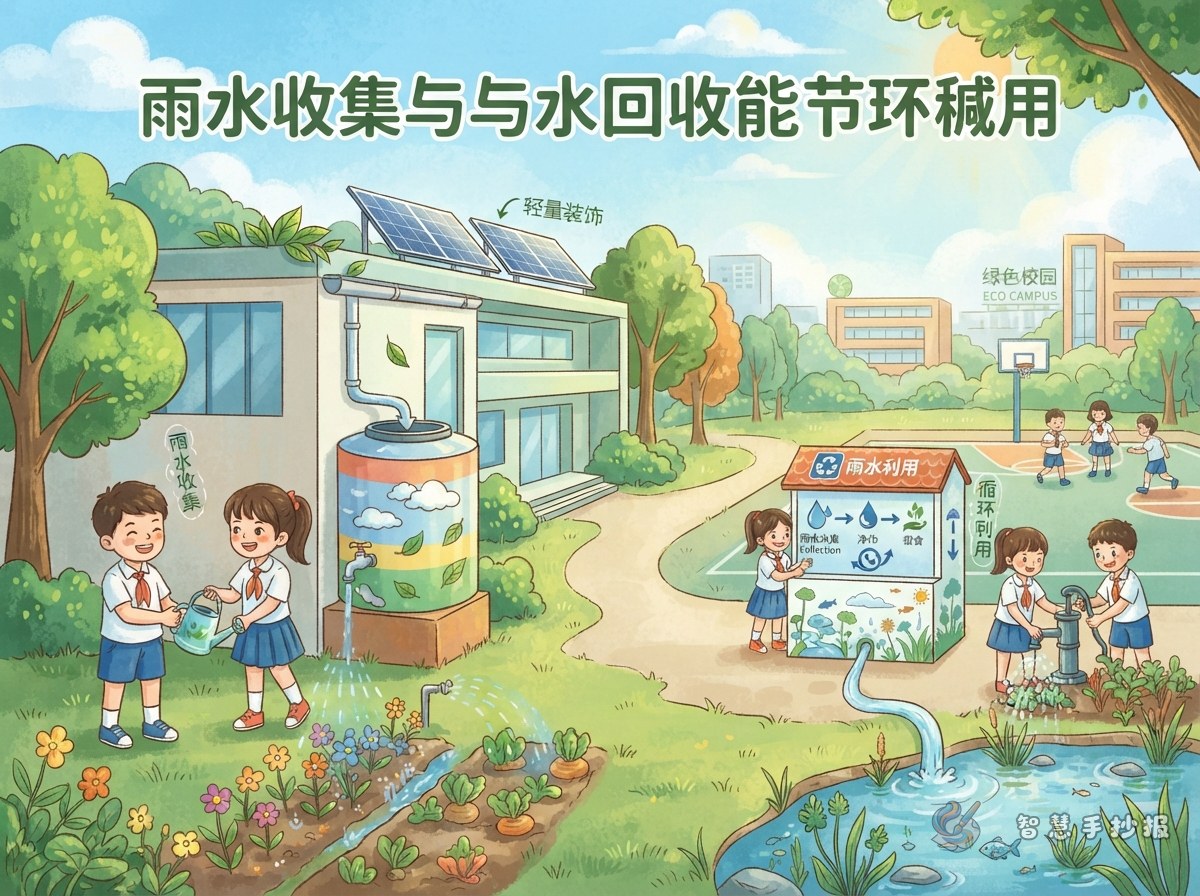
Start with a raindrop’s journey through school
This handwritten poster can follow one simple question: what can happen to rain after it falls on the school campus? Draw a large raindrop in the center, then connect it to a school roof, a downpipe, a storage barrel, and a garden bed. The picture will show how rainwater can be collected and used appropriately instead of becoming an abstract environmental slogan.
A strong main heading could be “Catch Every Raindrop, Build a Greener School,” with the subtitle “A Short Lesson on Rainwater Collection and Reuse.” The two lines make the topic clear while giving the poster a memorable visual direction.
Explain the water cycle in three clear steps
- Collect it: Draw rain falling onto a classroom roof and flowing through a downpipe. Add the note “Collect rainwater from suitable roof areas.”
- Store it: Use a covered barrel or small storage tank to show temporary storage. Write “Keep the container clean and use it safely.”
- Reuse it wisely: Connect the stored water to a garden, trees, or an outdoor cleaning area. Add “Use it only for suitable non-drinking purposes after proper management.”
The poster should clearly state that collected rainwater must not be treated as drinking water. Including this reminder shows both environmental awareness and careful thinking.
Short text that fits the poster
Water-saving idea: After collection and proper management, rainwater may be useful in suitable non-drinking situations. Avoiding unnecessary tap-water use is one way to value water resources.
School actions: Remind others when a faucet is not fully closed, avoid leaving water running while watering plants, use only the amount of water needed for outdoor cleaning, and deal with puddles or fallen leaves safely with a teacher’s guidance.
Slogan choices: “Every raindrop can have a new purpose,” “Catch nature’s gift and keep the campus fresh,” and “Start saving water in one corner of the school.” Choose one or two slogans so the design does not become crowded.
Turn the layout into a visible rain route
A horizontal or diagonal composition works well. Let the rain fall from the upper left, pass through the roof and storage system, and flow toward a garden in the lower right. Arrows, dots, or small streams can connect each scene, helping readers follow the story naturally.
- Top area: Place the title, clouds, and raindrops in fresh blue and green tones.
- Center area: Draw the three linked scenes of collection, storage, and reuse as the main visual focus.
- Bottom area: Add a “What I Can Do” section and leave some open space for neat handwriting.
- Corners: Decorate with ripples, leaves, a small bucket, and school buildings without overcrowding the page.
Text boxes can take the shape of raindrops, leaves, or water tanks. There is no need to fill every edge with color; different shades of blue and green can create a clean water-saving style.
Three finishing checks before you color
First, keep every sentence connected to the path of collection, storage, and reuse instead of listing unrelated environmental slogans. Second, make each picture match its words: if the text mentions watering plants, draw a garden and a watering can. Third, sketch the title, pictures, and sections lightly in pencil before adding text and color. This makes the page easier to balance.
For a quicker start, divide the paper into four questions: Where does the rain come from? How can it be caught? Where can it be used? What can I do? After the content is clear, continue refining the layout and making details in the “Zhihui Shouchaobao” WeChat mini program.