Choose the theme: two ways to imagine the same Moon
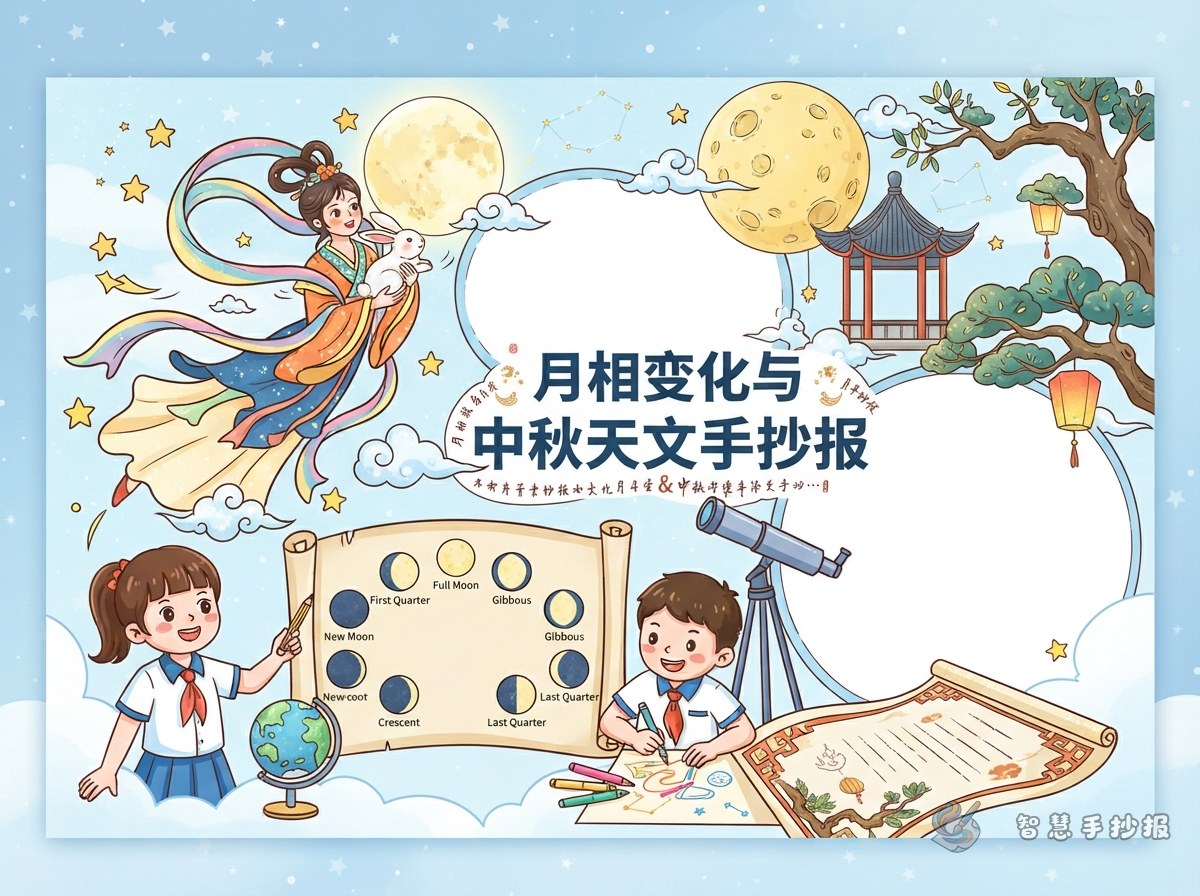
Build the poster around the question, “How have people come to understand the Moon?” Ancient people created stories such as Chang’e flying to the Moon, the Jade Rabbit, and the Moon Palace to express wishes for reunion. Today, we use observations of the Moon’s movement to understand its phases. Placing both ideas on one page keeps the poster from becoming only a myth retelling or a dry science report.
Under the main title, add a short line such as “From a Moon Palace legend to the real Moon in the sky.” It provides a natural bridge between culture and astronomy.
Let the Moon Palace story take the left side
Create a “Moon Legend” section on the left. Use a large Moon as the background and draw Chang’e, the Jade Rabbit, the osmanthus tree, and drifting clouds. A short text can say:
“According to a well-known legend, Chang’e went to the Moon and lived in the Moon Palace with the Jade Rabbit. During the Mid-Autumn Festival, people look at the bright Moon and express their wishes for family reunion and a happy life.”
To keep the difference between legend and science clear, add this note at the end: “This is a beautiful traditional story that shows how people imagined the Moon.”
Create a real Moon profile on the right
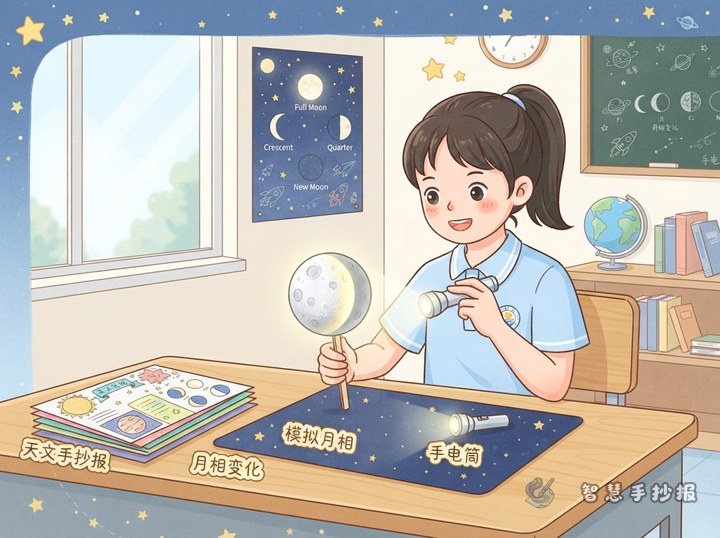
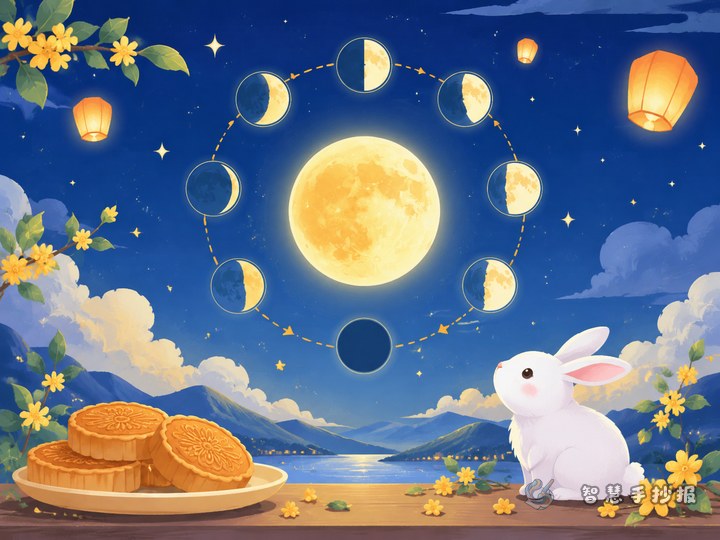
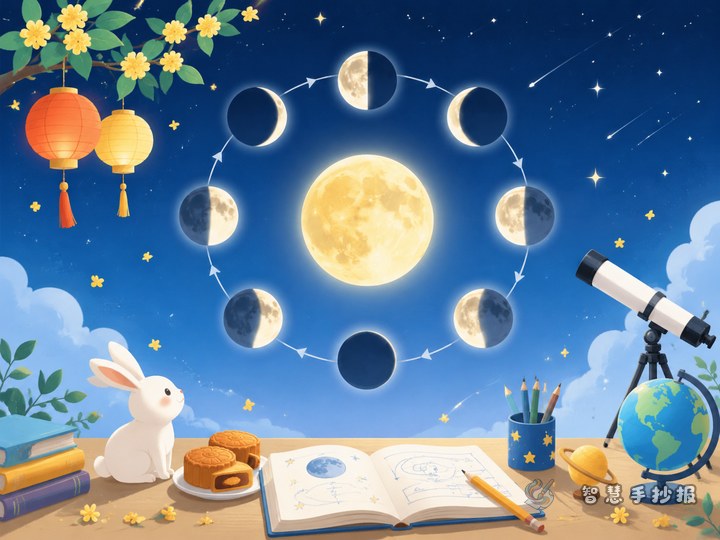
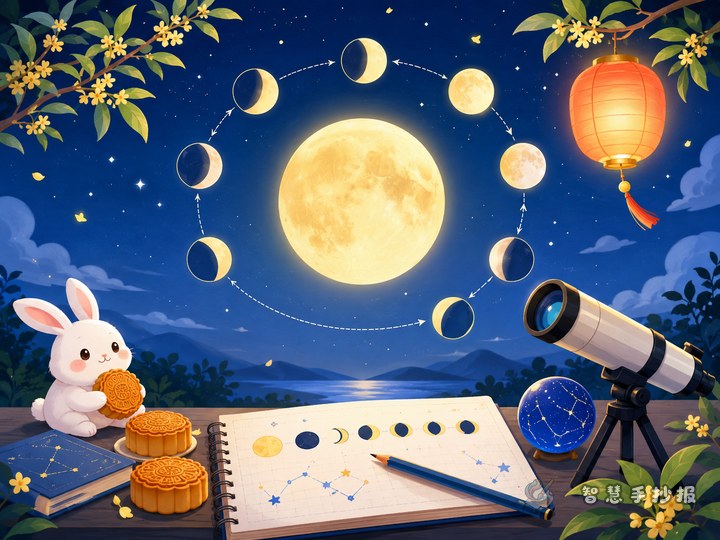
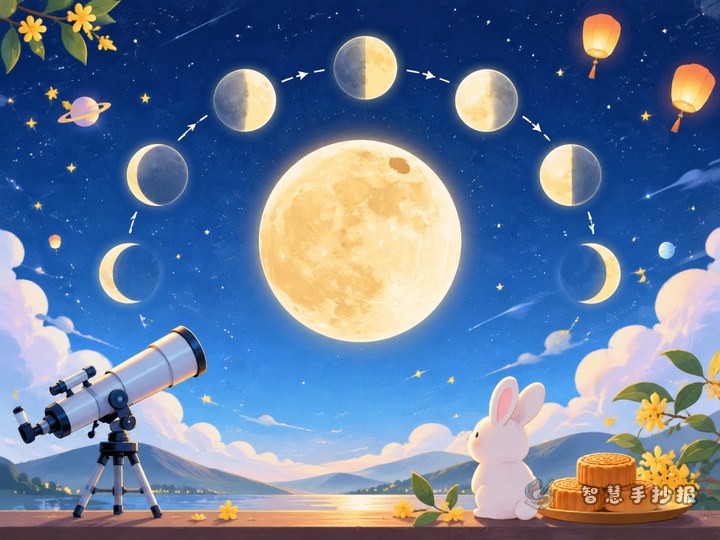
Use the right side for a simple science section about moon phases. The Moon does not make its own light. The moonlight we see is mainly sunlight reflected from its surface. As the Moon travels around Earth, the positions of the Sun, Earth, and Moon change. The bright part visible from Earth therefore appears to change, creating phases such as the new moon, first quarter, full moon, and last quarter.
- New moon: The sunlit side faces away from us, so the Moon is usually difficult to see.
- First quarter: The Moon looks roughly half-lit and is useful for introducing the sequence of phases.
- Full moon: Most of the side facing Earth is illuminated, creating a bright round Moon.
- Last quarter: The Moon looks half-lit again, with the bright side opposite the first quarter.
A simple Sun-Earth-Moon position diagram is enough. Avoid complex formulas and focus on a clear visual explanation.
Draw a starlight path from legend to science
Instead of dividing the page with a straight line, draw a curved trail of starlight from the lamp in Chang’e’s hand. Let it pass through the Moon Palace, the Moon, and the phase diagram before ending at a small “Keep Exploring” box. Place three short phrases along the path: “People once looked up with wonder,” “We observe the phases today,” and “Space still invites us to explore.”
This path works as both decoration and a reading guide. The page moves from story to science and then returns to the feeling of enjoying the Moon together.
Add a simple Moon-watching card
Leave space at the bottom for a “Look at the Moon Tonight” card. Include these easy tasks:
- Notice roughly where the Moon is in the sky.
- Decide whether it looks round, half-lit, or crescent-shaped.
- Check whether bright stars or thin clouds appear nearby.
- Write one sentence about how the Moon makes you feel.
There is no need to invent a date or observation result. Students can complete the card during the Mid-Autumn evening, making the poster more personal.
Finish with warm festival colors and clear diagrams
Choose pale cream or light blue for the background. Use orange, red, and green in the story section, and deep blue, violet, and silver-white in the science section. Write the title in large rounded lettering and add stars, osmanthus flowers, cloud patterns, and a small Jade Rabbit. Keep the moon-phase circles clean so they do not become crowded with text.
To organize the sections, title lettering, and decorations more quickly, open the WeChat Mini Program 智慧手抄报 and continue creating the poster there. You can then adjust the colors and spacing to fit your own paper.