Begin with one clear idea: Pingcheng as a meeting place
Datong was known as Pingcheng in ancient times and served as a capital during the Northern Wei period. Instead of filling the page with a long history paragraph, build the newspaper around the idea of “where the frontier met the capital.” Show northern mountains, walls, and roads on one side, and capital buildings, cave art, and cultural exchange on the other. This gives the whole design a strong focus.
Under the title, add a short introduction: “Explore Northern Wei Pingcheng and see how history, art, and daily life came together in a northern capital.” It provides a natural starting point for a classroom presentation.
Turn the layout into a small map of Pingcheng
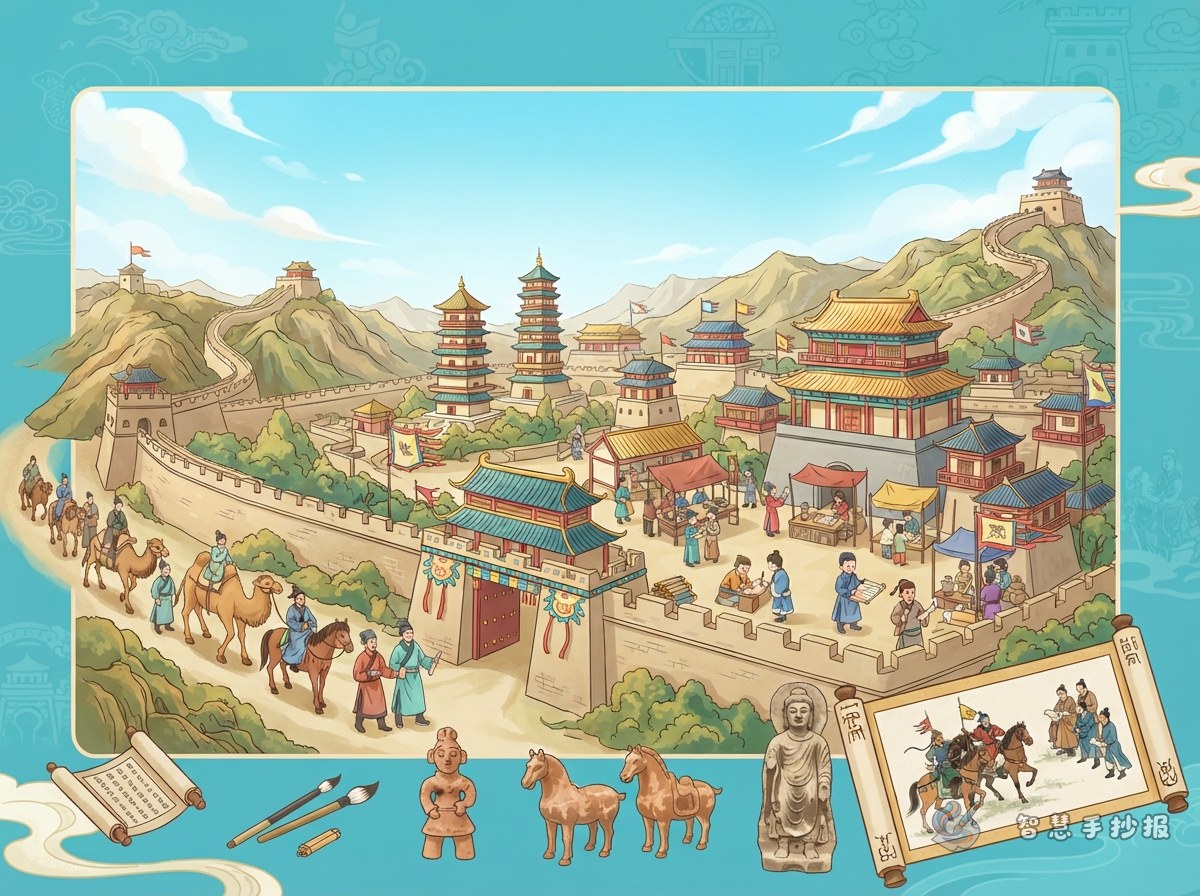
A horizontal layout works well. Draw a road leading from a city gate toward distant mountains in the middle of the page. Use it as the main visual line. Place the title at the top, a “Pingcheng Facts” box on the left, “Art in the Caves” on the right, and two smaller sections called “What I Found” and “Quick Questions” along the bottom.
- Center illustration: Combine a city gate, wall, mountains, and a road in a simple ancient-city scene.
- Upper left: Make a scroll-shaped box for the city name, capital period, and key words.
- Upper right: Draw a cliff outline with lines suggesting the cultural image of the Yungang Grottoes.
- Bottom border: Connect the sections with clouds, a road, or a brick pattern.
Four sections that show Pingcheng’s cultural layers
1. Pingcheng Facts
You can write: “Datong was known as Pingcheng in ancient times. The Northern Wei moved its capital to Pingcheng in 398 and moved it to Luoyang in 494. As a Northern Wei capital, Pingcheng left an important record of urban life and culture.” Put these dates on a simple timeline instead of making them too large, so readers can understand the sequence quickly.
2. The Frontier and the Capital
This is the special angle of the newspaper. Write: “Pingcheng stood in the north. It had the openness and strength of a frontier region, as well as the roads, palace areas, and public life needed by a capital. Drawing mountains, gates, and city order together shows its two-sided character.” Mountain shapes, towers, and roads will work well beside this text.
3. Art in the Caves
The Yungang Grottoes were begun during the Northern Wei period and are one of the most recognizable cultural features connected with Pingcheng. You do not need to copy complicated figures. Use cliff outlines, arched niches, lotus patterns, and rays of light to suggest the cave art. Add the note: “The grottoes preserve the sculpture and cultural exchange of the Northern Wei period.”
4. What I Found
Invite the student to add a personal observation, such as: “I learned that an ancient capital is not only made of palaces and walls. Its art, roads, and traces of everyday life are also part of its history.” A sticky-note or speech-bubble design makes this section feel personal rather than like a simple list of facts.
Use color to show the character of a northern city
Choose ochre, brick red, and deep blue as the main colors. Ochre can represent walls and mountains, brick red can highlight the title and gate, and deep blue can be used for the sky, borders, and timeline. Add a little warm gold to the grotto section, but keep the area limited so the page does not become too dark.
Good decorative motifs include bricks, ridgelines, clouds, roads, and scrolls. Draw people or animals as small silhouettes so they do not compete with the text. Use bold brush-style lettering for the title and clear, easy-to-read writing for the body text. This keeps the historical mood without sacrificing readability.
Three final checks before finishing
- Make sure the timeline is clear and does not mix Northern Wei Pingcheng with the later move to Luoyang.
- Keep two or three main points in each section, and highlight important words with bold lettering or colored blocks.
- Plan the title, pictures, and text boxes with a pencil first, then add color and ink while leaving a little white space around the edges.
When you are ready to adjust the title lettering, section positions, and colors, open the WeChat mini program 智慧手抄报 and continue creating your own Pingcheng culture handwritten newspaper.