Start With One Simple Thread: the Journey of Light
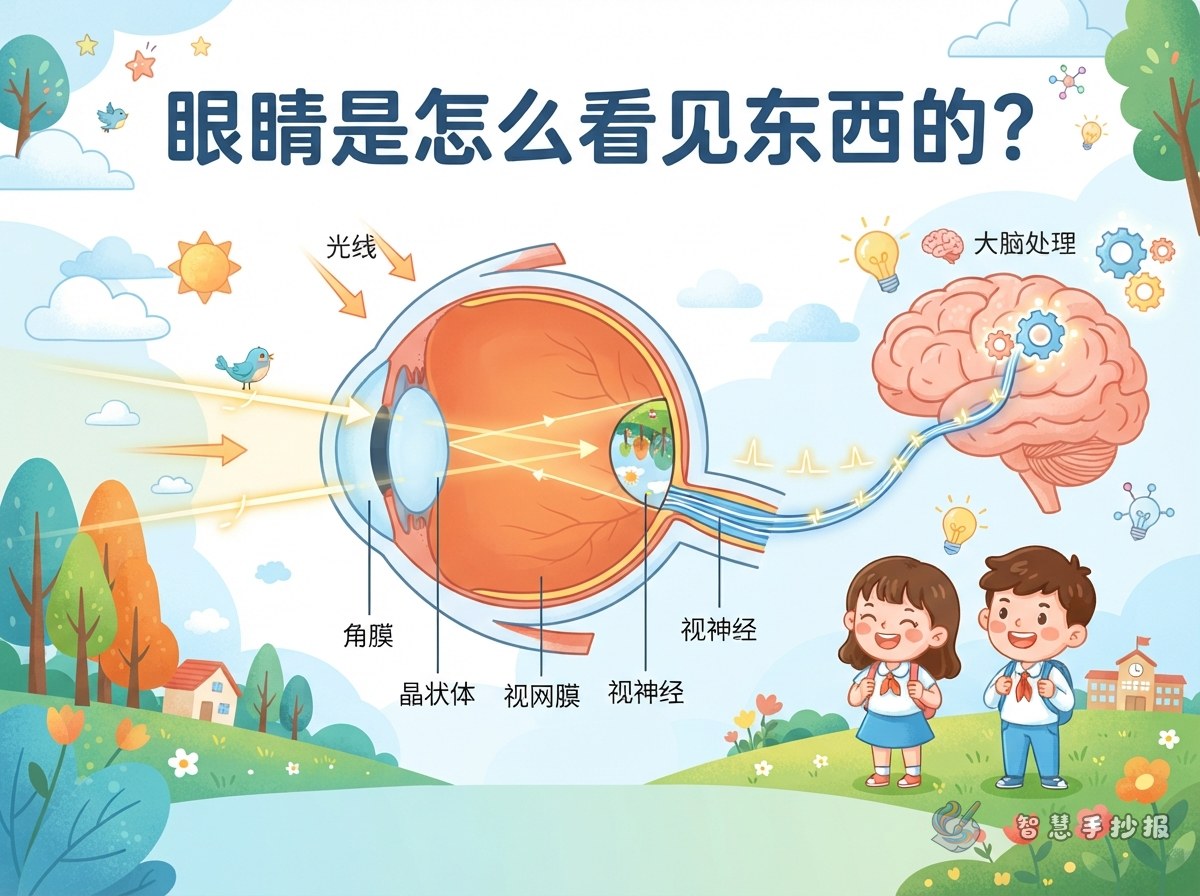
Before you draw a single eyeball, decide what the poster is really about. The answer is light. Light passes through the cornea, enters the eye through the pupil, is focused by the lens, and lands on the retina as an image. The optic nerve then carries the signal to the brain, which turns it into the picture we see.
Write this order in a clear spot on your poster. Once readers understand the main thread, the labelled diagram, the fun facts and the eye-care tips all fit neatly around it.
Four Blocks Are Enough to Fill the Page
You do not need to cram in everything. Four blocks will do:
- Title area: a short headline such as "The Secret of Eyes", with a large eye drawn beside it.
- Diagram area: a labelled cross-section showing the cornea, pupil, lens, retina and optic nerve.
- Path of light: a horizontal arrow strip reading "light → cornea → pupil → lens → retina → optic nerve → brain".
- Eye-care box: reading distance, good lighting and regular breaks to look into the distance.
If space is left over, add a small question box with two or three curious questions about eyes.
Lines You Can Copy Straight Onto the Poster
Use these as they are, or rewrite them in your own words:
- The eyeball is a rounded organ protected by the eye socket and eyelids.
- The cornea is the clear window at the front of the eye, where light enters.
- The pupil works like a door: it becomes smaller in bright light and wider in dim light.
- The lens is like a stretchy convex lens that focuses light onto the retina.
- The retina works a little like the film in a camera; the image forms there first.
- The optic nerve is the cable that carries signals from the eye to the brain.
- The world we see is a picture the brain builds from those signals.
Add two or three eye-care reminders, such as keeping a proper distance from your book, reading in suitable light, and looking at distant trees or buildings after long periods of close work.
Drawing the Cross-Section Without It Going Wonky
Many students get stuck here. Three simple proportions keep the drawing steady:
- Draw a circle for the eyeball. A slight oval looks more natural than a perfect circle.
- Leave a small space at the front for the cornea, shaped like a clear arc resting on the ball.
- Add a thin tube at the back for the optic nerve, angled slightly inward and backward.
Then use two shades inside: the lens and a small dark pupil at the front, and a pale layer along the inner back wall for the retina. Pull labels out with straight lines, and keep the lettering small and neat. Clear labelling matters more than fancy drawing.
Colours, Decoration and a Final Check
Blues, soft purples and light greys suit an eye poster, especially with plenty of white space. Use a dark blue or purple for the headline, a pale blue wash behind the diagram, and a different colour for the eye-care box. Small decorations such as eyelashes, glasses, stars and magnifiers work well, but do not overcrowd the page. Leave a tiny white highlight on each drawn eye so it looks lively.
Read the whole poster once before handing it in. Cut any repeated sentences and check that every organ name is spelled correctly. If you would rather begin from a ready-made layout, open WeChat and search for 智慧手抄报, where human body and life science templates and text ideas are ready to use.