Start with the Body’s “Command Center”
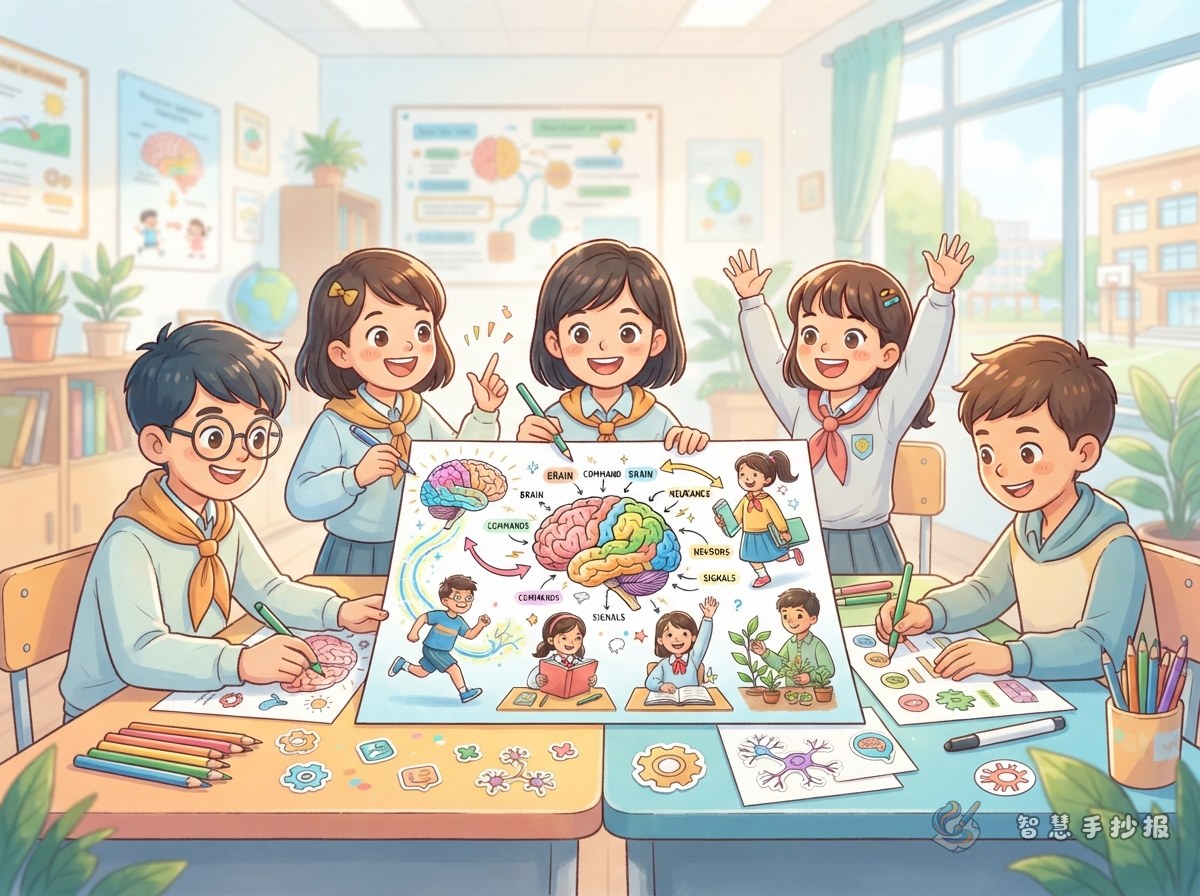
For this handwritten newspaper, present the brain as the body’s small command center. Draw colorful lines connecting it with the eyes, ears, hands, and feet so readers can quickly understand the process of receiving information, making decisions, and sending instructions. Place a simple brain outline in the center, then arrange the nervous system, sense organs, and movement icons around it.
- The brain: Show its roles in thinking, memory, sensation, and voluntary movement.
- The cerebellum: Introduce it as a movement coordinator that helps with balance and coordinated actions.
- The brainstem and spinal cord: Present them as important pathways linking the brain and the rest of the body.
- Nerves: Draw thin lines spreading through the body to represent the movement of information.
Turn the Science into a Short Story
Instead of filling the page with a list of organ names, use a familiar situation, such as quickly pulling your hand away after touching a hot cup. The skin senses the stimulus, nerves carry the message, the body processes it, and instructions are sent to the arm and hand muscles. This story is easy to understand and works well as an arrow-based flowchart.
- The eyes, ears, and skin receive information from the surroundings.
- Nerves carry the information toward the spinal cord and brain for processing.
- The brain or spinal cord sends instructions, and muscles complete the movement.
- The body senses the result of the movement, creating an ongoing exchange of information.
Ready-to-Write Sections
Section 1: What the Brain Does — The brain is like a busy command center. It helps us learn, remember, think, sense our surroundings, and control many voluntary movements.
Section 2: A Nervous System Fact — The brain, spinal cord, and nerves throughout the body make up the nervous system. Like information highways, they allow different parts of the body to send messages to one another.
Section 3: Ways to Protect the Brain — Get enough sleep, eat a balanced diet, exercise moderately, take breaks while studying, and use proper safety protection during sports or cycling.
Plan the Page with “Nerve Pathways”
Try a horizontal flow layout: place the sense organs on the left, highlight the brain and spinal cord in the middle, and show movement responses on the right. Use blue for incoming information, orange for instructions sent by the body, and green for brain-health tips. Put the title at the top and add a “Try This” box at the bottom, such as observing how the body keeps balance while standing on one foot with the eyes closed.
Make One Final Clarity Check
Keep all arrows moving in a consistent direction and avoid placing every sentence beside the brain drawing. Limit each fact to two or three sentences and mark organ names with colorful labels. Before finishing, check whether “sensation—message—decision—action” forms a clear chain. Stars, lightning shapes, or circuit-like borders can add a scientific feel. To arrange sections, colors, and text more quickly, continue creating in the 智慧手抄报 WeChat mini program.