Begin with the question: What makes the body move?
Instead of presenting bones, joints, and muscles as separate facts, build the handwritten newspaper around one clear idea: bones provide support, joints connect moving parts, and muscles create pulling force. Open with a question such as which body partners work together when we run, jump, or bend. This gives the page a strong science focus and a clear reading path.
Turn the topic into three easy science cards
Bones: the body’s framework
Write a short explanation: bones form the body’s framework, help us keep a posture, and protect important areas such as the head and chest. Draw a few simplified bone shapes and place the words support, protection, and movement beside them.
Joints: the places that allow movement
A joint is a place where bones connect and can move. Shoulder, elbow, knee, and ankle joints are easy to label. Add curved arrows to show how an arm or leg changes position.
Muscles: the source of pulling force
When a muscle contracts, it becomes shorter and creates force. Through tendons, it pulls on bones so the body can move. For younger readers, three key words are enough: contract, pull, and move. Add an arrow from a muscle area toward a bone.
Use one action picture to show the whole process
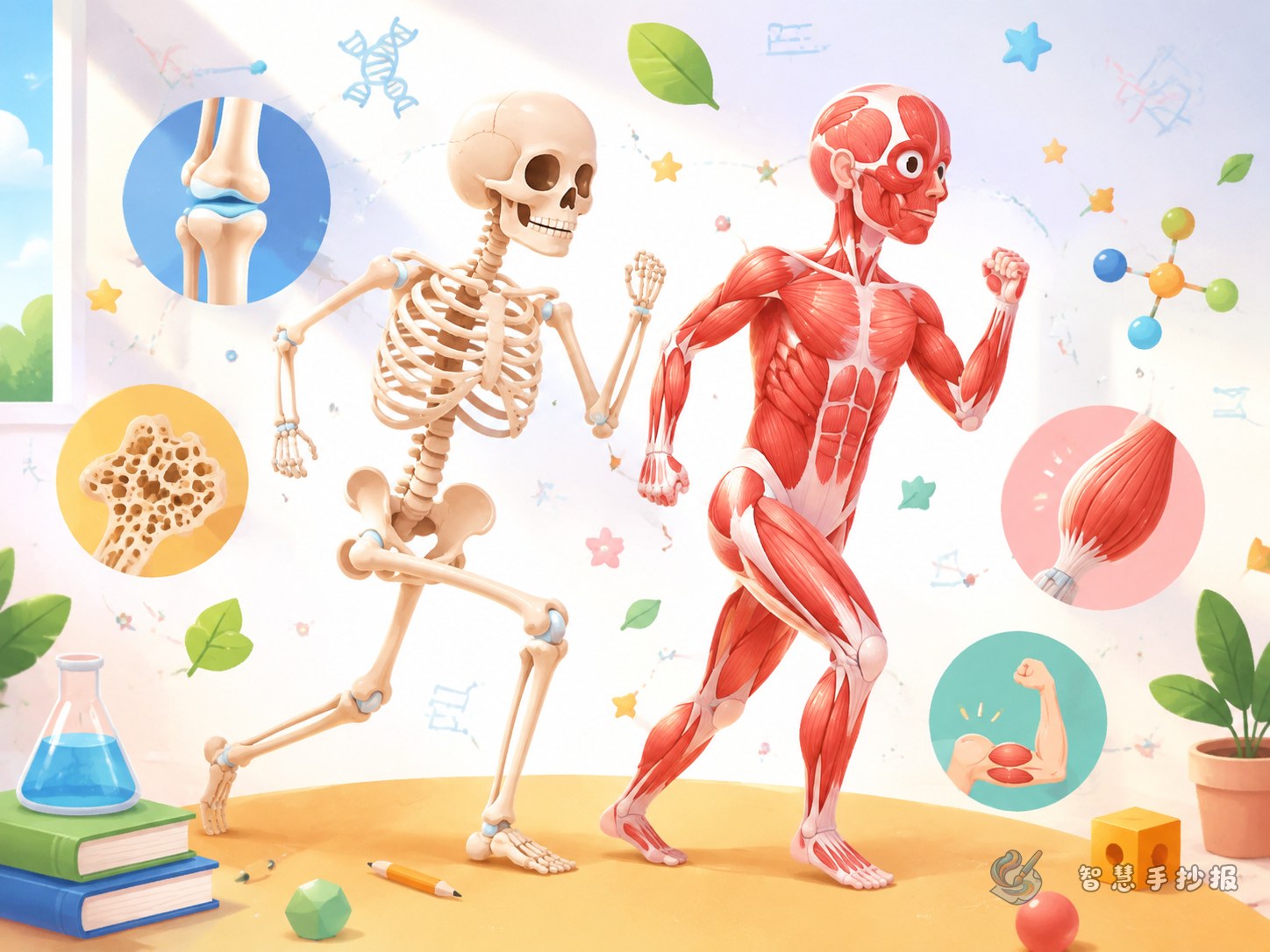
Choose a running, skipping, kicking, or stretching figure for the main illustration. It does not need to look like a medical textbook. The important thing is that readers can understand the movement at a glance.
- Draw the outline of a moving person and mark the main bones in the head, trunk, and limbs.
- Use one color for muscle areas and another color to circle the shoulder, elbow, knee, or ankle.
- Add arrows to show the bending direction of a joint and the pulling direction of a muscle.
- Place a caption beside the figure: bones are the framework, muscles provide power, and joints help the body move flexibly.
Make the layout feel active
A central action figure surrounded by small information cards is an effective layout. Put the title at the top, the movement diagram in the middle, a bone profile on the left, a joint-and-muscle cooperation card on the right, and exercise tips along the bottom. Orange or blue can highlight the title, pale yellow can represent bones, red can mark muscles, and green can accent joints. Three or four main colors are enough.
- Title area: Use a question to create curiosity, followed by a subtitle about the musculoskeletal system.
- Fact areas: Keep each section to two or three sentences and pair it with a small icon.
- Connection area: Use arrows to link bones, joints, and muscles and emphasize teamwork.
- Decoration area: Add footprints, motion lines, a ball, or a small dumbbell without covering the text.
End with practical movement reminders
Finish with a healthy movement section that connects science to everyday life. You can mention warming up before exercise, keeping a safe posture, relaxing after activity, and stopping to tell a parent or teacher if pain appears. After checking the draft for clear headings, accurate arrows, and readable writing, continue arranging and making the finished page in the 智慧手抄报 WeChat mini program.