Begin with a Mystery: Why Does Obsidian Look Like Black Glass?
Build the poster around the question “Is obsidian a rock or glass?” Obsidian is natural volcanic glass formed when lava cools very quickly. It is classified as an igneous rock rather than a single mineral. Rapid cooling leaves too little time for large mineral crystals to grow, giving obsidian its smooth, glassy appearance.
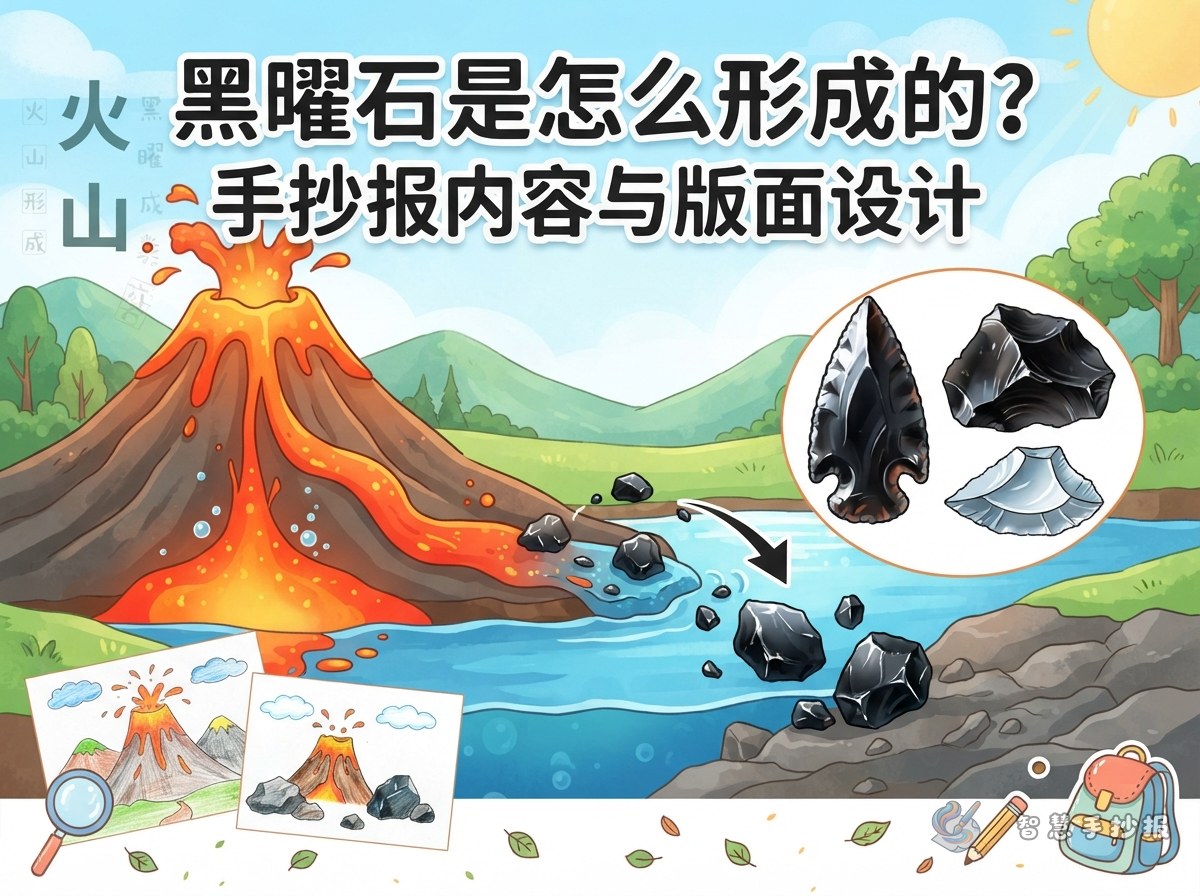
Tell Its Story as a Four-Step Lava Journey
- Magma rises: Hot molten material moves upward through cracks below the ground.
- Lava reaches the surface: Magma is called lava after it erupts, and it begins losing heat.
- Cooling happens quickly: Some silica-rich, sticky lava hardens before visible crystals can develop.
- Obsidian forms: The solid material keeps a glassy structure and is often black, although brown, gray, and patterned pieces also occur.
Connect a volcano, a lava flow, and a sample of obsidian with bright arrows so readers can follow the sequence at a glance.
Create Three Field-Note Panels
Appearance
Obsidian commonly has a glassy luster and reflects light. Not every specimen is completely black or transparent.
Fracture
When broken, obsidian often develops curved, shell-like surfaces called conchoidal fractures. Draw nested curves to represent them, but do not break a real specimen because its edges can become extremely sharp.
Classification
Obsidian lacks abundant, easily visible crystals. Label it accurately as natural volcanic glass and an igneous rock, rather than calling it a black mineral.
Shape the Layout Around a Cooling Lava Flow
Place an orange-red lava ribbon across the center and gradually turn it black. Put the formation sequence on one side, the field-note panels on the other, and a short “common mistakes” strip at the bottom. Use bold black lettering with a thin orange outline for the title. Keep much of the background light so the page remains easy to read.
- Use black, rock gray, and lava orange as the main colors, with pale yellow for key facts.
- Keep each text panel short and emphasize only essential terms.
- Use small volcano, crystal, and curved-fracture sketches to support the science.
Check the Science Before Finishing
- Do not claim that every piece of obsidian is pure black; other shades and patterns can occur.
- Do not say that lava must touch water to become obsidian. The key idea is the rapid cooling of suitable silica-rich lava.
- Never handle a sharp broken edge without guidance from a teacher or parent.
After organizing the facts, continue in the Smart Handwritten Newspaper WeChat Mini Program to choose a layout, adjust the sections, and complete the poster.